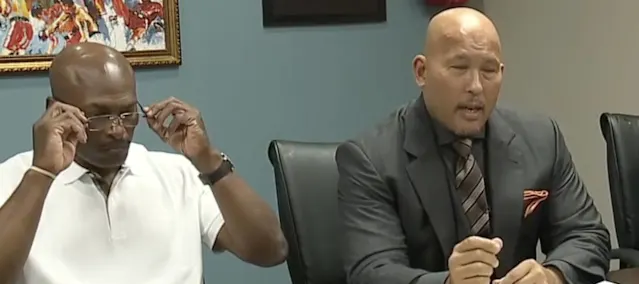
Detroit man jailed 25 years for crime he didn’t commit ordered to return $1M to Michigan after court ruling

Desmond Ricks spent 25 years in prison for a murder he didn’t commit before his conviction was overturned and he was released.
Following his exoneration, Ricks received more than $1 million under Michigan’s Wrongful Imprisonment Compensation Act. The law, which took effect in 2017, pays roughly $50,000 for each year someone is wrongfully incarcerated. The compensation is intended to acknowledge what exonerees lose while behind bars.
Detroit man jailed 25 years for crime he didn’t commit ordered to return $1M to Michigan after court ruling
Desmond Ricks spent 25 years in prison for a murder he didn’t commit before his conviction was overturned and he was released.
Following his exoneration, Ricks received more than $1 million under Michigan’s Wrongful Imprisonment Compensation Act. The law, which took effect in 2017, pays roughly $50,000 for each year someone is wrongfully incarcerated. The compensation is intended to acknowledge what exonerees lose while behind bars.
Must Read
Thanks to Jeff Bezos, you can now become a landlord for as little as $100 — and no, you don't have to deal with tenants or fix freezers. Here's how
Dave Ramsey warns nearly 50% of Americans are making 1 big Social Security mistake — here’s what it is and 3 simple steps to fix it ASAP
I’m almost 50 years old and have nothing saved for retirement. What do I do? Don’t panic. Here are 6 easy ways to catch up (and fast)
Ricks is one of 77 exonerees who have received compensation under the law as of July 2024. In total, Michigan has awarded nearly $52 million through these claims (1). But his attorney says no dollar amount could come close to repairing the damage.
“Desmond Ricks endured the worst harm and suffering you can imagine," his lawyer, Wolf Muller, told WXYZ Detroit (2). “25 years in a cage for a crime he didn’t commit. The compensation under the state, a million and a quarter, doesn’t come close to the harm he suffered.”
Now, the State of Michigan is asking Ricks to return that money. Here’s why.
Why the state is clawing the money back
The order requiring Ricks to repay his state compensation stems from a ruling by the Michigan Court of Appeals, following a separate civil settlement tied to his wrongful conviction.
That settlement came from the City of Detroit, which agreed to pay Ricks $7.5 million to resolve a lawsuit alleging police misconduct. Ricks claimed officers switched bullet evidence to frame him for the 1992 murder (3).
The case was reopened in 2016 after the Innocence Clinic at the University of Michigan Law School uncovered new evidence. Tests showed the bullets recovered from the victim, Gerry Bennett, did not match the .38-caliber gun prosecutors had identified as the murder weapon.
Under Michigan law, exonerees must repay compensation received through the Wrongful Imprisonment Compensation Act if they later recover damages from a third party tied to the same conviction. This process, known as a clawback, allows the state to reclaim money it has already paid (4).
Outside wrongful-conviction cases, clawbacks are more commonly used in corporate and financial settings, such as recouping executive bonuses after misconduct or recovering improperly paid government benefits.
Similar clawback provisions exist in multiple states, meaning exonerees who secure civil settlements are often barred from keeping both awards.
See full original story below.
Detroit man jailed 25 years for crime he didn’t commit ordered to return $1M to Michigan after court ruling
Desmond Ricks spent 25 years in prison for a murder he didn’t commit before his conviction was overturned and he was released.
Following his exoneration, Ricks received more than $1 million under Michigan’s Wrongful Imprisonment Compensation Act. The law, which took effect in 2017, pays roughly $50,000 for each year someone is wrongfully incarcerated. The compensation is intended to acknowledge what exonerees lose while behind bars.
Must Read
Thanks to Jeff Bezos, you can now become a landlord for as little as $100 — and no, you don't have to deal with tenants or fix freezers. Here's how
Dave Ramsey warns nearly 50% of Americans are making 1 big Social Security mistake — here’s what it is and 3 simple steps to fix it ASAP
I’m almost 50 years old and have nothing saved for retirement. What do I do? Don’t panic. Here are 6 easy ways to catch up (and fast)
Ricks is one of 77 exonerees who have received compensation under the law as of July 2024. In total, Michigan has awarded nearly $52 million through these claims (1). But his attorney says no dollar amount could come close to repairing the damage.
“Desmond Ricks endured the worst harm and suffering you can imagine," his lawyer, Wolf Muller, told WXYZ Detroit (2). “25 years in a cage for a crime he didn’t commit. The compensation under the state, a million and a quarter, doesn’t come close to the harm he suffered.”
Now, the State of Michigan is asking Ricks to return that money. Here’s why.
Why the state is clawing the money back
The order requiring Ricks to repay his state compensation stems from a ruling by the Michigan Court of Appeals, following a separate civil settlement tied to his wrongful conviction.
That settlement came from the City of Detroit, which agreed to pay Ricks $7.5 million to resolve a lawsuit alleging police misconduct. Ricks claimed officers switched bullet evidence to frame him for the 1992 murder (3).
The case was reopened in 2016 after the Innocence Clinic at the University of Michigan Law School uncovered new evidence. Tests showed the bullets recovered from the victim, Gerry Bennett, did not match the .38-caliber gun prosecutors had identified as the murder weapon.
Under Michigan law, exonerees must repay compensation received through the Wrongful Imprisonment Compensation Act if they later recover damages from a third party tied to the same conviction. This process, known as a clawback, allows the state to reclaim money it has already paid (4).
Outside wrongful-conviction cases, clawbacks are more commonly used in corporate and financial settings, such as recouping executive bonuses after misconduct or recovering improperly paid government benefits.
Similar clawback provisions exist in multiple states, meaning exonerees who secure civil settlements are often barred from keeping both awards.
Read More: Young millionaires are rethinking stocks in 2026 and banking on these assets instead — here’s why older Americans should take note
The unfinished cost of wrongful convictions
State Sen. Joe Bellino said Michigan’s clawback provision is intended to protect the Wrongful Imprisonment Compensation Act fund when exonerees later receive large payouts from lawsuits or other third-party sources tied to the same conviction.
He pointed to periods when the fund ran low as evidence of why lawmakers want a way to recover state payments once additional compensation is awarded. The debate extends beyond budgeting questions, highlighting broader failures in policing and prosecution that have contributed to wrongful convictions nationwide.
As civil lawsuits and multimillion-dollar settlements become more common, Bellino said recouping state funds is seen as a way to preserve the program for future exonerees rather than allow overlapping payouts to strain limited resources.
“The state isn’t a huge bucket to double-dip when there is a mistake made,” he said.
That framing often overlooks the financial reality exonerees face after release.
When Marvin Cotton Jr. was freed in 2020 after nearly two decades in prison, he struggled to secure housing and employment (5). He quickly burned through savings and relied on high-interest loans to cover basic expenses. Years removed from the workforce, lingering background-check issues and the absence of immediate income left him financially exposed at the moment he was expected to rebuild his life.
Victoria Vesovski
Mon, January 5, 2026 at 6:30 PM EST 5 min read
Comments