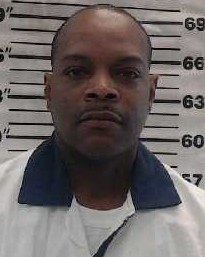
Breaking news Andre Knight was released.
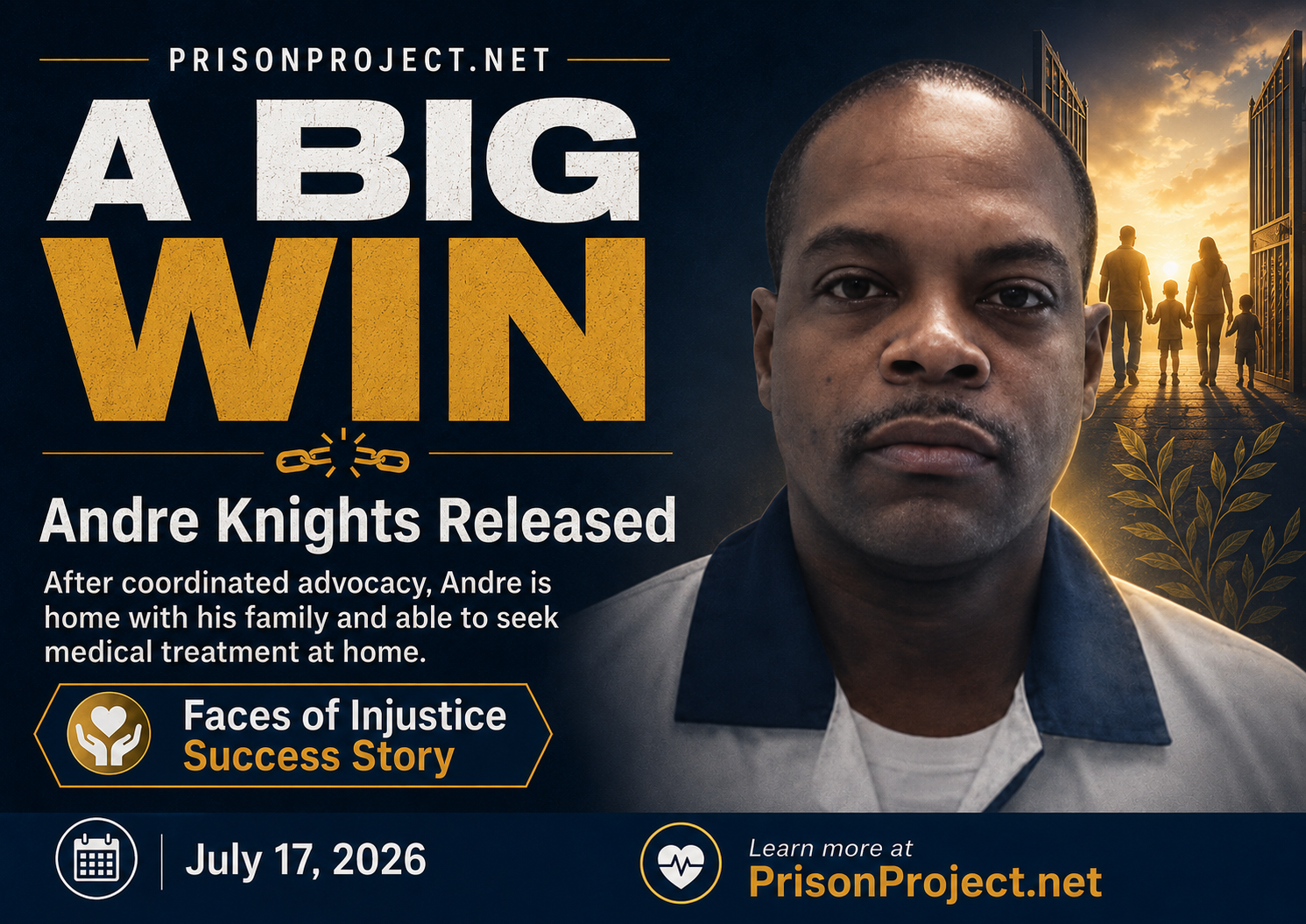
Andre Knights is home.
On July 17, 2026, Andre was released from prison approximately three months before the scheduled end of his term. His release marks the first confirmed success of PrisonProject.net’s Faces of Injustice pilot this year—and shows what organized and persistent advocacy can accomplish.
Andre had been serving a five-year sentence that included mandatory prison time at Augusta State Medical Prison. While incarcerated, he was dealing with serious medical problems. His family and supporters were concerned about his health, access to treatment and whether he could safely recover inside a prison medical facility.
PrisonProject.net agreed that Andre’s circumstances deserved to be heard.
We helped coordinate an advocacy campaign through the channels available in his case. Supporters were encouraged to contact the Georgia State Board of Pardons and Paroles and ask officials to review Andre’s case for medically appropriate release. A motion was also filed with the sentencing court seeking relief based on his medical condition, individual circumstances and approaching release date.
The campaign was built on documented facts, public support and repeated efforts to place Andre’s situation before the people with authority to act.
Then the news came: Andre was being released.
He was allowed to return home approximately three months early and serve the remaining portion of his sentence in the community. He can now reunite with his family, seek medical treatment outside prison and begin rebuilding his life.
After learning that he was coming home, Andre thanked PrisonProject.net:
“I want to sincerely thank PrisonProject.net for believing in me and fighting for me when I needed it most. Their advocacy gave me hope, and because of their efforts, I can now be with my family, get the medical care I need, and begin this next chapter of my life. I will never forget what they did for me.”
Andre Knights is not asking to walk away from responsibility. He is asking to survive it.
On October 10, 2025, Andre was convicted in Forsyth County of fleeing and eluding and possession of cocaine. He was sentenced to one year and ten days in confinement, followed by five years of probation. At sentencing, the court did not receive critical medical evidence. That omission was not Andre’s doing, and it changed everything.
Andre is living with end-stage renal disease, congestive heart failure, and stage-four hypertension. He requires dialysis three times a week to stay alive. While in custody, the Georgia Department of Corrections failed to properly prepare his dialysis treatment. The result was a medical emergency and a week-long hospitalization.
This was not a fluke. It exposed a system that cannot reliably meet his medical needs. Andre’s doctors have been clear. His treating nephrologist and primary care physician have documented that continued incarceration places his life in danger. Andre is currently on the kidney transplant list. He needs specialized, consistent medical care.
His facility cannot provide it.
That leaves two unavoidable truths. Keeping Andre incarcerated creates a serious and unjustifiable risk of death. Keeping him incarcerated also places an extraordinary and unnecessary medical burden on the State, one that could be avoided through supervised alternatives.
Andre is not denying accountability. He is asking for a humane, medically appropriate alternative that allows punishment and supervision without turning a sentence into a death sentence.
He has asked the Georgia State Board of Pardons and Paroles to consider options the law already allows: home confinement, supervised home detention, medical parole, or another parole-based conditional release appropriate to his condition. There is more at stake than Andre alone.
His fiancée is two months pregnant with their second child. Andre is the primary financial and emotional support for his family. His continued incarceration destabilizes them, while his medical condition makes confinement potentially fatal.
Andre has offered full compliance. Electronic monitoring. Strict supervision. Medical reporting. Probation conditions. Whatever is required. This is not a request for convenience. It is a request for survival. This case raises a simple question with heavy consequences. What public safety purpose is served by keeping a critically ill man in a facility that cannot keep him alive?
Andre Knights’ story is not about avoiding punishment. It is about whether the system will recognize when punishment crosses the line into irreversible harm.