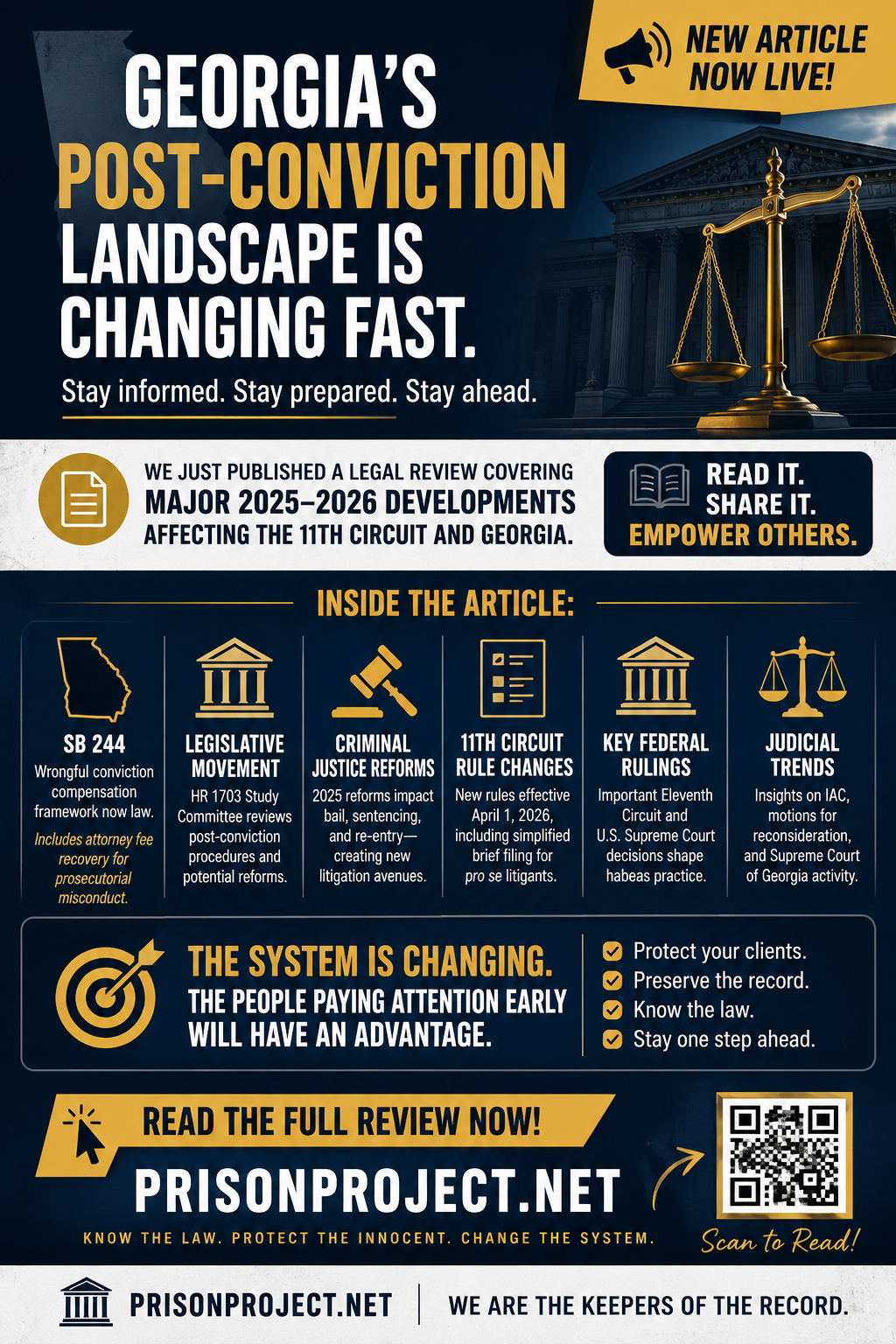
 Post-Conviction Relief Developments:
Georgia and the Eleventh Circuit (2025–2026)
Introduction
This briefing provides an overview of recent developments in post-conviction relief (PCR) within Georgia and the United States Court of Appeals for the Eleventh Circuit. These developments are important for appellate attorneys, post-conviction practitioners, and advocacy organizations because they affect wrongful conviction litigation, habeas corpus practice, prosecutorial accountability, and procedural strategy in both state and federal courts.
Rather than attempting to predict outcomes, this review focuses on identifiable legislative changes, procedural developments, and emerging judicial trends that may affect criminal appeals and collateral review moving forward.
Georgia Legislative Developments
Senate Bill 244
(The Wrongful Conviction and Incarceration Compensation Act / Act 361)
Effective July 1, 2025, Senate Bill 244 established Georgia’s first standardized framework for compensating individuals who have been wrongfully convicted and incarcerated.
Before SB 244, compensation typically depended on individual legislative resolutions passed on a case-by-case basis. Critics argued that the process was inconsistent, politically dependent, and lacked predictable standards. SB 244 shifted the process into a more formal administrative structure by directing claims through the Office of State Administrative Hearings (OSAH).
The Act establishes compensation rates of:
• $75,000 per year of wrongful incarceration
• An additional $25,000 per year for time spent on death row
The law also created a dedicated trust fund intended to streamline payment distribution without requiring separate legislative approval for every claim.
Appellate and Strategic Impact
SB 244 contains an additional provision that has received significant public and legal attention. In certain circumstances involving prosecutorial disqualification for misconduct, courts may award reasonable attorney’s fees and litigation costs.
The provision became a subject of statewide attention during litigation connected to Fulton County District Attorney Fani Willis and the election interference prosecution involving former President Donald Trump. Ongoing appellate litigation concerning fee exposure and prosecutorial disqualification may ultimately clarify:
• the scope of judicial authority to impose fee awards
• the financial consequences of prosecutorial misconduct findings
• the limits of state oversight over locally elected prosecutors
For defense and post-conviction counsel, the practical significance is not merely political. The provision potentially increases financial consequences associated with prosecutorial misconduct litigation and may influence future strategic decisions involving recusal and disqualification motions.
House Study Committee on Criminal Post-Conviction Litigation
(HR 1703)
House Resolution 1703 established a study committee focused on criminal post-conviction litigation in Georgia.
The committee was tasked with examining:
• the effectiveness of current post-conviction procedures
• procedural barriers affecting reviewability
• efficiency concerns within collateral review systems
• possible legislative reforms
Although the committee itself does not create binding law, its findings may influence future legislation affecting:
• habeas corpus procedures
• filing deadlines
• evidentiary standards
• access to post-conviction review
• procedural default rules
Attorneys practicing in Georgia PCR litigation should closely monitor any resulting recommendations.
2025 Criminal Justice Reforms
Georgia’s 2025 legislative session also included broader criminal justice reforms affecting:
• bail procedures
• sentencing
• re-entry policy
• supervision structures
While these reforms are not strictly post-conviction measures, changes at the front end of criminal procedure frequently create downstream litigation issues involving:
• retroactivity
• sentencing proportionality
• ineffective assistance claims
• due process challenges
Practitioners should remain attentive to whether future appellate decisions permit retrospective application of any reforms or create new constitutional arguments tied to sentencing and confinement practices.
Eleventh Circuit Federal Developments
Rule Changes
(Effective April 1, 2026)
The Eleventh Circuit implemented several procedural rule revisions effective April 1, 2026.
Two changes are particularly relevant:
11th Cir. Rule 31-3
Incarcerated pro se litigants are no longer required to file paper copies of briefs. While procedural in nature, the rule reduces logistical burdens on incarcerated individuals pursuing federal appeals without counsel.
11th Cir. Rule 34-1
The Court expanded the list of authorized session locations to include:
• Birmingham
• Fort Lauderdale
• Orlando
This change primarily affects administrative and logistical considerations for practitioners appearing before the court.
Key Federal Developments
Hernandez Alvarez v. Warden
(May 2026)
In Hernandez Alvarez v. Warden, the Eleventh Circuit ruled against aspects of mandatory immigration detention practices that denied bond hearings for certain detainees.
The decision is important within immigration detention litigation and broader federal habeas practice because it reflects continued judicial scrutiny regarding the legality and duration of confinement without individualized review.
The ruling does not broadly expand habeas relief generally. However, it may provide persuasive analytical support in litigation involving:
• prolonged detention
• due process concerns
• individualized review requirements
• confinement legality challenges
The long-term reach of the decision remains uncertain and will depend on subsequent interpretations by lower courts.
Supreme Court Guidance on Federal Habeas Appeals
In early 2026, the United States Supreme Court issued a decision further clarifying limitations on federal habeas review.
The ruling reinforced principles already central to federal habeas litigation under AEDPA, including:
• substantial deference to state court rulings
• strict procedural exhaustion requirements
• limited federal review of state factual findings
• narrow pathways for relief absent clearly established constitutional violations
For practitioners handling §2254 litigation, the decision reinforces the importance of:
• preserving issues early in state proceedings
• fully exhausting constitutional claims
• creating strong factual records during trial and direct appeal
• anticipating procedural default arguments
Georgia Judicial Trends
Supreme Court of Georgia Activity
The Supreme Court of Georgia continues to maintain an active criminal docket involving:
• direct appeals
• sentencing issues
• evidentiary disputes
• post-conviction procedural questions
Recent opinions in cases such as Lee v. State and Haywood v. State demonstrate the continuing importance of closely monitoring state appellate decisions for evolving standards affecting:
• preservation requirements
• harmless error analysis
• evidentiary review
• constitutional claims
Even decisions that are not formally classified as PCR cases often shape future collateral review litigation.
Ineffective Assistance of Counsel
Ineffective Assistance of Counsel (IAC) remains one of the most common and significant grounds for post-conviction relief in Georgia.
Successful IAC claims continue to depend heavily on:
• factual investigation
• preservation of trial records
• expert consultation where appropriate
• demonstrating prejudice under Strickland v. Washington
Georgia courts continue to apply a highly deferential standard toward trial counsel strategy decisions. As a result, generalized complaints about representation rarely succeed without clear factual support demonstrating both deficient performance and prejudice.
Motions for Reconsideration
Motions for reconsideration continue to serve as an important procedural mechanism in criminal litigation.
Although they are often overlooked, these motions can:
• preserve issues for appeal
• clarify factual disputes
• allow correction of legal errors
• strengthen the appellate record
• narrow procedural disputes before higher review
Their usefulness depends heavily on timing, specificity, and preservation strategy.
Strategic Observations
Several broader themes are emerging across Georgia and Eleventh Circuit post-conviction practice:
1. Record preservation remains critical.
Courts generally do not correct issues that were never properly documented, preserved, or exhausted.
2. Administrative procedure is becoming increasingly important.
SB 244 shifted wrongful conviction compensation into a structured administrative process requiring familiarity with OSAH procedures and evidentiary presentation.
3. Federal habeas review remains narrow.
Recent federal decisions continue emphasizing AEDPA deference and procedural barriers rather than expansion of collateral review rights.
4. Prosecutorial accountability litigation is evolving.
Fee-shifting provisions and misconduct-related litigation may increasingly affect strategic decisions involving recusal, disqualification, and Brady-related claims.
5. Continuous monitoring of appellate decisions is essential.
Both Georgia appellate courts and the Eleventh Circuit continue issuing rulings that shape procedural standards governing collateral review.
Conclusion
The post-conviction landscape in Georgia and the Eleventh Circuit continues to evolve through a combination of legislative reform, procedural rule changes, and judicial interpretation.
SB 244 represents one of the most significant structural changes in Georgia wrongful conviction law in decades. At the same time, federal courts continue reinforcing procedural rigor and deference standards within habeas litigation.
For attorneys and advocacy organizations working in this space, the practical lesson remains consistent:
Successful post-conviction litigation depends less on broad allegations and more on disciplined record preservation, procedural precision, factual development, and sustained legal strategy.
Comments