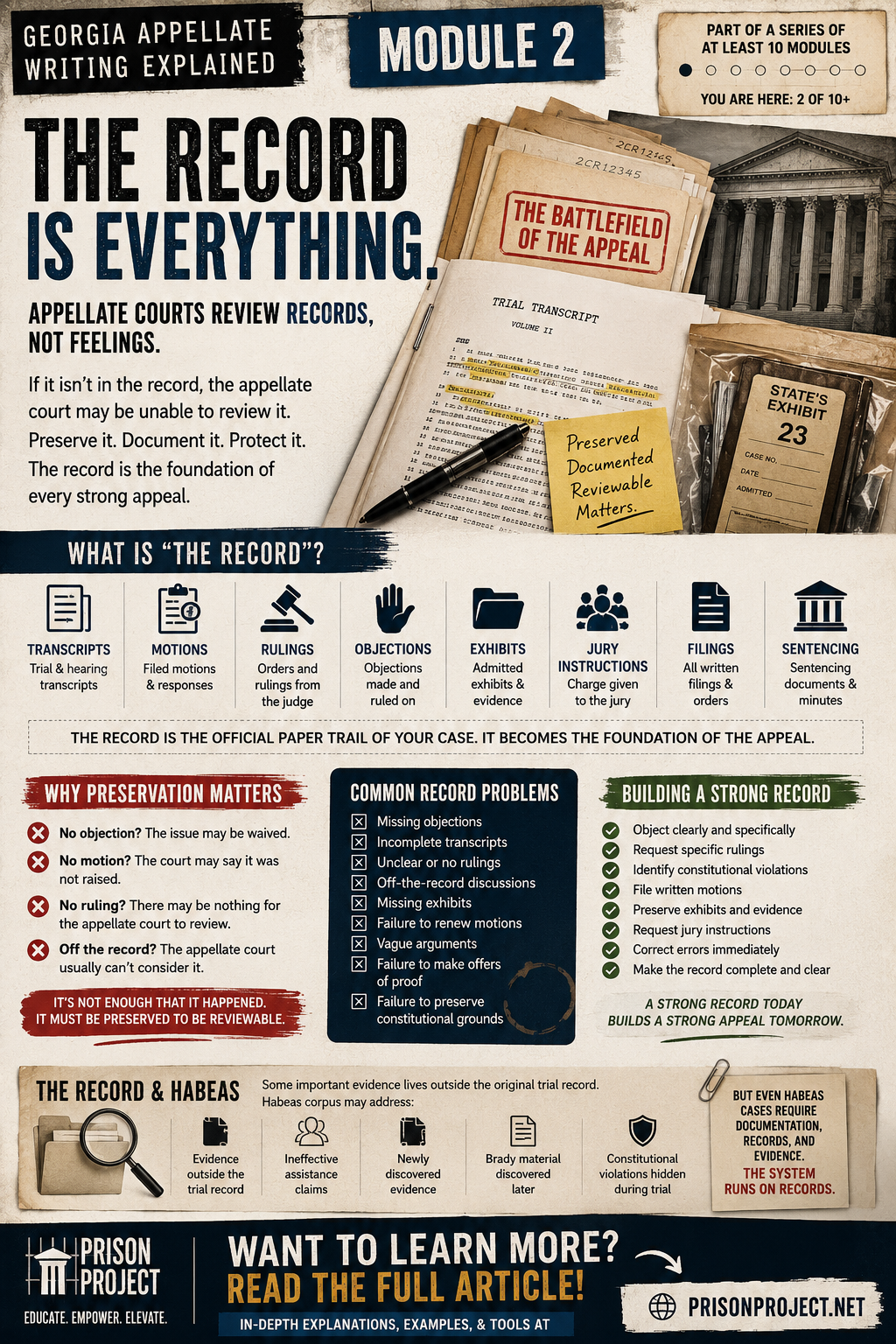
 Georgia Appellate Writing Explained
Module 2 — The Record Is Everything
If Module 1 explained what an appeal is, Module 2 explains what appeals are built on:
The record.
In appellate litigation, the record is not just paperwork.
The record is the battlefield.
Appellate courts do not retry cases.
They review what was preserved, documented, filed, transcribed, and ruled upon in the lower court.
If something is outside the record, appellate courts are often limited in what they can do with it.
This is one of the most important concepts in post-conviction work:
Courts cannot review what was never properly recorded.
What Is “The Record”?
The appellate record usually includes:
- trial transcripts
- hearing transcripts
- motions
- written responses
- exhibits
- objections
- rulings from the judge
- jury instructions
- sentencing documents
- filed orders
- admitted evidence
In simple terms:
The record is the official paper trail of the case.
That paper trail becomes the foundation of the appeal.
Why Preservation Matters
One of the most devastating phrases in appellate law is:
“The issue was not preserved.”
That usually means:
- no objection was made
- no motion was filed
- no ruling was requested
- or the issue was raised incorrectly
When that happens, appellate courts often refuse to fully review the issue.
This is why preservation matters so much.
For example:
If a prosecutor says something improper during trial but defense counsel never objects, the appellate court may later say the issue was waived.
If evidence comes in improperly but no legal challenge is made, the court may treat the issue as abandoned.
If the judge makes an incorrect ruling but nobody clearly objects or requests clarification, appellate review becomes much harder.
The Difference Between “It Happened” and “It’s Reviewable”
This is where many families and incarcerated people become frustrated.
A person may know misconduct occurred.
Witnesses may know misconduct occurred.
Everyone in the courtroom may know something was wrong.
But appellate courts still require:
- documentation
- preservation
- legal framing
- record support
This is because appellate courts operate through reviewable records, not personal belief.
That does not mean injustice did not happen.
It means the legal system requires the injustice to be documented in a way appellate courts can evaluate.
Common Record Problems
Some of the most common appellate problems include:
- missing objections
- incomplete transcripts
- unclear rulings
- off-the-record conversations
- missing exhibits
- failure to renew motions
- vague arguments
- failure to make offers of proof
- failure to preserve constitutional grounds
These problems destroy appeals every day.
Not because the issues were necessarily weak.
But because the record was weak.
Why Trial Lawyers Matter So Much
Many appeals are won or lost before the appeal even begins.
A strong trial lawyer:
- makes clear objections
- preserves constitutional arguments
- creates a detailed record
- forces rulings onto the record
- files motions properly
- protects issues for review
A weak record at trial often becomes a weak appeal later.
That is one reason effective trial advocacy and effective appellate advocacy are deeply connected.
Building the Record
Good appellate advocacy often starts during trial.
That means:
- objecting clearly
- requesting specific rulings
- identifying constitutional violations
- filing written motions
- preserving exhibits
- requesting jury instructions
- correcting errors immediately
The record should tell the story clearly enough that someone who was never in the courtroom can understand:
- what happened
- why it mattered
- and why the law may require relief
Habeas and the Record
Sometimes important evidence never makes it into the original trial record.
That is where habeas corpus may become important.
Habeas proceedings can sometimes address:
- evidence outside the trial record
- ineffective assistance claims
- newly discovered evidence
- Brady violations discovered later
- misconduct hidden during trial
But even habeas cases still depend heavily on documentation, affidavits, records, and evidence.
Again:
The system runs on records.
Final Thought
People often believe appeals are won through emotion, outrage, or dramatic arguments.
Most are not.
Appeals are usually won through:
- preserved issues
- documented error
- organized records
- precise legal arguments
- and clear demonstrations of prejudice
The record is not just paperwork.
The record is the foundation of review.
And in many cases, freedom depends on what was preserved long before the appellate brief was ever written.
Comments