
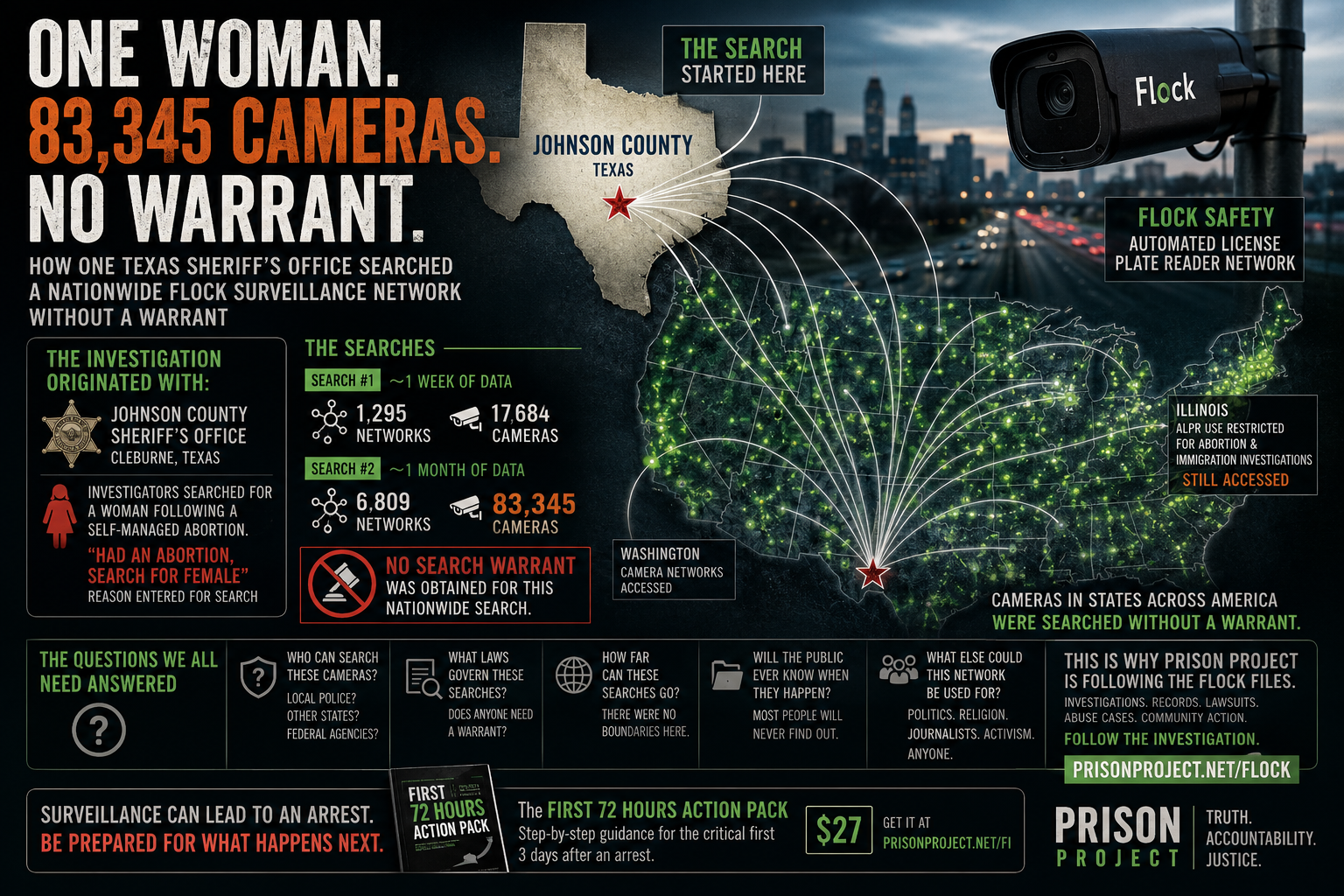
 THE SEARCH THAT REACHED 83,345 CAMERAS:
HOW ONE TEXAS INVESTIGATION EXPOSED FLOCK'S NATIONWIDE SURVEILLANCE NETWORK
One woman.
One Texas sheriff's office.
6,809 interconnected Flock networks.
83,345 cameras.
And apparently no search warrant authorizing the nationwide database search.
What happened in Johnson County, Texas, should concern Americans regardless of what they think about abortion, policing or surveillance technology.
An investigator with the Johnson County Sheriff's Office was trying to locate a woman following a self-managed abortion.
The investigator turned to Flock Safety's automated license plate reader system.
The reason entered for the search was remarkably direct:
"had an abortion, search for female"
But the reason wasn't the most extraordinary part.
The reach was.
According to records obtained by investigative journalists and subsequently analyzed by the Electronic Frontier Foundation, one search reached 6,809 Flock networks containing 83,345 cameras.
Those cameras weren't confined to Johnson County.
They weren't confined to Texas.
The search crossed state lines and reached Flock networks thousands of miles away.
No judge appears to have reviewed and approved a warrant authorizing this enormous database search beforehand.
That leaves a question considerably larger than the investigation of one Texas woman:
WHEN DID THOUSANDS OF LOCALLY INSTALLED POLICE CAMERAS BECOME SOMETHING RESEMBLING A NATIONAL SEARCHABLE VEHICLE-LOCATION NETWORK?
THE INVESTIGATION BEGINS
The case originated with the Johnson County Sheriff's Office, headquartered in Cleburne, south of Fort Worth.
Authorities were attempting to locate a woman after learning that she had apparently self-managed an abortion.
Sheriff Adam King later characterized the effort publicly as involving concern for the woman's welfare.
Subsequently obtained investigative records complicated that explanation.
Those records showed that investigators had also opened what they called a "death investigation" and explored whether criminal charges could potentially be brought.
We have found no evidence that the woman was ultimately criminally charged.
But investigators wanted to find her.
And they had access to Flock.
THE FIRST SEARCH WAS ALREADY ENORMOUS
According to records examined by the Electronic Frontier Foundation, investigators conducted at least two significant Flock searches.
The first reportedly searched approximately one week of historical information.
Its reach:
1,295 Flock networks.
17,684 cameras.
Think about that number before going any further.
An investigation originating with one county sheriff's office in Texas could search a system containing nearly 18,000 cameras.
Then investigators expanded the search.
83,345 CAMERAS
The second query reportedly looked across approximately one month of historical information.
Its reach exploded:
6,809 networks.
83,345 cameras.
The search crossed state boundaries and included networks in jurisdictions far removed from Johnson County, including states such as Illinois and Washington.
This wasn't an investigator checking cameras surrounding a crime scene.
It wasn't a detective calling neighboring police departments asking whether someone had seen a particular vehicle.
It was a database query reaching an interconnected surveillance infrastructure containing tens of thousands of cameras.
And based upon the records publicly reported so far, investigators did not first obtain a warrant authorizing that nationwide search.
THE CAMERA DOWN THE STREET ISN'T JUST A CAMERA
This case exposes one of the most misunderstood aspects of automated license plate readers.
Residents generally encounter Flock cameras individually.
One appears beside a highway.
Another sits near a subdivision.
Another appears at an entrance into town.
Police departments frequently explain that these cameras help recover stolen vehicles, identify wanted suspects and locate missing people.
Those are legitimate law-enforcement uses.
But looking at individual cameras obscures what happens when thousands of cameras become interconnected.
The individual camera isn't the most powerful part of the system.
The network is.
Automated license plate reader systems can associate a vehicle observation with a particular location and time.
Collect enough observations across enough locations and investigators can potentially learn a great deal about where a vehicle has traveled.
Connect thousands of jurisdictions and something fundamentally changes.
A locally purchased crime-fighting tool begins resembling national surveillance infrastructure.
The Johnson County investigation demonstrated just how enormous that infrastructure can become.
WHO AUTHORIZED THE SEARCH?
Apparently, no judge had to authorize this Flock database query beforehand.
That does not automatically establish that the search was unconstitutional.
That legal question is increasingly being fought in American courts.
But it raises a serious Fourth Amendment issue.
The Fourth Amendment protects Americans against unreasonable government searches.
American courts have repeatedly had to decide how that protection applies when new technologies give government investigative abilities previous generations never imagined.
GPS tracking raised that question.
Historical cellphone-location information raised it again.
Mass automated license plate surveillance may become another major constitutional battleground.
The question is increasingly difficult to avoid:
At what point does searching enormous quantities of historical vehicle-location information become a government search requiring a warrant?
If searching information generated by 83,345 cameras doesn't raise that question, what number would?
STATE BORDERS DIDN'T STOP THE SEARCH
Another part of this investigation deserves just as much attention.
The search reached camera networks in states whose laws and policies differed dramatically from Texas.
Illinois became particularly important.
Illinois restricts the use of automated license plate reader information for certain abortion- and immigration-related investigations.
Yet Illinois ALPR information was reportedly accessible to the Texas search.
Illinois officials subsequently investigated how that happened.
Flock later restricted access for a number of outside law-enforcement agencies and introduced additional controls involving searches connected with abortion and immigration enforcement.
But that happened after the system demonstrated what it could do.
That leaves every community operating these cameras with questions:
If local taxpayers purchase surveillance cameras for their police department, who else can search the information those cameras generate?
Police departments elsewhere in the state?
Sheriffs hundreds of miles away?
Investigators in another state?
Federal agencies?
Immigration authorities?
And when an outside agency searches that information, will anyone in the community ever know?
THIS IS BIGGER THAN ABORTION
Abortion exposed the system.
The surveillance issue extends far beyond abortion.
Change the reason for the search.
Imagine the same infrastructure being used to identify vehicles associated with:
A political demonstration.
A gun-rights meeting.
A church, synagogue or mosque.
An immigration attorney.
A journalist meeting a confidential source.
A medical clinic.
A union meeting.
A criminal-defense lawyer.
A government protest.
A controversial political organization.
The technology doesn't have political beliefs.
The person controlling the search determines its purpose.
That is exactly why surveillance rules cannot depend upon whether we happen to approve of today's investigation.
Power created under one administration remains available to the next.
Technology created to find someone we fear can eventually be used to find someone we support.
THE GEORGIA CONNECTION
This is where the Texas investigation becomes particularly important to Prison Project.
Flock Safety is headquartered in Georgia.
The company's technology has spread extensively throughout this state.
Hundreds of Georgia law-enforcement agencies and businesses reportedly participate in the Flock ecosystem, with thousands of cameras operating throughout metro Atlanta and elsewhere.
Prison Project has already begun documenting another disturbing part of Georgia's Flock story:
Law-enforcement officers accused of improperly accessing automated license plate reader systems.
Those cases demonstrate the danger of individual misuse.
Texas demonstrates something different.
Network power.
The question for Georgians can no longer simply be:
"Who can use the Flock camera in my county?"
We need to ask:
"WHO CAN SEARCH THE INFORMATION THAT CAMERA COLLECTS?"
Those are entirely different questions.
Can a Texas investigator search information generated by a Georgia camera?
Can an investigator in California
Comments