
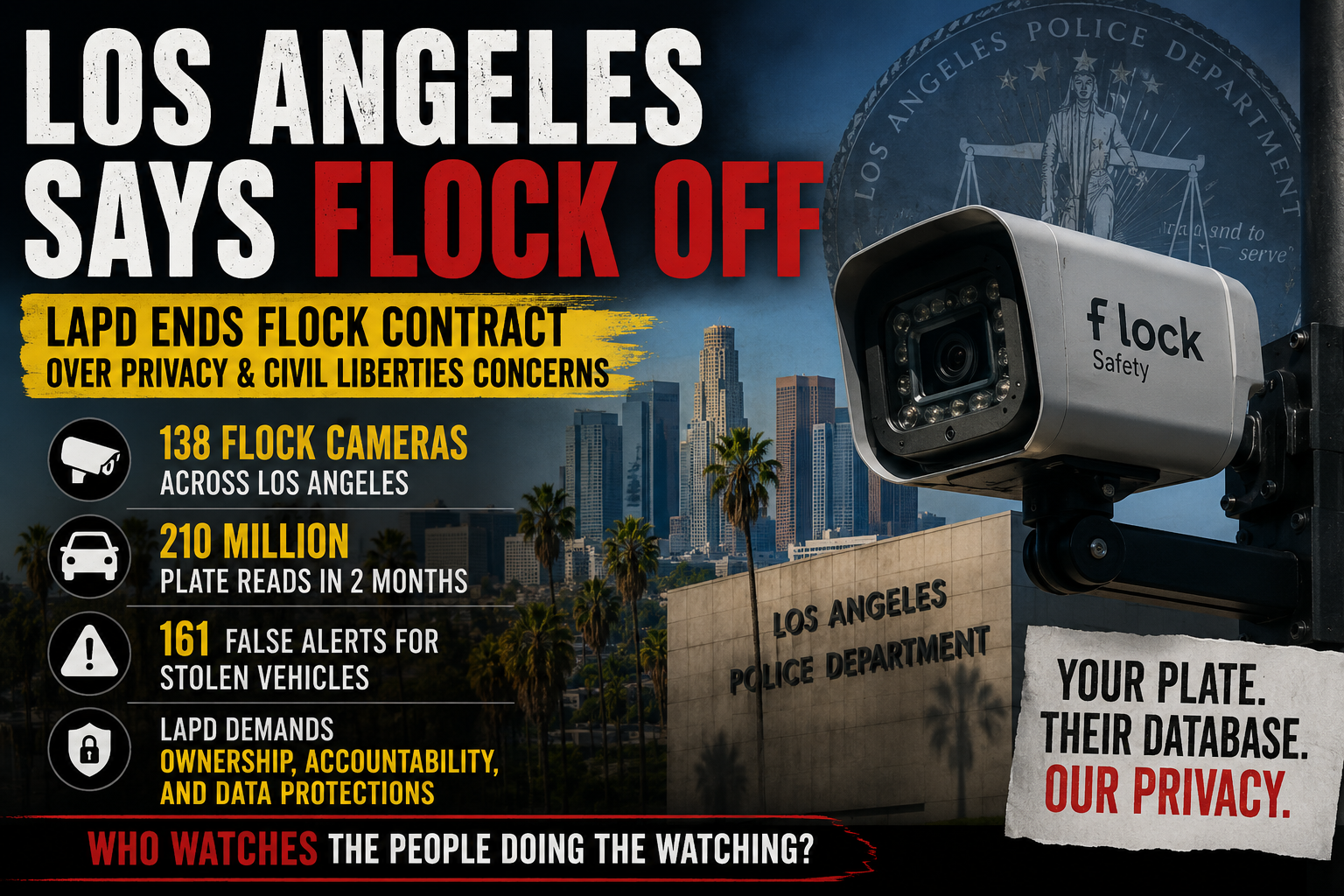
 LOS ANGELES PUTS FLOCK ON PAUSE
210 Million Plate Reads, False Alerts, Federal-Access Concerns and Questions About Who Controls the Data Finally Forced One of America's Largest Police Departments to Stop and Ask Questions
────────────────────────────
Los Angeles just did something every Georgia law-enforcement agency using Flock Safety should be watching.
In July 2026, the Los Angeles Police Department stopped its regular use of Flock Safety after a three-year agreement covering 138 cameras expired.
LAPD did not simply sign another agreement and keep going.
The department cited serious concerns involving privacy, civil liberties, data ownership, security and information sharing.
But there is an important distinction.
LAPD has not permanently abandoned Flock.
Officials are negotiating with the company over a possible new agreement containing substantially stronger safeguards.
And LAPD has not abandoned automated license plate readers generally.
That actually makes this story more important.
This isn't an anti-police department declaring surveillance technology useless.
It's a major police department saying:
THIS TECHNOLOGY MAY HELP US SOLVE CRIMES — BUT THAT DOESN'T MEAN WE'RE SATISFIED WITH THE RULES GOVERNING THE INFORMATION IT COLLECTS.
For Georgia, where Flock is headquartered and law-enforcement agencies have deployed the company's cameras throughout the state, that's a conversation worth having.
────────────────────────────
138 FLOCK CAMERAS ACROSS LOS ANGELES
LAPD entered into its three-year arrangement with Flock Safety in July 2023.
The program involved 138 Flock cameras mounted on poles throughout Los Angeles.
The cameras automatically photograph passing vehicles and capture license plate and associated vehicle information that investigators can later search.
Police say this technology helps locate stolen vehicles, identify suspects and develop investigative leads.
And there is evidence that it does.
But the individual cameras aren't what make modern automated license plate reader systems extraordinary.
THE NETWORK DOES.
Connect enough cameras, jurisdictions and searchable databases together and a tool designed to identify a stolen car can become something considerably larger:
A system capable of reconstructing pieces of where vehicles have traveled across cities, counties and potentially state lines.
That's where the Los Angeles story begins to resemble what Prison Project has been documenting elsewhere in America.
────────────────────────────
210 MILLION PLATE READS IN TWO MONTHS
One number from the Los Angeles Police Department Inspector General's examination deserves to stop you cold.
During a two-month review period beginning in August 2025, LAPD's Flock cameras processed more than:
210,000,000 PLATE READS
That does not mean 210 million suspected criminals were tracked.
Quite the opposite.
Automated license plate reader systems work because they collect enormous quantities of information about ordinary traffic.
Most motorists passing a camera aren't wanted.
They aren't under investigation.
They haven't been accused of anything.
THEY SIMPLY DROVE PAST A CAMERA.
The investigative value comes later, when somebody searches the accumulated information.
Which makes another question unavoidable:
WHO GETS TO SEARCH IT?
────────────────────────────
THE SYSTEM ALSO GOT SOME VEHICLES WRONG
The Inspector General's review documented another side of the technology.
During the review period, Flock-generated alerts reportedly incorrectly identified a plate as associated with a stolen vehicle in 161 instances.
That doesn't mean 161 innocent motorists were arrested or even stopped.
It does mean automated alerts aren't infallible.
That matters because an electronic alert can influence a real-world police decision.
But another number matters too.
The review found 337 alerts associated with recoveries of stolen vehicles.
Both facts belong in an honest discussion.
Flock can help police find stolen vehicles.
Flock can also generate incorrect alerts.
The existence of legitimate police uses doesn't eliminate the need for safeguards.
If anything, the power of the technology makes those safeguards more important.
────────────────────────────
THEN CAME THE CONTRACT PROBLEM
Los Angeles' concerns extended well beyond false alerts.
The Inspector General identified weaknesses surrounding the contractual controls governing automated license plate reader information.
The questions included:
• Who owns the information?
• Who owns the associated metadata?
• How long can information be retained?
• Who can access it?
• Which outside agencies can search it?
• Can information be disclosed to third parties?
• Can federal agencies obtain access?
• What security requirements apply?
• What happens to information after a contract ends?
These aren't technical footnotes.
THEY DETERMINE WHETHER A LOCAL CRIME-FIGHTING TOOL REMAINS LOCAL.
────────────────────────────
CALIFORNIA ALREADY HAD RULES — AND THE RULES WERE STILL BROKEN
This is where Los Angeles becomes particularly important for Georgia.
California didn't enter this controversy without privacy protections.
State law already restricts law-enforcement agencies from sharing automated license plate reader information with federal and out-of-state agencies in ways prohibited by California law.
Yet investigative reporting based on Flock audit records found Southern California law-enforcement agencies repeatedly conducting or facilitating searches involving federal agencies.
The agencies identified included LAPD and sheriff's departments in San Diego, Orange and Riverside counties.
Some audit entries explicitly referenced federal agencies such as Customs and Border Protection and Homeland Security Investigations.
And across hundreds of thousands of searches examined by investigators, many contained vague explanations such as "investigation" or "criminal justice."
That creates an accountability problem.
IF AN AUDIT LOG EXISTS BUT THE JUSTIFICATION ENTERED INTO IT TELLS THE PUBLIC ALMOST NOTHING, HOW MEANINGFUL IS THE AUDIT?
That's enormously important for Georgia.
California has stronger statutory restrictions surrounding ALPR information than Georgia.
Yet California still discovered access and sharing that its safeguards were supposed to prevent.
Georgia shouldn't look at California and conclude:
"Their laws are different, so this isn't our problem."
Georgia should ask the opposite question:
IF STRONGER RESTRICTIONS DIDN'T PREVENT EVERY QUESTIONABLE SEARCH IN CALIFORNIA, WHAT EXACTLY IS PREVENTING THEM HERE?
────────────────────────────
IMMIGRATION CHANGED THE POLITICAL CALCULATION
The possibility of federal immigration access made those questions especially explosive in Los Angeles.
California has attempted to restrict ALPR information from flowing to federal and out-of-state agencies in prohibited circumstances.
But investigations based on audit records have exposed pathways through which locally collected information could nevertheless become useful to federal authorities.
That creates an important distinction.
A city doesn't necessarily have to hand a database directly to ICE for locally collected surveillance information to become useful outside the city.
Information can potentially travel through searches, shared access, partner agencies and interconnected systems.
That's one reason audit logs matter so much.
They can reveal not merely what a department says its policy is.
THEY CAN REVEAL WHAT PEOPLE ACTUALLY SEARCHED.
────────────────────────────
THIS PAUSE DIDN'T COME OUT OF NOWHERE
Los Angeles officials didn't suddenly discover Flock in July.
Privacy and immigration advocates had spent months pressuring city officials over automated license plate surveillance, federal access and the city's relationship with Flock.
The Stop LAPD Spying Coalition repeatedly appeared before city officials demanding greater transparency and an end to the relationship.
The coalition also pursued public records concerning LAPD's Flock arrangement.
By 2026, questions surrounding the program had reached the Police Commission and its Inspector General.
The Inspector General subsequently examined LAPD's ALPR program and identified substantial oversight and contractual concerns.
Then the Flock agreement expired.
LAPD DIDN'T SIMPLY RENEW IT.
It would be an exaggeration to claim activists alone caused that decision.
But it would also be wrong to pretend sustained public scrutiny played no role.
Citizens kept asking questions about a surveillance system most motorists probably never knew was recording their vehicles.
Eventually government had to answer some of them.
────────────────────────────
LOS ANGELES DIDN'T SIGN ANOTHER BLANK CHECK
When the agreement expired, LAPD stopped regular access while officials negotiated stronger protections.
And the protections Los Angeles wants are revealing.
Under proposed terms, LAPD would retain ownership of:
• Images
• Records
• Associated metadata
Proposed restrictions would also limit Flock's ability to distribute, disclose or otherwise use LAPD information outside the purposes authorized by the city.
Los Angeles has also sought restrictions preventing its information from being used to train artificial intelligence or for unrelated commercial purposes.
And proposed security provisions include rapid notification following a data breach.
Think about who is demanding those protections.
NOT AN ANTI-POLICE ORGANIZATION.
THE LOS ANGELES POLICE DEPARTMENT.
────────────────────────────
LOS ANGELES DIDN'T ACTUALLY ABANDON LICENSE-PLATE SURVEILLANCE
This distinction matters just as much.
LAPD paused its relationship with Flock.
It did not abandon automated license plate readers.
The department operates a broader ALPR ecosystem involving other vendors and vehicle-mounted systems.
That means replacing Flock wouldn't necessarily solve the underlying surveillance problem.
A different company can collect the same type of information.
A different database can create similar privacy concerns.
A different vendor can still operate under inadequate contractual safeguards.
In fact, Los Angeles' Inspector General raised concerns involving LAPD's relationships with other ALPR vendors as well.
That's why Prison Project isn't treating this simply as an anti-Flock story.
FLOCK MAY BE THE COMPANY FORCING AMERICA TO CONFRONT THE ISSUE, BUT AUTOMATED MASS VEHICLE SURVEILLANCE IS THE LARGER ISSUE.
The safeguards should follow the information regardless of which company's logo appears on the camera.
────────────────────────────
THE CAMERAS DIDN'T NECESSARILY STOP COLLECTING
There is another unusual aspect of the Los Angeles situation.
Ending regular LAPD access isn't necessarily the same thing as immediately removing every camera or eliminating previously collected information.
That creates another series of questions:
• What happens to information collected during a contractual transition?
• Who owns it?
• How long does it remain available?
• Who can access it?
• What happens if negotiations fail?
Those questions shouldn't first be asked after a contract expires.
THEY SHOULD BE ANSWERED BEFORE THE FIRST CAMERA STARTS COLLECTING INFORMATION.
────────────────────────────
FLOCK WANTS LOS ANGELES BACK
Flock Safety has pushed back against criticism surrounding LAPD's decision.
The Atlanta-based company has characterized the development as a pause rather than a permanent breakup and has indicated it wants to resolve LAPD's concerns and restore the relationship.
That position deserves to be included.
Flock maintains that its technology helps law enforcement solve serious crimes and that privacy and security controls can coexist with effective policing.
LAPD's own data provides evidence of legitimate investigative value, including stolen-vehicle recoveries associated with alerts.
The debate therefore isn't:
"Does this technology ever help police?"
It clearly does.
The harder question is:
HOW MUCH SURVEILLANCE INFRASTRUCTURE SHOULD GOVERNMENT BUILD, AND WHAT ENFORCEABLE SAFEGUARDS SHOULD EXIST BEFORE IT BUILDS IT?
────────────────────────────
NOW BRING THIS HOME TO GEORGIA
Flock Safety isn't some distant California technology company.
FLOCK WAS BORN IN GEORGIA.
The company is headquartered here.
Georgia law-enforcement agencies have embraced automated license plate readers across the state.
And Georgia is simultaneously experiencing an extraordinary series of cases involving law-enforcement personnel accused of misusing ALPR information.
Prison Project is documenting those cases in our continuing investigation.
FLOCK ON THE WRONG SIDE OF THE LAW
Georgia officers, deputies, supervisors and even a police chief have been arrested, fired, investigated or disciplined over alleged misuse of automated license plate reader systems.
We're building the statewide record.
READ THE GEORGIA INVESTIGATION:
https://prisonproject.net/flock-on-the-wrong-side-of-the-law
────────────────────────────
GEORGIA SHOULD STEAL LOS ANGELES' HOMEWORK
Forget California politics for a minute.
Forget whether you like Los Angeles.
Forget whether you support Flock.
Look at the questions LAPD is asking.
Then ask your Georgia sheriff or police chief the same questions:
• Who legally owns every image collected by your cameras?
• Who owns the metadata?
• Can the vendor disclose that information to anybody else?
• Can it be used for commercial purposes?
• Can it be used to train artificial intelligence?
• Which outside agencies can search it?
• Can federal agencies access it directly or indirectly?
• How long is information retained?
• What happens to information when the contract expires?
• How quickly must the vendor disclose a security breach?
• Who audits officer searches?
• How frequently are those audits actually reviewed?
• What justification must an officer enter before conducting a search?
• Does anyone verify that justification?
Those aren't radical questions.
ONE OF AMERICA'S LARGEST POLICE DEPARTMENTS IS ASKING VERSIONS OF THEM.
────────────────────────────
AND THEN THERE'S TEXAS
Los Angeles becomes even more significant when placed beside another investigation Prison Project has documented.
In Johnson County, Texas, an investigator searching for a woman following a self-managed abortion conducted a Flock query reportedly reaching:
6,809 NETWORKS
83,345 CAMERAS
The search reached information far outside the investigator's local jurisdiction.
No warrant authorizing a nationwide database search has been identified in the public reporting Prison Project reviewed.
Texas demonstrated the potential geographic scale of interconnected ALPR surveillance.
Los Angeles demonstrates what happens when a major police department starts asking whether the safeguards surrounding that infrastructure are adequate.
READ NEXT: THE 83,345-CAMERA SEARCH
See how one local Texas investigation reached thousands of Flock networks across America.
Find it in the Prison Project Flock Files:
https://prisonproject.net/flock
────────────────────────────
THIS ISN'T ACTUALLY JUST A STORY ABOUT LOS ANGELES
Los Angeles is the latest laboratory.
The larger story is happening nationally.
Communities bought individual cameras to solve local crimes.
Those cameras became interconnected.
Interconnected systems created enormous searchable databases.
Outside agencies developed pathways into locally generated information.
Audits began uncovering access communities didn't expect.
Other audits began uncovering alleged officer misuse.
Citizens started asking who controlled the information.
Now governments are trying to write rules around infrastructure that already exists.
THE TECHNOLOGY GOT THERE FIRST.
THE OVERSIGHT IS TRYING TO CATCH UP.
────────────────────────────
THE FLOCK FILES
Prison Project is building a continuing investigation into Flock Safety and automated license plate surveillance.
We're tracking:
• Georgia officer misuse
• Outside agencies searching locally collected information
• Immigration and federal access
• Interstate information sharing
• Cities suspending, restricting or terminating Flock programs
• Government contracts and camera counts
• Security failures
• Fourth Amendment litigation
• State and federal legislation
• Flock corporate developments
We're also distinguishing between allegations and proven misconduct, between cities that actually terminate contracts and cities that merely consider doing so, and between criticism of Flock specifically and concerns inherent in ALPR technology generally.
BECAUSE THIS INVESTIGATION IS ONLY USEFUL IF THE RECORD IS ACCURATE.
FOLLOW THE FLOCK FILES
Georgia investigations. National developments. Public records. Surveillance. Accountability.
https://prisonproject.net/flock
────────────────────────────
WHEN SURVEILLANCE BECOMES AN ARREST
A license plate database isn't merely an abstract privacy issue.
A database alert can become a police encounter.
A police encounter can become detention.
And detention can become an arrest.
Families are often completely unprepared for what happens next.
THE FIRST 72 HOURS ACTION PACK — $27
Prison Project created a practical family action system for the critical first three days following an arrest.
Step-by-step guidance. Checklists. Worksheets. A plan for getting organized when everything suddenly becomes chaotic.
GET THE FIRST 72 HOURS ACTION PACK:
https://prisonproject.net/fi
Purchases help support Prison Project investigations and free public educational resources.
────────────────────────────
THE QUESTION GEORGIA SHOULD BE ASKING
Los Angeles didn't prove Flock is useless.
It proved something considerably more interesting.
A police department can believe surveillance technology helps solve crimes and still refuse to automatically continue using it until fundamental questions about the information are answered.
Georgia now has those same questions sitting directly in front of us.
Who owns our information?
Who searches it?
Who receives it?
Who audits the searches?
What happens when somebody abuses access?
And perhaps the oldest surveillance question of all:
WHO WATCHES THE PEOPLE DOING THE WATCHING?
Los Angeles finally started demanding answers.
GEORGIA SHOULD TOO.
PrisonProject.net
Comments