
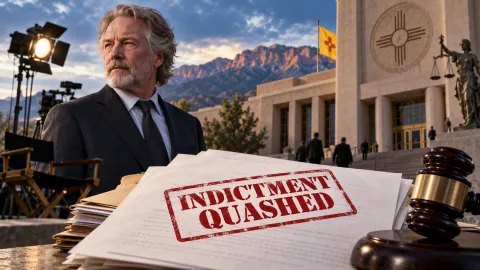
ALBUQUERQUE, New Mexico, October 17, 2026: A New Mexico district judge has thrown out a four-count indictment against actor and television director Timothy Busfield after finding that prosecutors improperly interfered with grand jurors' requests to hear additional witnesses.
In a six-page order filed October 16, Second Judicial District Judge Joseph Montano granted Busfield's motion to quash the indictment. The judge concluded that the prosecution failed to provide fair and impartial guidance about the process for calling witnesses, undermining legal protections designed to preserve the independence of the grand jury.
The ruling is a major setback for prosecutors in a case involving allegations of inappropriate sexual contact with a child on the Albuquerque set of the television series The Cleaning Lady. Busfield has consistently denied the allegations. The dismissal is not an acquittal, and the judge expressly left the state free to initiate new criminal proceedings.
Grand jurors asked to hear more witnesses
According to the court's October 16 order, the grand jury indicted Busfield on February 5, 2026, on four counts of criminal sexual contact of a minor. Only two witnesses testified during the grand-jury proceedings: Albuquerque police Detective Marvin Brown and Busfield himself.
While testifying, Busfield referred to an independent Warner Bros. investigation, a polygraph examination and other potential witnesses who were available to testify. The court later heard testimony from eight people who said they had been present and willing to appear before the grand jury.
Judge Montano found that several grand jurors expressed a desire to hear additional witnesses on at least three separate occasions. They specifically identified one witness, Alan Caudillo, who was present and available.
Instead of facilitating those requests, the prosecutor told jurors that eight members first had to agree that a witness was necessary, and all 12 would then have to agree to return for testimony after a subpoena process requiring at least 36 hours' notice.
The judge found no rule or statute supporting that two-stage voting requirement. The prosecutor also failed to explain that willing witnesses could appear without subpoenas and that a judge could approve shorter notice when a subpoena was required.
After receiving those instructions, grand jurors made no further requests for testimony. The judge found the prosecutor's approach had effectively prevented the grand jury from hearing witnesses it had requested.
Prosecutors argued the defense failed to follow procedure
The state argued that Busfield's lawyers had not followed the established procedure for requesting that a grand jury be alerted to potentially exculpatory evidence. Prosecutors also maintained that Busfield had already described the evidence in his own testimony and that the grand jurors did not repeat their requests after being told the process for calling witnesses.
Judge Montano acknowledged an important point in the state's favor: Busfield had not made the formal request contemplated by the relevant New Mexico procedure. But the judge determined that this did not resolve the separate problem of grand jurors themselves asking to hear witnesses.
Once those requests were made, the court concluded, the prosecution could not use an unsupported voting procedure and an incomplete description of subpoena requirements to prevent the jurors from pursuing relevant testimony.
A ruling about the integrity of the grand-jury process
The decision cited New Mexico Supreme Court precedent, including Herrera v. Sanchez and Jones v. Murdoch, addressing the prosecutor's duty to assist a grand jury fairly and the jury's independent role in assessing whether probable cause exists.
New Mexico law distinguishes challenges to the sufficiency of evidence from challenges to the structure and fairness of the grand-jury process. Where the required structural protections have been violated, the court explained, dismissal may be warranted without a separate showing that the error changed the outcome.
In this case, Judge Montano found that the prosecutor's instructions violated protections designed to keep the grand jury independent. The order granted the defense motion to quash the indictment.
The court did not decide whether the underlying allegations against Busfield were true or false. The judge's findings concerned the procedure used to obtain the indictment, not a verdict on the accusations.
What the decision does not mean: The judge did not determine guilt or innocence. Quashing the indictment ends that indictment, but does not prohibit prosecutors from seeking new charges through lawful procedures.
What happens next?
As of October 17, the Bernalillo County district attorney's office had not publicly announced a decision to seek a new indictment. A spokesperson told Reuters that the office was evaluating its options.
Busfield, known for his work on Thirtysomething, The West Wing and Field of Dreams, has denied wrongdoing. The allegations arose from his work on The Cleaning Lady, where two young twin brothers had appeared as child actors. The allegations remain disputed.
Why the ruling matters beyond a celebrity case
Grand juries are meant to provide an independent check on whether criminal charges should proceed. Prosecutors present evidence and explain the law, but they must not improperly control the jurors' ability to seek relevant information.
The Busfield ruling illustrates a broader criminal-justice principle: procedural safeguards are not optional simply because allegations are serious or a case attracts public attention. A court may invalidate an indictment when the process used to obtain it violates the law, while leaving prosecutors the option to pursue charges through a lawful process.
For defendants, complainants and the public alike, the distinction matters. Quashing an indictment is not the same as finding a person innocent; preserving grand-jury independence is not the same as deciding the merits of a criminal accusation.
Sources and court records
- New Mexico Second Judicial District Court: Order on Defendant's Motion to Quash Grand Jury Indictment, October 16, 2026 (PDF).
- New Mexico Second Judicial District Court: State v. Timothy Busfield, official case-document archive.
- Reuters: October 16 reporting on the dismissal and district attorney's response.
- Associated Press: October 16 reporting on the case and prosecution's arguments.
Prison Project reporting note: This article describes the October 16 court order and information available as of October 17, 2026. The criminal allegations are disputed. No finding of guilt or innocence was made in the ruling.
Comments