
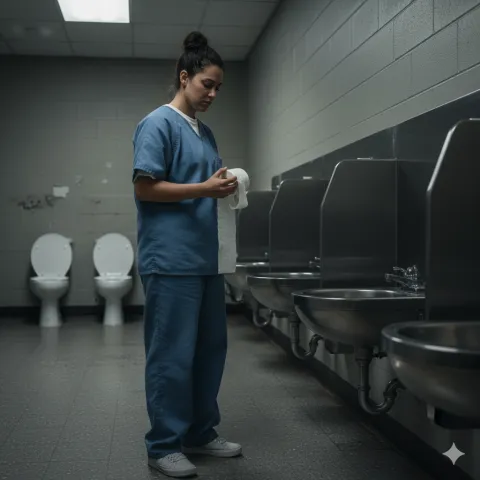
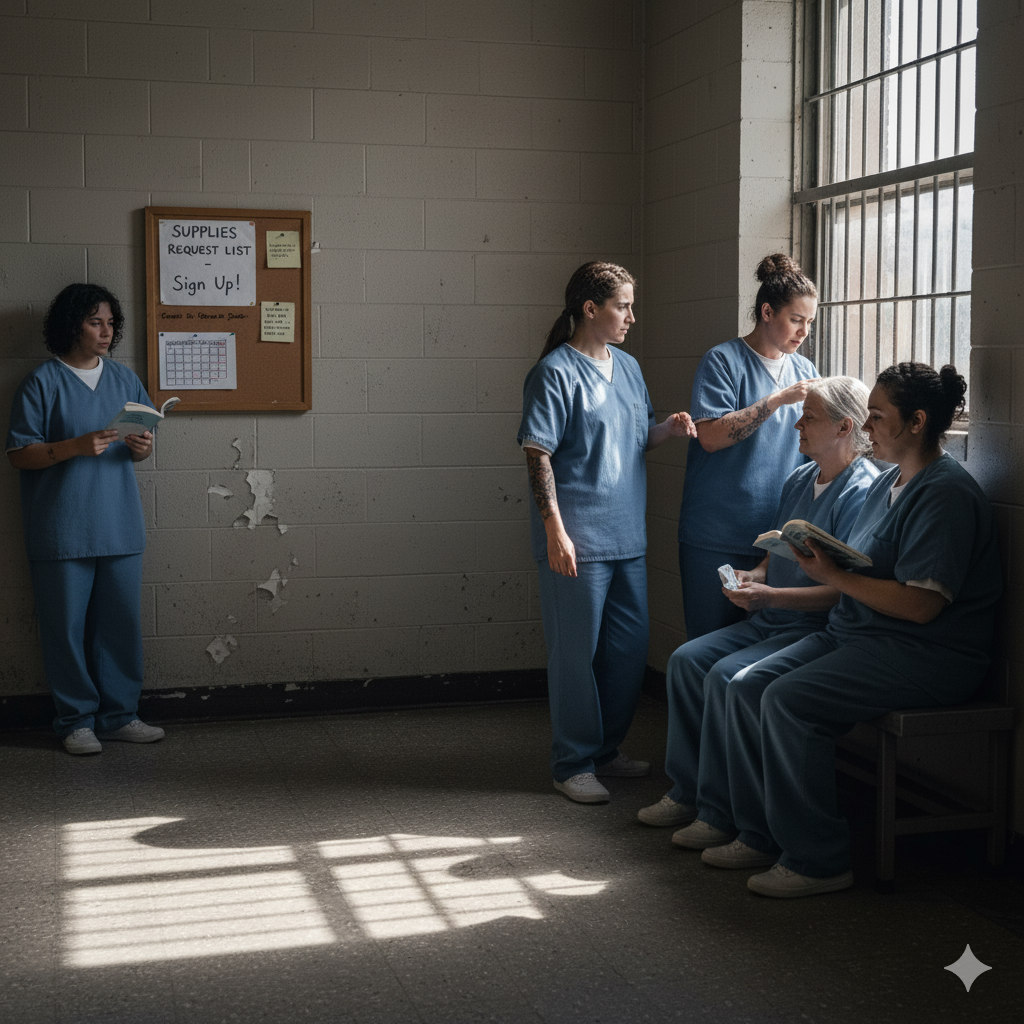
Our analysis of prison rules and sanctions across all fifty states and the federal system — as well as accounts of incarcerated people — reveal troubling trends in how the carceral system punishes people for a physiological process they have no control over.
by Miriam Vishniac and Emily Widra, November 12, 2025
Prisons are primarily designed to confine and control men, which makes managing menstruation extraordinarily difficult, uncomfortable, and often downright dangerous for people inside. Incarcerated people are routinely denied the basic dignity of having the sanitary products and practices they need to care for themselves. When they band together and try to cope by engaging in survival strategies such as sharing supplies, they often fall prey to prison disciplinary systems used to target them for cruel punishment. To make matters worse, those punishments erect even greater barriers to menstrual health and hygiene.
Prison disciplinary systems lay out the wide-ranging rules that govern nearly every aspect of prison life, as well as the power of corrections officers to identify rulebreaking, enforce arbitrary rules, and determine the consequences. While corrections departments justify these far-reaching disciplinary systems as necessary to ensure safety, security, and order by deterring and punishing “misconduct,” in practice, they grant corrections officers wide and virtually unchallenged discretion to turn everyday behaviors into “rule violations” that jeopardize access to important programming and services.
people for menstruating:
- Damaging property: Rules designed to prevent damage to prison property result in punishing people for bleeding on prison-issued property, using more menstrual products than allotted, and supplementing their limited menstrual products with other materials like toilet paper, paper towels, or rags. ⤵
- Maintaining personal hygiene: Rules that mandate tidiness and personal cleanliness can be used against people who are menstruating when they have inadequate menstrual products and limited changes of clothing. ⤵
- Contraband: Rules restricting the type of property people can have in their cell, as well as the amount of allowed property that people can have in their cell and how that property is used, can turn basic or makeshift hygiene products into prohibited items.
- Movement: Rules that govern the physical movement of people throughout prisons inevitably impact people who are menstruating by limiting access to bathroom, shower, and laundry facilities. ⤵
- Work assignments: Rules requiring participation in work assignments — or impose sanctions for unauthorized absences — unfairly punish people who are menstruating and cannot maintain their usual job performance or tolerate being at work. ⤵
- “Feigning” illness: Rules supposedly designed to reduce the unnecessary and expensive use of healthcare resources undoubtedly results in the dismissal of real, severe symptoms experienced in menstruation. ⤵
In addition to rules that put people who menstruate in the crosshairs of the disciplinary system, many of the sanctions for breaking them further restrict access to menstrual products, including:
- Confiscation: A common sanction for being found in possession of “contraband” is confiscation — and it is easy to see how prisons can classify menstrual products as contraband if people have more than the allotted number of products, have traded for menstrual products, or use products acquired in an unauthorized manner. ⤵
- Work assignments: Sanctions that result in the loss of work assignment or lowered pay can make it even more challenging for people to afford menstrual products, and requiring additional labor as a punishment can be impossible for people who do not have access to menstrual products or who are experiencing menstruation-related symptoms and medical conditions, including pain and heavy bleeding. ⤵
- Fines, fees, restitution and assessed costs: Sanctions requiring monetary payment disproportionately impact women, trans, and nonbinary people, who tend to enter prison with fewer financial resources than men, and who need to spend what little they have on menstrual products from the commissary. ⤵
- Loss of privileges: Revoking access to the commissary prohibits people from accessing menstrual products (when it is the sole provider of them) and disallows people from safely supplementing the menstrual products they have when needed. Other privileges are often revoked as well, including visitation, recreation, and programming, all of which are tied to lower rates of prison misconduct and recidivism. ⤵
- Restrictive housing: Sanctions that confine people to their cells or restrict access to personal property inevitably limit access to necessary menstrual products when they are otherwise unavailable in restrictive housing or disciplinary segregation. ⤵
Basic menstrual care runs afoul of several common prison rules
Prisons typically have many rules, many of which may seem mundane — or even reasonable — that can cause serious issues for people menstruating behind bars. Combined with officer discretion, the general lack of oversight in prisons means even the most basic rules can be weaponized. As it stands, research shows that women are more likely to be written up and disciplined for breaking prison rules, and receive disproportionate punishment for minor, subjective infractions like “disrespect.”
While in prison, having a record of rule violations of any kind can exclude people from placement in less-restrictive housing units, program participation, and other services that could benefit them. In addition, pathways to release like parole and clemency proceedings take disciplinary records into consideration, so even the most minor infractions can influence how long someone spends in prison.
This article was taken and reprinted from the prison initiative.org. a fantastic organization we support wholeheartedly and 100% to read the story and others about mass incarceration and to gain unique insight into the world behind the wall please visit them often. Also read the full story and others like it here
https://www.prisonpolicy.org/blog/2025/11/12/discipline_menstruation/
Comments