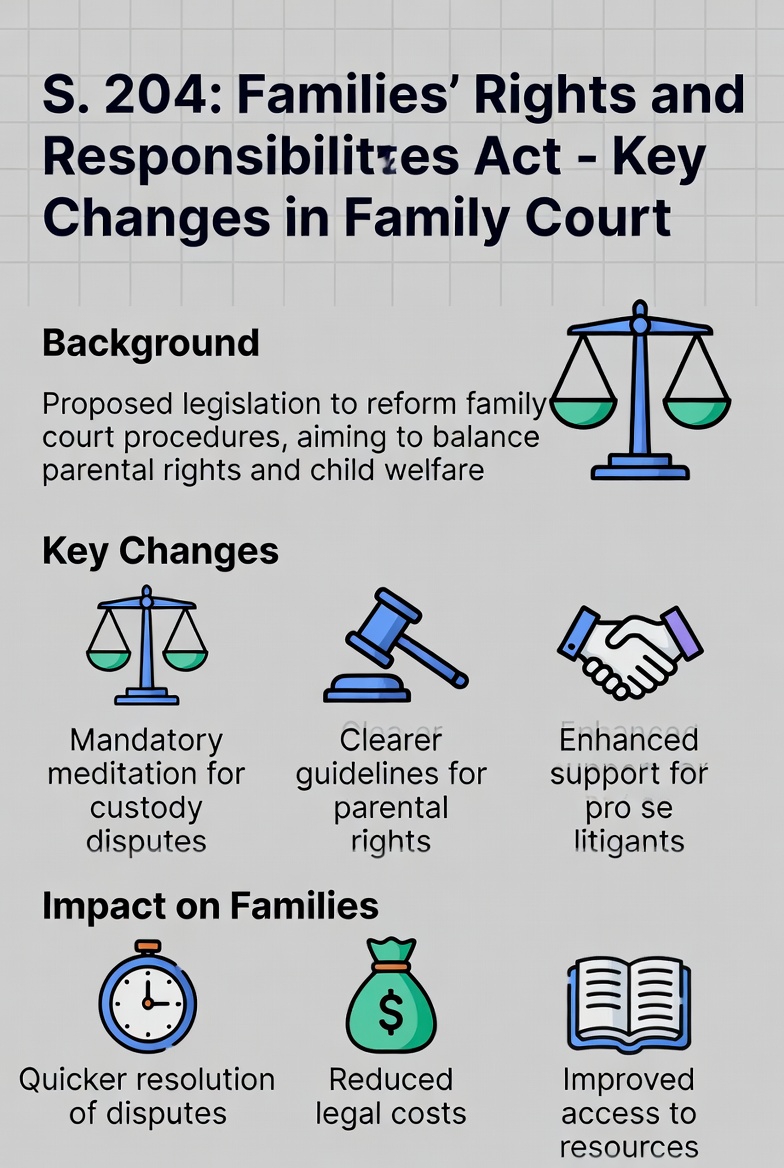
 S. 204: What the Families’ Rights and Responsibilities Act Would Change in Family Court
For years, families across the country have raised concerns about how family courts and child welfare systems operate. Critics have pointed to financial incentives tied to federal funding, broad discretion given to caseworkers and courts, and the difficulty families face when trying to challenge state intervention.
S. 204 — the Families’ Rights and Responsibilities Act — was introduced in response to those concerns. Whether one agrees with the bill or not, it represents a significant federal attempt to redefine how courts review government actions affecting family rights.
Here is what the bill seeks to do.
1. It Elevates the Legal Standard to “Strict Scrutiny”
Under current practice, many family court decisions are reviewed under deferential standards that heavily favor the state.
S. 204 would require courts to apply Strict Scrutiny in cases involving fundamental family rights.
Strict Scrutiny is the highest constitutional standard. It requires the government to prove:
A compelling governmental interest
That the action is narrowly tailored
That it is the least restrictive means available
This shifts the posture of the courtroom. Instead of a parent having to prove the state acted improperly, the state must justify its intrusion at the highest level of constitutional review.
2. It Shifts the Burden to the Government
In many family court settings, parents effectively bear the burden of defending themselves against allegations while navigating sealed records, expedited hearings, and limited procedural safeguards.
S. 204 places the burden on the government to demonstrate that its actions meet constitutional standards. That is a structural change.
The question becomes: Not “Why should this family keep its rights?” But “Why does the state have the authority to restrict them?”
That distinction matters.
3. It Allows Recovery of Attorney’s Fees
One of the most significant provisions in S. 204 is its attorney’s fee section.
If a family prevails in showing that their rights were unlawfully burdened, the bill would allow courts to award attorney’s fees.
This provision addresses a practical barrier. Litigation is expensive. Many families lack the financial ability to challenge state action, even when constitutional questions are involved.
Allowing fee recovery changes the calculus. It makes legal challenge more realistic and creates accountability when government actors overstep.
4. It Responds to Long-Standing Funding Concerns
Federal funding structures tied to child support enforcement and child welfare services have long been debated. Some argue that financial incentives may influence how aggressively states pursue certain actions.
S. 204 does not eliminate federal funding programs. Instead, it addresses the constitutional review framework that governs state actions taken within those systems.
In short, it focuses on how courts review state conduct, not how programs are funded.
Why This Bill Matters
At its core, S. 204 is about constitutional structure.
It asks a fundamental question: When the government intervenes in a family, what level of justification should it be required to meet?
Supporters argue that family rights are fundamental and deserve the highest protection.
Opponents may argue that child welfare systems require flexibility and deference to protect vulnerable children.
That debate is legitimate. But S. 204 forces the debate into constitutional terms rather than leaving it at the level of administrative discretion.
What Happens Next
Like any federal bill, S. 204 must move through committee and floor votes before becoming law.
If you believe constitutional standards should apply strictly in family rights cases, the next step is civic engagement. Contact your U.S. Representative. Ask where they stand on S. 204. Make your position clear.
Policy changes do not happen in silence.
Comments