
 Federal Yard Series
Part 2 of 6
Yard Politics
The Illusion of Choice: From the Poor Box to the Rec Yard
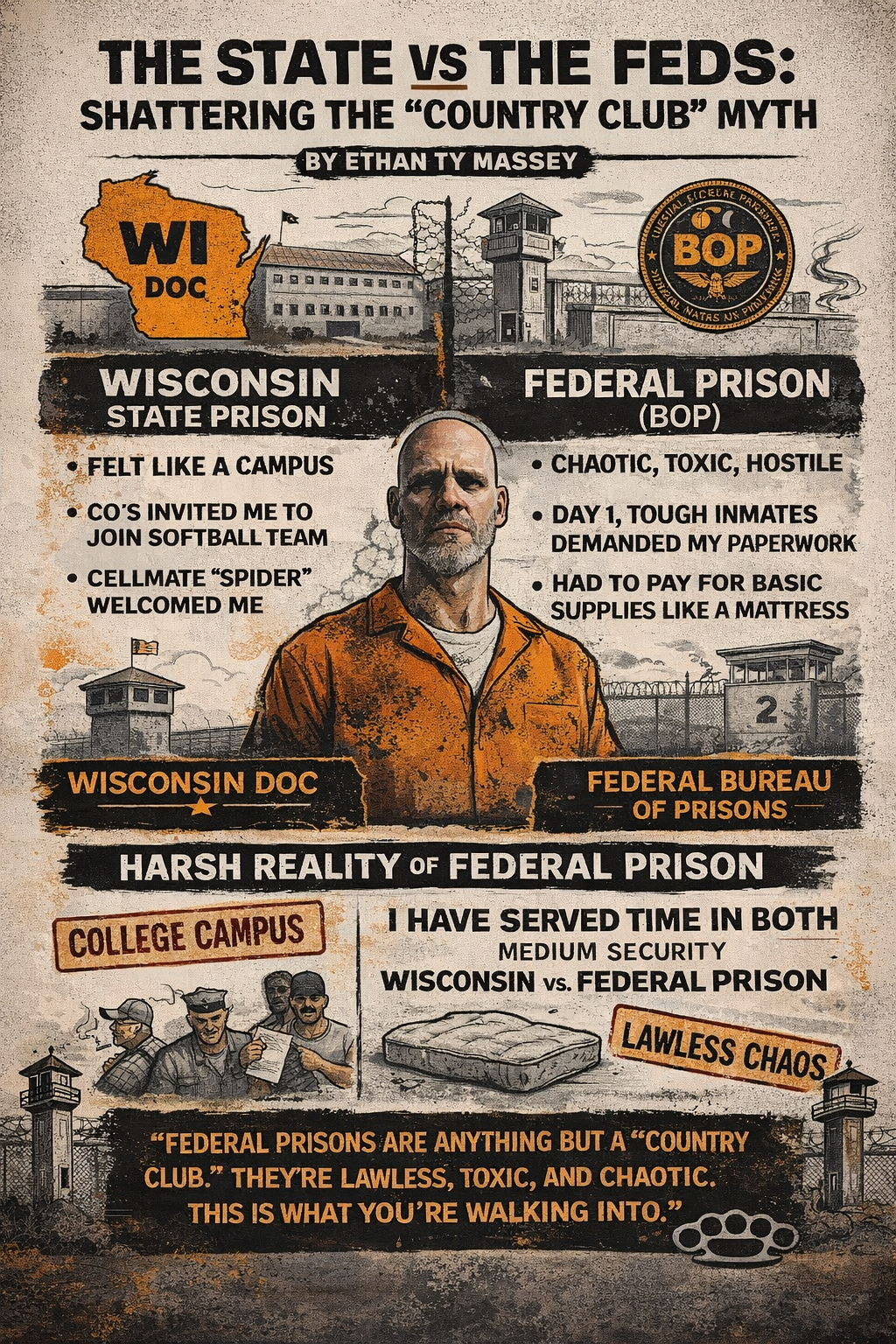
Before diving into this, I need to make one thing clear: everyone’s time is different. The prison experience is not a monolith. A guy doing 18 months at a minimum-security camp is not walking the same yard as a guy doing a 20-piece at a penitentiary. I’m not speaking from the sidelines. I’ve been all the way up to maximum custody at Columbia Correctional Institution in Portage—the same walls where Jeffrey Dahmer met his end. I’ve seen the extremes of what the system has to offer, and I’ve seen how the game changes from the state level all the way up to the feds.
The biggest lie sold in this life is the illusion of choice.
It usually starts with a pitch. Years ago, back in Wisconsin, a state-level gang member tried to recruit me. He talked up the brotherhood and the power, making it sound like some organized fraternity.
I looked at him and asked a simple question: “So, there are rules?”
He paused and said, “Yeah, a couple.”
I asked, “So there are consequences?”
“Yeah,” he said. “Some punishments. Nothing major.”
“And then we’ve gotta pay?”
“Well, yeah. We usually have a ‘poor box’ that holds money for guys who don’t have anything.”
I snapped back, “Sounds like extortion to me. I’m out.”
That “poor box” mentality doesn’t survive long once you step onto a real yard—a federal yard.
In the feds, there is no gray area. You might think you can just do your own time—what they call “man time”—keep your head down, lift weights, stay out of politics. But if you walk onto a federal yard as a white man, that idea disappears fast. Your path is carved into the concrete the second the bus drops you off. You are getting in a “car.” You fall in line. You learn your place.
I remember standing on the rec yard, already embedded in the white car, watching the politics play out in real time. If you want to understand what the absence of choice feels like, it’s this: a massive car circling up for a meeting.
It doesn’t happen fast. It’s calculated.
One minute you hear basketballs bouncing, the clank of weights, casual conversations. Then it all fades. The yard gets quiet. You see dozens of men moving into formation, circling out to handle whatever business has to be handled.
The rest of the yard freezes.
You stand there hyper-aware of every movement because you know how dangerous that moment is. Every man out there feels it. Because if that circle breaks the wrong way, everything changes.
You aren’t an individual in that moment. You’re part of something bigger, whether you like it or not.
Nowhere is that hierarchy more visible than in the chow hall. Every table is claimed. Every seat is earned. Every boundary is enforced.
At one point, there was a Black “man car”—a group of guys who wanted to step back from the car politics. But in a system that demands total allegiance, neutrality becomes a threat. That independent car was marginalized so severely they weren’t even allowed to sit down. They didn’t have a table. If you wanted independence, your reward was eating on your feet.
And then one day, your time is up. The gates open.
Walking out of prison isn’t freedom in the way people think. Inside, your life runs on structure. You don’t make many decisions. You react. You survive. You follow the board that’s already set.
Then you’re released into a world of infinite choices after years of living in a world with almost none.
That shift isn’t simple. It’s disorienting.
You can’t take a man who has had his independence reduced to survival instincts, hand him a bus ticket, and expect him to instantly function like nothing happened. If we don’t understand the psychological shock of release, we shouldn’t be surprised when men struggle.
Because when a man walks out unprepared for the freedom he’s handed, the system is always waiting to pull him back.
Comments