
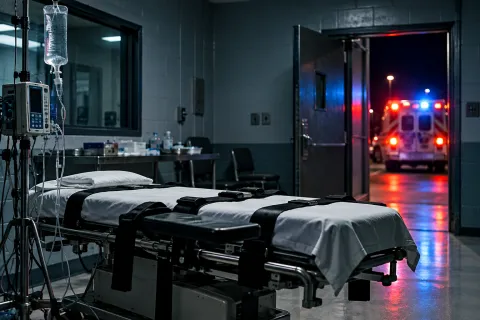
Christa Pike was supposed to die at Riverbend Maximum Security Institution in Nashville on September 30.
She did not.
Tennessee officials administered two doses of pentobarbital during the state's attempt to execute Pike by lethal injection. She survived the procedure and was taken from the prison by ambulance for emergency medical treatment.
By October 4, Pike's attorney said she had not regained consciousness and remained on a ventilator while hospital staff worked to clear the execution drug from her system.
Pike, 50, was sentenced to death for the 1995 torture and murder of 19-year-old Colleen Slemmer. The failed execution does not change the crime, the conviction, or the loss suffered by Slemmer's family.
It does raise a separate question about the government's conduct when it carries out a death sentence.
Tennessee halted the rest of its 2026 executions
Governor Bill Lee suspended Tennessee's remaining executions for 2026 and ordered an independent investigation into what happened.
Days later, Tennessee Department of Correction Commissioner Frank Strada announced that he would resign. Strada said the department believed it had followed its protocol, while also saying that stepping aside was in the state's best interest as the independent review moved forward.
The failed execution was Tennessee's second unsuccessful execution attempt in 2026.
The investigation now has to address more than whether the written protocol existed. It has to establish what happened in the room.
Questions include:
- whether the IV lines were placed correctly;
- whether the pentobarbital entered Pike's bloodstream as intended;
- what staff observed after the first dose failed to kill her;
- when emergency medical care began;
- what video, medical notes, drug records, execution logs, and other evidence are being preserved;
- and what legal consequences could follow if Tennessee later attempts to execute Pike again.
Pike's attorneys have asked for preservation of records connected to the execution attempt.
Why transparency matters
Execution protocols are often treated as specialized correctional procedures. But an execution is one of the most consequential government actions possible.
That makes documentation and outside scrutiny especially important when the process fails.
Media witnesses play a significant role because they provide independent observations of what happens inside an execution chamber. In Pike's case, witnesses reported that she remained alive after the drug was administered.
The public record now includes competing questions about IV access, drug delivery, emergency response, and whether Tennessee's safeguards were adequate.
Those questions should be answered with records, not assurances.
What Prison Project is watching
Prison Project will be watching five things as the investigation develops:
- Pike's medical condition and whether she regains consciousness.
- The findings of the independent review ordered by Governor Lee.
- Whether Tennessee changes its lethal-injection protocol before scheduling another execution.
- Whether courts address the constitutional significance of a second execution attempt if the state seeks one.
- Whether the state releases enough underlying records for the public to independently evaluate what happened.
A death sentence does not eliminate the government's obligation to follow the Constitution.
When the state exercises its most irreversible power, "trust us" is not oversight.
Sources
- Associated Press, October 4, 2026: Christa Pike's lawyer says she has not regained consciousness since the failed execution.
https://apnews.com/article/615fbde1a6ab5b1d5f2c9ca97d4dce33 - Reuters, October 3, 2026: Tennessee prison chief resigns after failed execution.
https://www.reuters.com/world/us/tennessee-prison-chief-resigns-after-failed-execution-2026-10-03/ - Reuters, October 1, 2026: Tennessee governor calls failed Christa Pike execution a tragedy and orders review.
https://www.reuters.com/world/us/tennessee-governor-calls-failed-christa-pike-execution-tragedy-2026-10-01/
Comments