
Prison Project | Records & Accountability
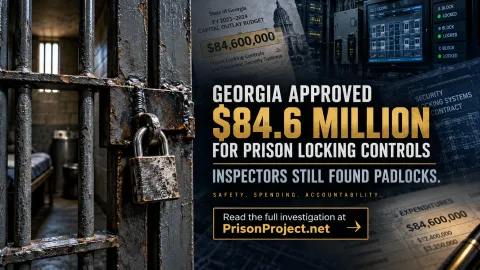
$84.6 million authorized for locking controls. New inspections still report padlocks on cell doors.
A documented budget, a 2024 federal warning, a 2011 contracting finding, and questions Georgia has not answered.
October 11, 2026 · Prison Project investigative follow-up · Original September 2026 inspection reporting: Georgia Prisoners' Speak
Georgia authorized $84,596,895 to replace prison locking-control systems in its amended fiscal 2026 budget. Yet on September 24, according to an investigation by Georgia Prisoners' Speak (GPS), state inspectors found cell doors secured with padlocks and slide bolts in four housing units at Washington State Prison. GPS reports that the warden attributed the workaround to broken mortise locks. Read the original GPS report.
The contrast demands scrutiny, but it does not establish that the new appropriation has already been spent or that fraud occurred. The records needed now are contracts, vendor invoices, inspection findings, repair logs, and acceptance tests.
What exactly did Georgia approve?
House Bill 973, signed March 3, 2026, included $84,596,895 in one-time funding for design and construction to replace locking controls statewide. A Georgia legislative summary says the program calls for installing six locking-control systems and designing two more. The governor had proposed $89,596,895 before lawmakers adopted the lower amount. HB 973 appropriation; legislative project summary.
These are integrated correctional security systems, not a bulk purchase of ordinary padlocks. A major installation may encompass door hardware, control stations, electrical systems, remote operating components, emergency release functions, and construction work. Without the project scopes and invoices, the cost per door cannot responsibly be calculated.
This follows an additional $34,262,515 authorized in amended FY2025 for locking-control design and construction at various facilities. That budget separately provided $248,062 for a specialized lock-repair team. These line items are related, but an appropriation is not a contractor payment or proof that systems are finished. FY2025 enacted budget.
The warning was already in the federal record
In its October 1, 2024 findings report, the U.S. Department of Justice described locks that could be manipulated, housing-unit doors left unsecured, and delays in critical maintenance. During site visits in 2022 and 2023, federal investigators observed padlocks on cell doors, including in occupied housing units. DOJ also reported contradictory statements from staff about whether padlocks were used. Read the DOJ findings report.
A door that will not stay locked is dangerous. A door that cannot be opened promptly in an emergency is dangerous too.
The two failures create different risks for incarcerated people and staff.
Why not just use padlocks?
Georgia’s Minimum Fire Safety Standards address that question directly. In the detention and correctional occupancy provisions, Rule 120-3-3, paragraph 22.2.11.1.2.1 prohibits padlocks or similar locking devices on housing-unit doors and doors in the interior means of egress. Other provisions distinguish certain exterior gates from interior housing doors. Read Georgia’s rule.
Prisons need hardware that secures cells and allows reliable, controlled release during an emergency. A padlock added because the built-in mechanism failed is not automatically a compliant replacement. The cited September 24 inspection itself has not yet been independently obtained by Prison Project; the facility details above are attributed to GPS.
A contracting conflict was documented years ago
A separate official record raises a procurement oversight question. In October 2011, Georgia’s Office of the State Inspector General found a clear conflict of interest involving a $638,950 locking-control renovation contract at Smith State Prison. According to the report, Correctional and Security Consulting prepared project specifications, Engineered Systems for Manufacturing won the contract, and Correctional Electronics Supply supplied components. Investigators documented overlapping ownership or family and business relationships among the companies. Read investigation 11-075.
The Inspector General also faulted a GDC engineering official for inadequate due diligence and recommended conflict-of-interest safeguards and an independent assessment of the technology being specified. The owner of one involved business disputed the allegations in contemporaneous reporting. Georgia Public Broadcasting’s 2011 report.
This historical conflict finding is not a finding of criminal fraud, and it does not implicate the contractors on the present $84.6 million program without new evidence. It does make the procurement files and post-2011 corrective measures important public records.
The unanswered questions
- Which six facilities are receiving installations, and which two are receiving designs?
- What contractors, subcontractors and consultants were selected, and under what procurement process?
- How much has actually been obligated and paid, separated from appropriations?
- Which doors failed inspection, how were defects corrected, and were units reinspected?
- What system testing, warranty coverage and final acceptance records exist?
- What steps did GDC take after the 2011 Inspector General recommendations?
Additional facilities: leads, not findings
Prison Project is also reviewing unverified reports involving improvised or padlocked locking fixtures at Augusta State Medical Prison and Smith State Prison. We have not independently confirmed current door conditions at either facility. We will not present those accounts as proven without adequate corroboration.
People with relevant records, dated photographs, inspection documents or firsthand accounts may contact Prison Project privately. Please do not post identifying information about incarcerated sources in public comments.
The public is owed an accounting of the money, the repairs, and whether the doors work when lives depend on them.
Documents and attribution
This story builds on the original October 9, 2026 reporting by Georgia Prisoners’ Speak. Prison Project has standing permission to reuse GPS research with source attribution. Our independent follow-up examines the enacted budgets, Justice Department findings, Georgia fire regulations and the historical Inspector General report.
- GPS original investigation
- GPS 118-point research collection
- Georgia HB 973, AFY2026 appropriations
- Legislative highlights: six installations, two designs
- Georgia HB 67, AFY2025 final appropriations
- U.S. DOJ findings report, October 2024
- Georgia State Minimum Fire Safety Standards, Rule 120-3-3
- Georgia OIG report 11-075, October 2011
- Georgia Public Broadcasting: State Probes Prison Contracts, 2011
Reporting standard: state appropriations are not treated as expenditures; contemporary facility observations attributed to GPS have not been presented as firsthand Prison Project inspection findings; unverified local reports are explicitly labeled; no present-day fraud allegation is asserted.
Comments