
PRISON PROJECT | SPECIAL INVESTIGATION
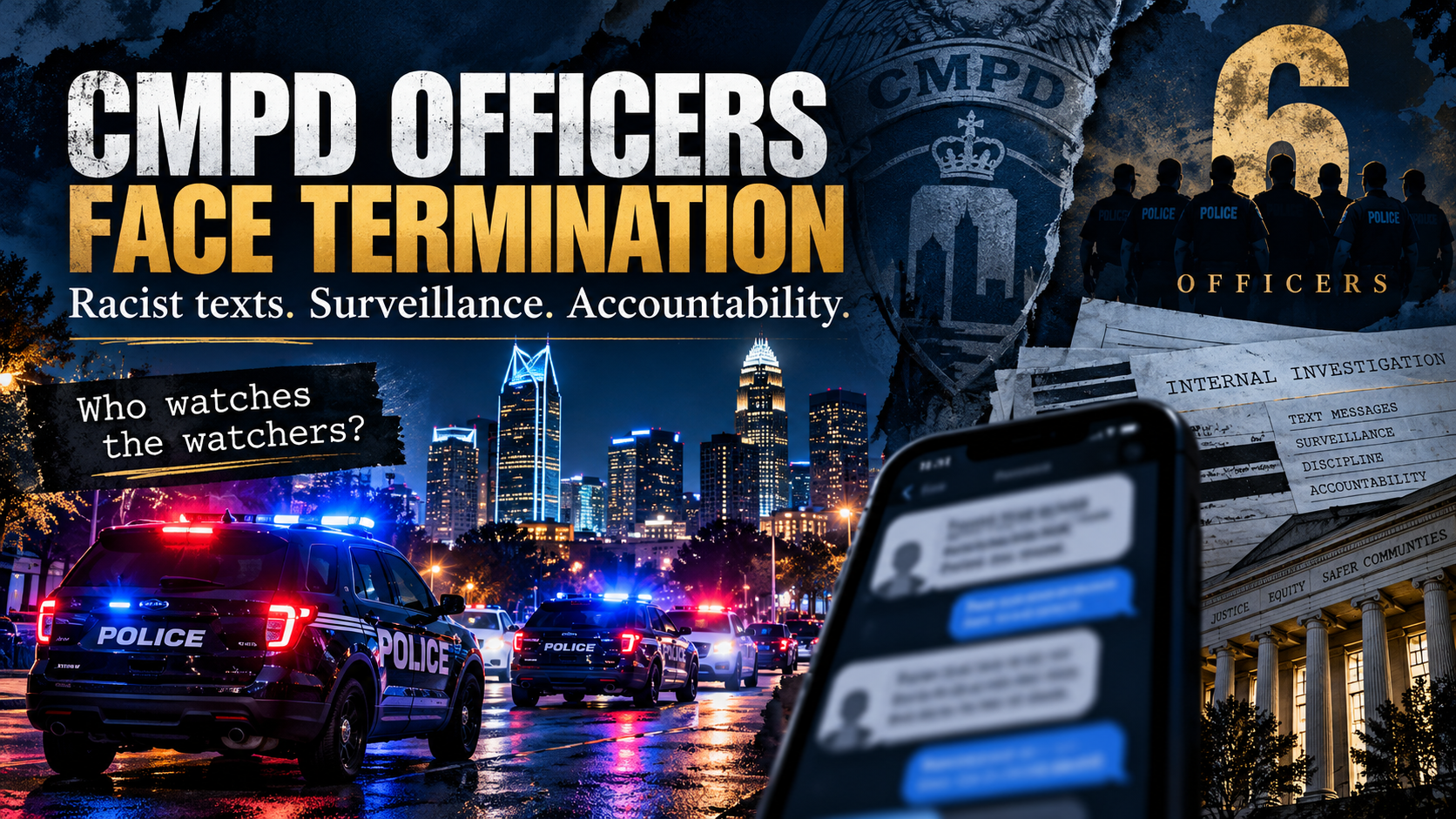
Six Charlotte police officers face termination over reported racist texts. The unanswered questions reach into criminal cases, surveillance access, state certification and the possibility of working at another department.
CHARLOTTE, NORTH CAROLINA | October 13, 2026 | Prison Project Newsroom
A developing investigation and practical guide to public records, officer certification and civilian oversight. Allegations are clearly distinguished from established actions.
Imagine being stopped by a police officer and later learning that officers in the same department allegedly discussed competing to pull over Black drivers. Was your own stop legitimate? Did the officer's assumptions affect what happened next? And if the officer later resigned, could another police agency hire that person?
These are not questions with established answers in every case. They are questions raised by an unfolding investigation involving the Charlotte-Mecklenburg Police Department (CMPD). On October 12, 2026, WBTV investigative reporter David Hodges reported that officers exchanged messages containing racist language and alleged discussion of a contest over stopping Black motorists. By October 13, WBTV reported that six officers had been cited for termination and others had resigned. WBT reported the six were suspended without pay. The identities and precise conduct of every participant have not been independently established publicly.
Even a final dismissal, however, would not settle every question. Officers make arrests, write reports, testify, and gain access to sensitive data. Responsibility may involve separate employment proceedings, state certification review, criminal prosecutions, and decisions about past cases.
1. What the reported messages said, and what is not yet proven
WBTV cited anonymous sources familiar with the inquiry who said officers used repeated racial slurs, referred to violence against Black residents, and discussed competing to stop the most Black drivers. WSOC-TV separately reported that sources described messages likening the conversation to a Ku Klux Klan gathering. WSOC expressly said it had not independently confirmed the alleged competition over stopping drivers.
WBTV reported participants came from the North Tryon, Freedom, and University City divisions. WSOC reported that one implicated officer had previously served as president of a recruit class and another received an employee-of-the-month award. The station also reported the officers under scrutiny represented more than one race. None of those details establishes that every participant sent the same messages or engaged in unlawful stops.
The central distinction is between speech, administrative misconduct, and conduct on the street. Reported hateful speech is a serious reason for investigators to inspect work records, but proof of an unlawful traffic stop requires evidence about that encounter. Investigators should identify who authored each message, its date, any referenced incident or individual, the recipient list, the authenticity and completeness of the conversation, and whether policing records corroborate or contradict the claims.
CMPD, led by Chief Estella Patterson, issued a statement emphasizing professional standards and public trust, without confirming or denying the details reported about the texts. Its internal findings have not yet been made public in full.
2. The timeline: An unrelated surveillance investigation opens the door
One of the most consequential aspects of the story is how investigators reportedly found the messages. They were not initially exposed through a traffic-stop complaint. According to WBTV, they surfaced during an SBI investigation into CMPD officer Seth Elliott involving access to government information systems.
February 26, 2024: Elliott was hired by CMPD, according to the department's later statement, and assigned to the University City Division.
June 16, 2026: Investigators allege he improperly accessed Flock and CJLEADS information for a non-law-enforcement purpose.
June 18: The North Carolina State Bureau of Investigation notified CMPD of the suspected unauthorized access.
June 22: CMPD placed Elliott on paid administrative assignment and revoked his access to intelligence systems while the investigation proceeded.
July 29: SBI arrested Elliott on a misdemeanor charge of illegally accessing a government computer. CMPD placed him on unpaid administrative leave.
Before October 12: According to his attorney George Laughrun, Elliott had resigned from CMPD more than a month before WBTV's first racist-text report.
October 12: WBTV reported that investigators reviewing information obtained from Elliott's phone encountered messages involving other CMPD officers, leading to an internal review.
October 13: WBTV reported six officers cited for termination and additional resignations. WBT reported six suspended without pay. Defense attorneys raised questions about affected prosecutions.
The dates and access allegations above come from CMPD's July 29 public statement. The phone-data discovery and resignations are attributed to WBTV's subsequent reporting. Elliott's charge is an allegation, and his case is distinct from the administrative allegations against others in the group conversation.
Why the Flock and CJLEADS connection matters
Flock systems can collect and make searchable automated license plate reader information, including plate and location-related observations. CJLEADS aggregates access to criminal justice data for authorized users. Such tools are intended for legitimate official work, not private favors or personal investigations.
WCCB reported an allegation that Elliott used those systems to identify an undercover investigator's vehicle at the request of a person involved in a drug investigation. That more specific account is an allegation from reporting, not a judicial finding. CMPD confirmed the narrower charge of non-law-enforcement access.
CMPD also said it does not own or operate the Flock cameras involved; rather, an agreement permits officers to access Flock cameras operated by other agencies or entities. That distinction points to records worth examining: authorization rules, search histories, identity verification, access logs, alerts, audit procedures, and what happens after an officer leaves employment.
Separately, the fact that downloaded phone data reportedly exposed a group conversation invites a supervision question: absent that unrelated investigation, what procedures would have identified the alleged misconduct? The public record does not answer it yet.
3. Could arrests, searches and convictions be affected?
Defense attorneys Brad Smith and Tim Emery told WBTV on October 13 that cases involving officers who participated in the thread deserved examination. Their stated concern was whether the reported messages could bear on officers' credibility, discriminatory enforcement, or the justification offered for a stop or search.
Under Brady v. Maryland and Giglio v. United States, prosecutors have constitutional obligations concerning material evidence favorable to defendants, including certain information bearing on the credibility of government witnesses. Those obligations are fact-specific. The existence of a troubling text message does not automatically reverse a conviction, dismiss a prosecution or prove a discriminatory stop.
According to WBTV, the office of Mecklenburg County District Attorney Spencer B. Merriweather III said that when internal police proceedings sustain violations, prosecutors must independently assess whether the facts reveal witness untruthfulness or bias disqualifying enough to affect their reliance on that officer. The office did not announce that all cases involving the officers would be dismissed.
Important questions remain: Which officers made stops, conducted searches or testified in pending and concluded cases? Were any involved in allegations of selective enforcement? Did any report inaccurately describe grounds for a stop? Have prosecutors evaluated disclosure duties? Will relevant defense counsel receive notice? Were body-camera recordings, dash-camera recordings, CAD logs and traffic-stop data preserved?
4. Community reaction: Public trust and institutional responsibility
Community advocate Robert Dawkins of Action NC told WBTV and WSOC that the apparent involvement of multiple officers raises broader questions about how departments identify shared misconduct. Charlotte City Council member Malcolm Graham publicly stressed the need for accountability while also expressing confidence in Chief Patterson. They did not independently verify the contents of every message; the stations attributed those allegations to sources.
The policy debate is not limited to punishment. It also involves training, supervision, internal reporting, independent review and data. A department needs the ability to perform lawful public-safety work. Residents need assurance that powers to stop, search, arrest and surveil are not being used on discriminatory or personal grounds. Neither objective is served by treating an unresolved allegation as a proven fact, or by treating resignation as proof that the investigation no longer matters.
5. Who actually oversees an officer? Five different accountability routes
There is no single board that simultaneously fires officers, revokes credentials, prosecutes crimes and reopens convictions. The relevant powers are divided:
CMPD Internal Affairs and independent chain-of-command review
Serious complaints can be investigated by Internal Affairs and considered by an independent chain-of-command review. CMPD publicly distinguishes findings such as sustained, not sustained, exonerated and unfounded. An internal outcome addresses employment rules but is not automatically a state certification or criminal-court determination. Read CMPD's complaint procedures.
Charlotte Civil Service Board: Final employment decisions
Charlotte's official guidance states that, for covered nonprobationary sworn officers, the chief recommends termination and the Civil Service Board makes the final employment determination after a hearing. It may approve or decline a recommended termination. It also hears certain suspension appeals. This is the relevant process for verifying whether a proposed firing actually became final.
Charlotte Citizens Review Board: Eligible public complaints
This is a different body. It reviews eligible citizen appeals of CMPD complaint dispositions, including arbitrary profiling, force, arrest/search/seizure and certain other allegations. Its role is principally advisory in the complaint-review framework. A complainant generally must act within the designated appeal period, commonly 30 days from notification, and should follow the instructions on the official decision. It is not the board that revokes an officer's state certification. Read Citizens Review Board information.
North Carolina Criminal Justice Standards Commission: Certification
The Criminal Justice Education and Training Standards Commission oversees certification of covered officers and can review qualifying potential rule violations. A resignation or job loss does not by itself establish decertification. The state may investigate qualifying allegations arising through agency reports, criminal matters, complaints or other credible evidence, subject to applicable procedures and due process.
Prosecutors and courts: Cases and criminal liability
Prosecutors independently decide how evidence of alleged misconduct affects criminal proceedings and whether charges are legally supportable. Courts adjudicate disputes, legal remedies and criminal allegations. Citizens may report documented potential criminal conduct to appropriate authorities, but may not themselves direct a prosecution or declare a verdict.
6. Can officers resign, then work somewhere else?
It is possible for a former officer to seek employment elsewhere, but several safeguards may apply. The first step is not a guess about where an officer went. It is verifying the final employment record, the state certification status, and any disqualifying finding.
A separation report: Form F-5B
North Carolina's Criminal Justice Standards Division uses an F-5B Affidavit of Separation. Its 2026 form instructs an agency to submit it no later than ten days after final separation. The form asks why the officer left, whether the agency knows of allegations of potential criminal activity or misconduct in the past 18 months, and whether the agency knows of substantiated allegations of untruthfulness. Affirmative answers require explanation. The report may contain confidential information and should not be assumed to be publicly accessible in full.
For Charlotte, a concrete oversight question is whether required reports were submitted for all departing certified officers, and whether the agency reported what it knew at the time. An independent standards review can continue to matter after a resignation.
A 2025 law requiring recent personnel-file review
Under G.S. § 17C-10.2, a North Carolina law enforcement agency considering someone for a sworn position must request and review the applicant's complete personnel files from North Carolina law enforcement agencies that employed the person during any part of the preceding five years. With a signed applicant release, former employers are to provide access. A parallel law, § 17E-7.1, governs qualifying sheriff hiring decisions.
The safeguards have limits: a five-year lookback is not an unlimited employment history; records maintained outside North Carolina may need different processes; and reviewing a concerning file does not automatically bar hiring. The public can ask agencies how they comply without demanding release of confidential personnel files.
The National Decertification Index
The International Association of Directors of Law Enforcement Standards and Training maintains a National Decertification Index for authorized standards and law enforcement users. It can alert hiring and certification agencies to qualifying reported actions. It is not an open public list of every complaint, resignation or investigation, and entries do not themselves create an automatic nationwide ban.
North Carolina's special witness-credibility reporting law
G.S. § 17C-16 requires reporting when a covered officer receives a qualifying formal notification that they may not be called to testify because of bias, interest or lack of credibility. Certain notices from specified judges, prosecutors or agency heads trigger duties, generally within 30 days, subject to the statute's hearing provisions. Transfer-related notification obligations may also apply. The underlying reports are not public records. The law does not automatically apply to every allegation or every officer named in a news story.
7. Citizen action guide: What you can do today
There are practical, lawful ways to examine officer accountability. They work best when requests are precise, evidence is preserved and reported allegations are not presented as established findings.
ACTION 1 — Verify state certification
Use the North Carolina Officer Certification Search. It distinguishes active, inactive, suspended, revoked and surrendered status. Inactive status may merely reflect a separation; some suspensions are for training deficiencies. Record the date and confirm identity before sharing a match.
ACTION 2 — Report documented concerns to state standards investigators
Contact the Criminal Justice Standards Division. Its published directory lists Thomas Hopkins, Deputy Director, (919) 779-8204, thopkins@ncdoj.gov. Ask whether the relevant allegations and separations fall within the state's certification-review responsibilities; supply dates, article links and firsthand records if available. Do not demand a predetermined outcome.
ACTION 3 — Request public employment and board records
Use the City of Charlotte Public Records Portal or email PublicRecordsRequest@charlottenc.gov. North Carolina G.S. § 160A-168 makes specified employment information public, including disciplinary action dates and, after a final disciplinary dismissal, the written final decision specifying the basis. The entire personnel file is not automatically public. Charlotte accepts anonymous requests, but material a requester supplies may be publicly disclosed.
ACTION 4 — File an eligible CMPD complaint
Use CMPD's complaint instructions. A person who experienced or witnessed alleged misconduct should supply a clear chronology, officer ID if known, evidence and a requested response. Eligible complainants may have a separate Citizens Review Board appeal route and deadline. Preserve every acknowledgment and decision.
ACTION 5 — Ask how prosecutors are reviewing affected cases
Contact the Mecklenburg County District Attorney's Office, led by Spencer Merriweather, at (704) 686-0700 or 700 East Trade Street, Charlotte, NC 28202. Ask generally what disclosure and case-review process is being used; defendants should contact their own lawyers for case-specific matters. Media requests can go to michael.j.stolp@nccourts.org.
ACTION 6 — Track later, verified employment
After names and final outcomes are publicly verified, check certification status and lawful public employment records periodically. Ask a new employing agency how it completed required screening, without seeking private home information or harassing individuals. A job change and a decertification are different events.
8. Follow the data: Public databases that can expose patterns
The January 2026 Prison Policy Initiative resource roundup highlighted a growing field of independently compiled police records. Their usefulness lies not in declaring guilt by database entry, but in finding questions and original documents that can be checked.
Open Data Policing — Stops and searches
Open Data Policing: North Carolina lists more than 33 million state traffic stops since 2002, with reported information on agencies, driver race, stops, searches and officer identifiers where available. It does not disclose officer names or driver names. To examine potential patterns related to this case, an investigator would first need to reliably connect officers to database IDs using lawful independent records and then consider assignments, location, reasons for stops and reporting limits. A disparity is a lead to examine, not proof of an unlawful stop.
National Police Index — Employment history
The National Police Index, North Carolina compiles historical employment and certification-related records extending back decades. Its public North Carolina page says the data were last updated in August 2023. It therefore cannot establish where an officer departing CMPD in October 2026 now works. Use it as historical context and corroborate with current state records.
Examples from other states
Other models include the Louisiana Law Enforcement Accountability Database, California's Police Records Access Project, Chicago's Civic Police Data Project, and the Legal Aid Society's New York Law Enforcement Look Up. Different projects contain different categories of officer complaints, disciplinary results, force incidents, legal settlements and employment history; their geographic and historical coverage varies. These are examples of approaches that can be adapted, not proof that Charlotte officer records are present in every dataset.
A how-to guide for community groups and defense lawyers
The National Association of Criminal Defense Lawyers' Full Disclosure Project explains how to plan requests, find source records and maintain a structured, evidence-based misconduct database. It also addresses organizational and verification practices suitable for community groups with limited resources.
9. Two ready-to-send accountability requests
These are models, not messages Prison Project has already sent. Replace the signature and edit the questions to match your purpose. Keep a copy of what you send.
Letter A: State certification-review inquiry
To: thopkins@ncdoj.gov
Subject: Certification oversight inquiry: CMPD October 2026 misconduct allegations
Dear Criminal Justice Standards Division:
I am requesting information about your general certification-oversight procedures as they apply to recent reporting on racist communications involving Charlotte-Mecklenburg Police Department officers. Media reports say six officers have been cited for termination and others resigned.
Can the Division explain: (1) how relevant misconduct allegations reach certification investigators; (2) whether review may continue when an officer resigns; (3) the F-5B separation-reporting requirements; (4) how subsequent employers learn of qualifying findings or sanctions; and (5) what certification outcomes the public can verify?
I recognize that confidential records and pending proceedings may limit case-specific disclosures. I am asking for an accurate explanation of the review process, not a predetermined finding about any individual.
Thank you,
[Name / organization]
Letter B: City of Charlotte records request
To: PublicRecordsRequest@charlottenc.gov
Subject: Request for public CMPD disciplinary and oversight records, October 2026
Dear Public Records Office:
Under North Carolina Chapter 132 and the public-information provisions of G.S. § 160A-168, please provide existing nonexempt records concerning the October 2026 CMPD investigation into alleged racist officer messages, specifically:
- Publicly available dates and types of suspension, resignation, separation or disciplinary dismissal of officers connected to the inquiry, where identifiable in public records.
- Written final disciplinary dismissal decisions and specific reasons, to the extent made public by G.S. § 160A-168.
- Public Civil Service Board dates, agendas and final decisions associated with the matter.
- Existing public policies governing internal complaint reviews, officer separations and employee access to shared law enforcement data systems.
- Any existing aggregate reports describing the number and type of related employment actions.
Please provide records electronically. If a record is withheld, identify the legal basis and provide nonexempt portions where reasonably possible. If a final decision does not yet exist, please state that.
Thank you,
[Name / organization]
10. The questions still awaiting answers
- Who? Which officers authored, received, endorsed or reported the messages? Names of all six have not been established in the records reviewed here.
- What? What do the complete authenticated messages say, including any dates and references to real policing incidents?
- When? How long did the conversations continue, and when did supervisors and investigators learn about them?
- On the street? Was any real traffic enforcement connected to a reported competition or discriminatory motive?
- In court? Which pending or completed criminal cases rely on an implicated officer, and what disclosure duties apply?
- Employment? Did all proposed terminations become final after Civil Service Board processes?
- Certification? Were relevant F-5B reports and certification referrals made, and are any state sanctions imposed?
- Surveillance? Which controls detected the alleged Flock/CJLEADS misuse, and have access and audit policies changed?
- Public confidence? What publicly verifiable results will officials provide after the investigations conclude?
Accountability should not end when an officer turns in a badge.
A lawful investigation must preserve the rights of accused officers and the public alike. But a resignation, suspension or firing answers only part of the question. Certification status, past prosecutions, surveillance access, required disclosures and any subsequent employment deserve separate, evidence-based scrutiny.
Sources, original reporting and public tools
The allegations about the content of the messages are attributed to journalists' sources, not an independently obtained full transcript. Official statutory language and agency procedures are linked separately below.
- WBTV, David Hodges, original investigation, October 12, 2026.
- WBTV, David Hodges, criminal-case implications, October 13, 2026.
- WBTV, Katy Solt, community and City Council reactions, October 13, 2026.
- WSOC-TV, Hunter Sáenz, October 13, 2026.
- WBT, Brett Jensen, suspensions and disciplinary status, October 13, 2026.
- CMPD official statement concerning Seth Elliott, July 29, 2026.
- CMPD complaint and Civil Service Board procedures.
- North Carolina public officer certification search and Criminal Justice Standards contact directory.
- Criminal Justice Standards forms, including F-5B Affidavit of Separation.
- North Carolina G.S. § 17C-10.2 and § 17E-7.1, previous personnel file review.
- North Carolina G.S. § 17C-16, qualifying witness-credibility notification reporting.
- North Carolina G.S. § 160A-168, city personnel public-information rules; Charlotte public records portal.
- Open Data Policing: North Carolina; National Police Index: North Carolina.
- NACDL Full Disclosure Project: Getting Started Tracking Police Misconduct.
- Mecklenburg County District Attorney's Office.