 Georgia Appellate Writing Explained
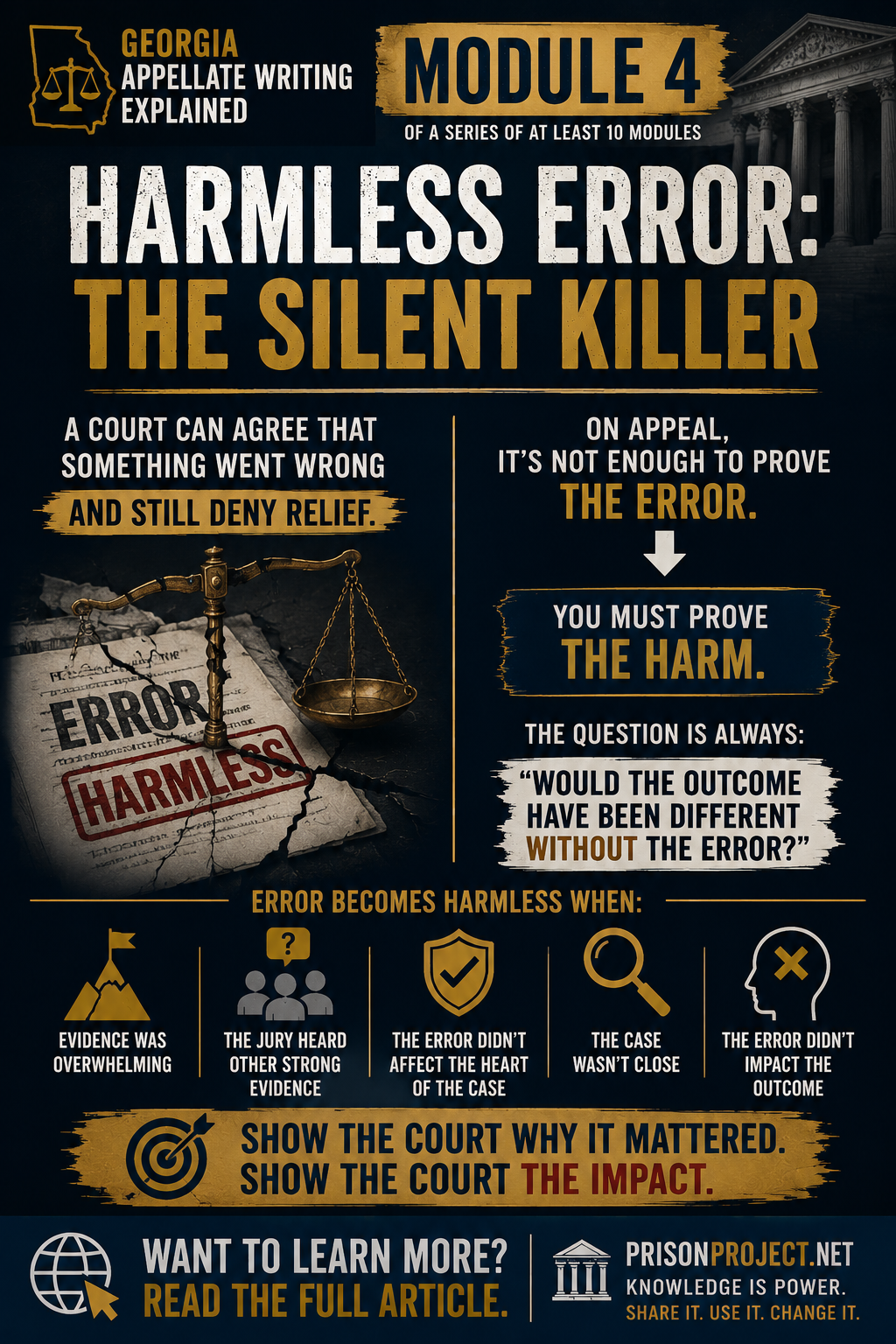
Module 4 — Harmless Error: The Silent Killer
One of the hardest truths in appellate law is this:
A court can agree that something went wrong and still deny relief.
That is harmless error.
Harmless error means the appellate court found a legal mistake, but decided the mistake did not affect the outcome enough to reverse the conviction, sentence, or ruling.
In plain English:
The error was real.
But the court says it did not matter enough.
This is one of the biggest reasons appeals fail.
Why Error Alone Is Usually Not Enough
Many people believe that once they prove the trial court made a mistake, the appeal should be won.
That is not how appellate courts usually work.
Most appellate arguments require two showings:
First:
The trial court committed legal error.
Second:
That error harmed the defense or affected the outcome.
This second part is called prejudice.
Without prejudice, many errors become harmless.
What Courts Look At
When deciding whether an error was harmless, appellate courts may ask:
- Was the evidence against the defendant overwhelming?
- Did the error affect the main issue in the case?
- Did the jury hear other evidence that made the mistake less important?
- Did the defense still get to present its theory?
- Did the prosecutor rely on the error during closing argument?
- Did the jury seem confused?
- Was the case close?
- Could the outcome have been different without the error?
The stronger the State’s case looks, the easier it is for the court to call an error harmless.
The closer the case looks, the stronger the prejudice argument becomes.
Why Harmless Error Is So Dangerous
Harmless error is dangerous because it allows courts to say:
“Yes, there was a mistake.
But we are not reversing.”
That means the fight is not only about proving something went wrong.
The real fight is proving the mistake mattered.
This is where many pro se litigants, families, and even some lawyers lose the thread.
They focus all their energy on proving misconduct or error.
But they do not explain how that error changed the trial.
What Makes an Error Prejudicial?
An error is more likely to matter when it affects the heart of the case.
Examples may include:
- evidence that should not have been admitted
- defense evidence that was wrongly excluded
- improper jury instructions
- limits on cross-examination
- prosecutorial misconduct during closing argument
- constitutional violations
- errors affecting witness credibility
- mistakes that weakened the defense theory
- errors that made the State’s case look stronger than it was
The question is not just:
Was it wrong?
The question is:
How did it damage the fairness of the proceeding?
Signs of a Close Case
A close case can make a prejudice argument stronger.
Signs of a close case may include:
- long jury deliberations
- jury questions during deliberation
- requests to rehear testimony
- conflicting witness testimony
- weak physical evidence
- credibility problems with key witnesses
- acquittals on some counts
- a prior hung jury
- heavy reliance on one witness
- a defense theory that had real support in the record
These details matter because they show the outcome was not automatic.
If the case was close, one legal error may have changed everything.
The Trial That Happened vs. The Trial That Should Have Happened
One powerful way to understand prejudice is to compare two versions of the trial.
Version one:
The trial that actually happened.
Version two:
The trial that should have happened without the legal error.
Ask:
- What did the jury hear that it should not have heard?
- What did the jury not hear that it should have heard?
- Did the error change how the jury viewed the evidence?
- Did the error damage the defense theory?
- Did the error make the State’s case look cleaner, stronger, or more reliable than it really was?
This comparison helps explain why the error mattered.
Not All Errors Are Treated the Same
Some errors are more serious than others.
Some errors affect basic constitutional protections.
Some errors affect the structure of the trial itself.
Some errors may require a stronger harmless-error analysis.
But most appellate claims still require the appellant to explain harm clearly.
That is why appellate writing must address prejudice directly.
Do not assume the court will see the harm on its own.
Make it plain.
The Mistake Families Often Make
Families often say:
“But the judge was wrong.”
“But the prosecutor lied.”
“But the lawyer failed.”
“But the evidence should not have come in.”
“But the jury never heard the truth.”
Those points may matter.
But on appeal, the next question is always:
What difference did it make?
That question is not emotional.
It is legal.
And if the appellate brief does not answer it, the court may call the error harmless.
How to Build a Strong Prejudice Argument
A strong prejudice argument should explain:
- what the error was
- where it appears in the record
- how it affected the defense
- how it helped the prosecution
- why the case was close
- why the outcome could have been different
- why the court should not dismiss the error as harmless
This is where structure matters.
A strong appeal does not just say:
“This was unfair.”
It says:
“This error changed the way the jury saw the case, and there is a reasonable basis to believe the outcome may have been different without it.”
Why This Module Matters
Harmless error is one of the most important concepts in appellate law.
It explains why many appeals lose even when real mistakes occurred.
It also teaches a critical lesson:
Do not stop at error.
Show harm.
Show impact.
Show why the mistake mattered.
Final Thought
The appellate court may agree that the trial was flawed.
That alone may not be enough.
The question becomes whether the flaw affected the result.
That is why prejudice is not a side issue.
It is often the heart of the appeal.
In appellate litigation, the most dangerous words may be:
“Any error was harmless.”
The strongest advocates are the ones who know how to answer those words with the record.
Comments