
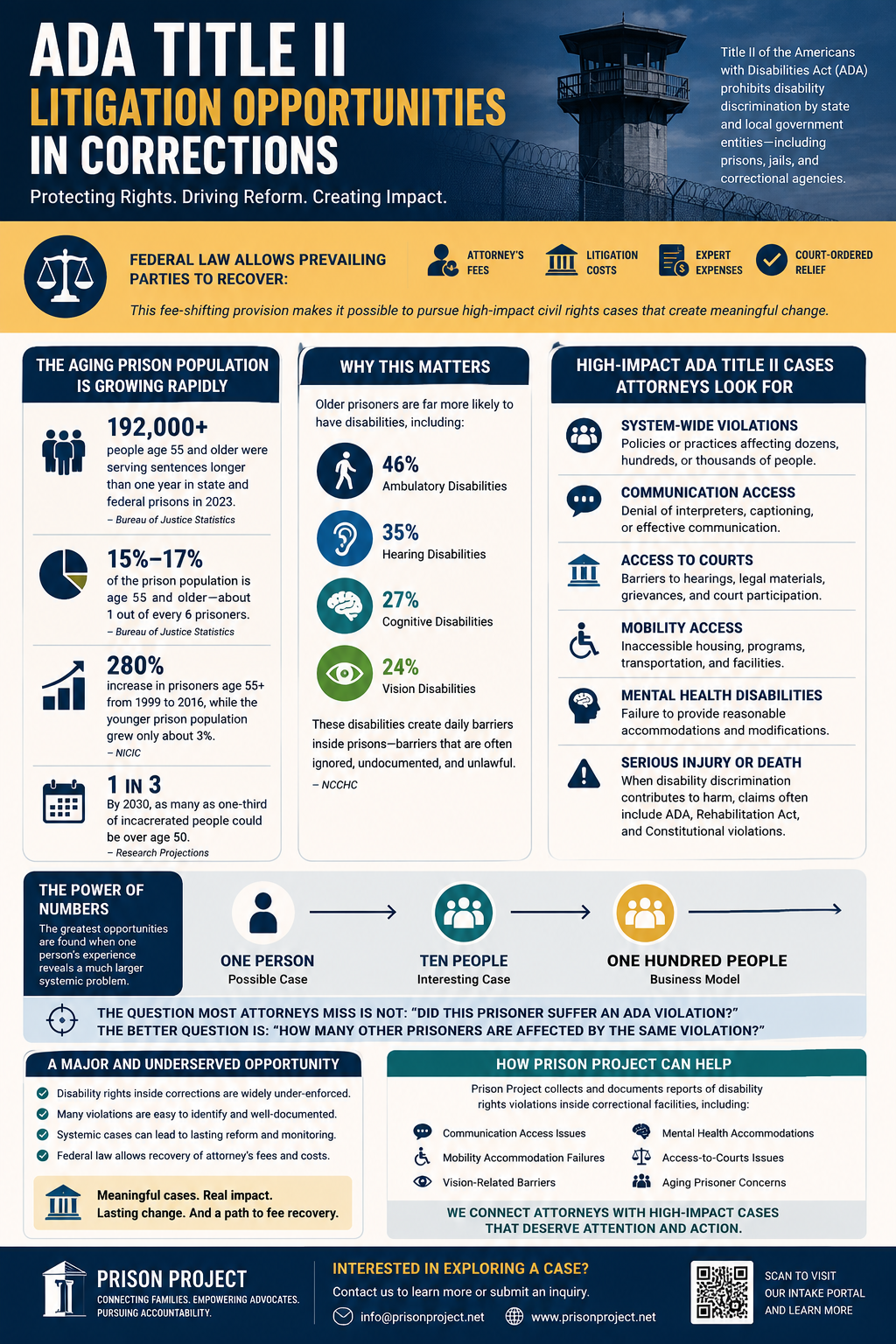
 ADA Title II Litigation Opportunities in Corrections
An Untapped Area of Civil Rights Enforcement
Every day, incarcerated people with disabilities are denied access to programs, services, communication, housing, education, medical care, grievance procedures, and court processes. Many of these violations go unchallenged, not because they lack merit, but because few attorneys actively screen correctional cases through an ADA Title II lens.
Prison Project is working to identify and document potential disability-rights violations occurring in correctional facilities across Georgia and beyond.
For attorneys interested in civil-rights litigation, prison ADA cases may present opportunities for meaningful impact, systemic reform, and recovery of attorney's fees under federal law.
Why Corrections Matter
Most attorneys understand that the ADA applies to government agencies. Fewer realize that state prisons, county jails, probation departments, parole agencies, courts, and sheriff's offices are generally subject to Title II of the Americans with Disabilities Act.
The incarcerated population contains a disproportionately high percentage of individuals with:
- Mobility impairments
- Vision impairments
- Hearing impairments
- Cognitive disabilities
- Serious mental illness
- Chronic medical conditions
- Developmental disabilities
Yet disability accommodations inside correctional systems often receive little scrutiny.
The Growing Opportunity
America's prison population is aging rapidly.
Today, hundreds of thousands of incarcerated individuals are age 55 and older. This population experiences significantly higher rates of:
- Mobility limitations
- Hearing loss
- Vision impairment
- Cognitive decline
- Dementia-related conditions
- Chronic disease
- Multiple concurrent disabilities
As correctional populations continue to age, disability-related litigation is expected to become an increasingly important area of civil-rights enforcement.
For attorneys seeking meaningful cases with long-term impact, the aging prison population presents a largely underserved area of practice.
Areas Frequently Overlooked
Communication Access
Potential issues include:
- Deaf prisoners denied interpreters
- Lack of captioning or communication devices
- Inability to communicate with medical staff
- Disciplinary proceedings conducted without accommodations
- Denial of access to educational or rehabilitative programming
Vision Impairment
Potential issues include:
- Lack of accessible grievance procedures
- Inaccessible legal materials
- Failure to provide large-print or alternative-format documents
- Barriers to educational programming
Mobility Disabilities
Potential issues include:
- Inaccessible housing units
- Lack of wheelchair-accessible showers or toilets
- Exclusion from prison programs
- Transportation barriers
- Failure to accommodate mobility devices
Mental Health Disabilities
Potential issues include:
- Disability-related disciplinary actions
- Failure to provide reasonable modifications
- Exclusion from programs and services
- Barriers to treatment access
Access to Courts and Legal Processes
Potential issues include:
- Inability to participate in hearings
- Lack of effective communication accommodations
- Barriers to legal research and legal materials
- Inaccessible grievance systems
Where High-Impact Cases Often Develop
While individual accommodation disputes may present valid claims, the most significant correctional ADA cases often involve patterns affecting multiple individuals.
Examples include:
- Facility-wide communication failures
- Systemic denial of accessible housing
- Prison-wide barriers to grievance systems
- Classification policies affecting disabled prisoners
- Statewide practices impacting entire categories of incarcerated individuals
These cases can lead to meaningful institutional reform while protecting the rights of large numbers of people.
Understanding the Economics of ADA Litigation
One of the most misunderstood aspects of ADA Title II litigation is how these cases are funded.
Federal law allows prevailing parties to seek recovery of reasonable attorney's fees and litigation expenses. This fee-shifting structure exists because Congress recognized that civil-rights violations often go unchallenged when individuals lack the resources to hire counsel.
As a result, attorneys who successfully litigate ADA cases may recover:
- Attorney's fees
- Litigation costs
- Expert expenses where permitted
- Court-awarded relief
- Settlement-based fee recovery
The largest correctional ADA cases are often those involving:
- Multiple affected individuals
- Facility-wide policies
- Statewide practices
- Communication-access failures
- Accessible housing deficiencies
- Program-access exclusions
- Systemic barriers affecting disabled populations
The Question Most Attorneys Miss
Many legal screenings begin with:
"Did this prisoner suffer an ADA violation?"
A more valuable question is often:
"How many other prisoners are affected by the same ADA violation?"
When a disability-related barrier affects dozens, hundreds, or even thousands of incarcerated individuals, a single complaint may reveal a larger systemic issue requiring institutional reform.
Those are often the cases that produce the greatest impact for incarcerated individuals and the greatest opportunity for meaningful civil-rights litigation.
How Prison Project Can Help
Prison Project receives reports from incarcerated individuals, family members, advocates, and community members regarding conditions inside correctional facilities.
We are developing a database of potential disability-rights concerns, including:
- Communication access issues
- Mobility accommodation failures
- Vision-related barriers
- Mental health accommodation concerns
- Access-to-courts issues
- Program-access exclusions
- Aging prisoner accommodation failures
Attorneys interested in reviewing potential ADA Title II matters are encouraged to contact us.
Together, we can identify overlooked violations, improve accountability, and expand access to justice for incarcerated individuals with disabilities.
Contact: info@prisonproject.net
PrisonProject.net
Connecting Families. Empowering Advocates. Pursuing Accountability.
Comments