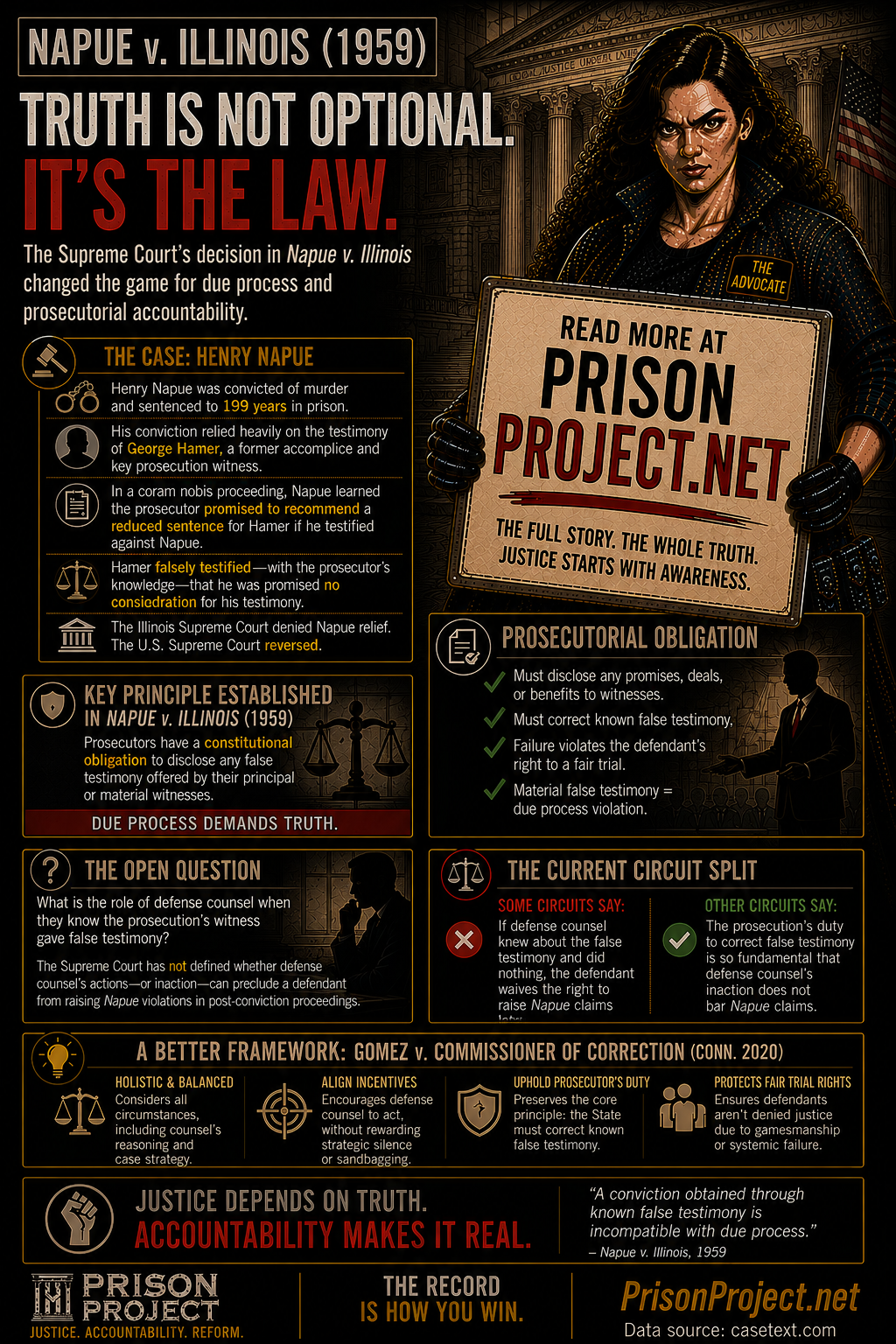
Henry Napue was convicted of murder and sentenced to 199 years imprisonment. His conviction was heavily influenced by the testimony of his former accomplice—and the prosecution’s key witness—George Hamer. Napue filed a post-conviction petition after learning that, in a coram nobis proceeding, the prosecutor promised to recommend a reduction in Hamer’s sentence if Hamer testified against Napue. Napue alleged that Hamer, with the prosecutor’s knowledge, falsely testified that he had been promised no consideration for his testimony during the original trial. The Illinois Supreme Court, however, denied Napue relief.
But the Supreme Court of the United States reversed. To protect the due process rights of defendants who are convicted because of material incriminating false testimony, the Supreme Court, in Napue v. Illinois (1959) and its progeny, established a prosecutorial obligation. Prosecutors are now required to disclose any false testimony offered by their principal or material witnesses during trial.
However, the Court has yet to define the scope of defense counsel’s role in cases where defense counsel knows the prosecution’s witness gave false testimony at trial. More specifically, it remains an open question whether the defense’s conduct in such circumstances—or lack thereof—precludes the defendant from alleging Napue violations in post-conviction proceedings. This Essay argues that Gomez v. Commissioner of Correction (Conn. 2020) provides an appropriate, holistic framework for determining when defense counsel should be precluded from raising Napue arguments in post-conviction proceedings.
In Part I, this Essay begins by tracing the evolution of the prosecutorial obligation since Napue. Part II describes the current circuit split on whether defendants waive their right to bring Napue violations in post-conviction proceedings when the defense counsel knew about the false testimony in the original trial. Finally, Part III argues in favor of Gomez’s approach for balancing defense counsel’s incentives against the prosecution’s obligations to correct known false testimony at a criminal trial so as to adequately protect a criminal defendant’s right to a fair trial.
This is an excerpt from a more in-depth discussion here, from the University of Chicago law School.
Comments