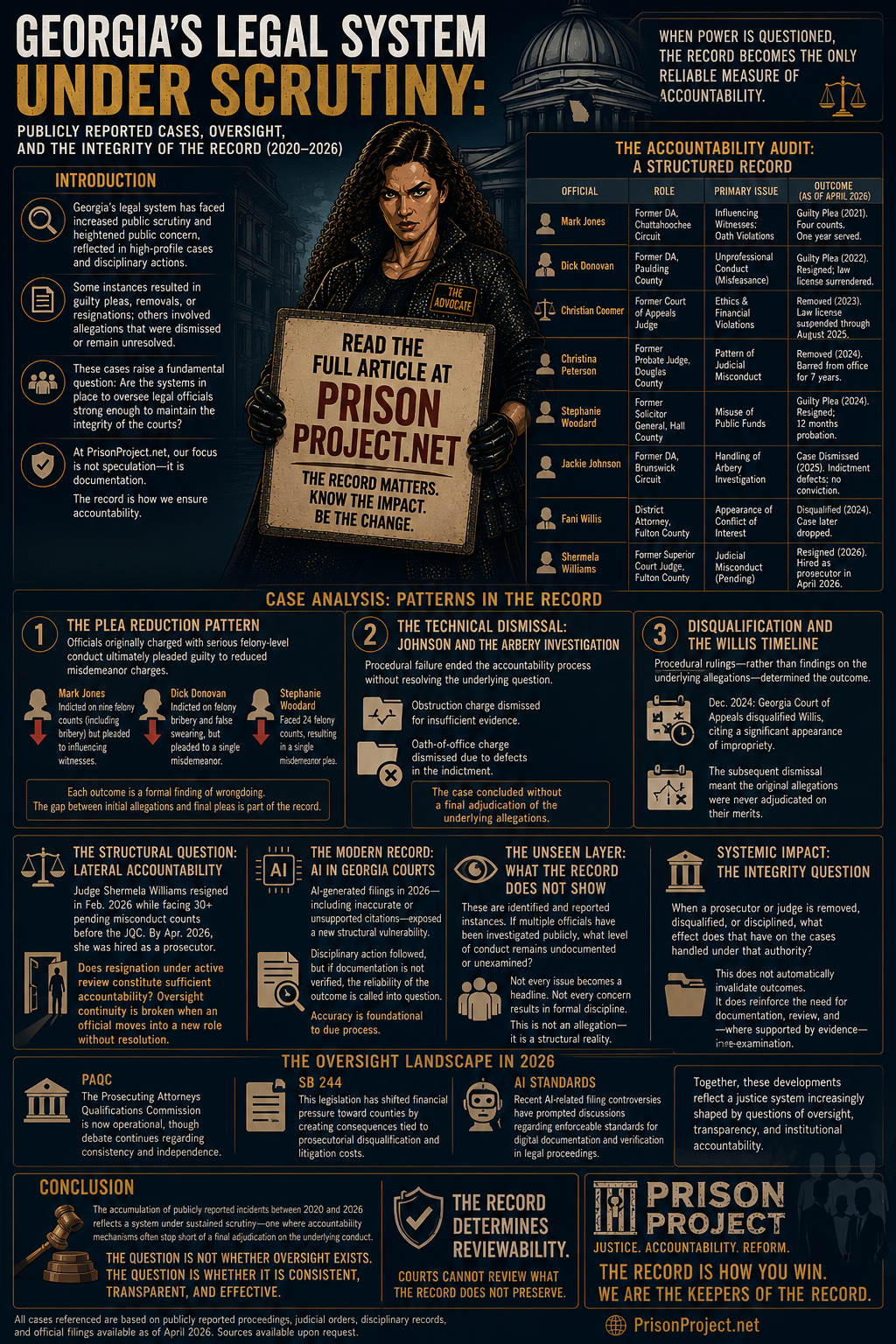
 Georgia’s Legal System Under Scrutiny:
Publicly Reported Cases, Discipline, and the Integrity of the Record (2020–2026)
Introduction
Over the past several years, Georgia’s legal system has faced increased public scrutiny and a measurable decline in public confidence, reflected in high-profile cases and disciplinary actions involving prosecutors, judges, and other legal officials. Some instances resulted in guilty pleas, removals, or resignations. Others involved allegations that were dismissed or remain unresolved.
At PrisonProject.net, the focus is not speculation. It is documentation.
Taken together, these cases raise a broader question: Are the systems in place to oversee legal officials strong enough to maintain the integrity of the courts?
When the exercise of power is questioned, or found to be improperly exercised, the record becomes the only reliable measure of accountability.
The Accountability Audit: A Structured Record
Mark Jones
Former District Attorney
Primary Issue: Bribery and improper influence
Status as of 2026: Guilty plea. Served prison time.
Christina Peterson
Former Judge
Primary Issue: Misconduct and abuse of authority
Status as of 2026: Removed from office and barred for seven years.
Christian Coomer
Former Appeals Judge
Primary Issue: Ethics and financial violations
Status as of 2026: Removed and professionally disciplined.
Stephanie Woodard
Former Solicitor General
Primary Issue: Handling of public funds
Status as of 2026: Guilty plea entered in 2024.
Dick Donovan
Former District Attorney
Primary Issue: False statements
Status as of 2026: Guilty plea and surrender of law license.
Jackie Johnson
Former District Attorney
Primary Issue: Handling of the Ahmaud Arbery investigation
Status as of 2026: Charges dismissed in 2025. No conviction.
Fani Willis
District Attorney
Primary Issue: Appearance of conflict
Status as of 2026: Disqualified. Ruling upheld on appeal.
Shermela Williams
Former Judge and Prosecutor
Primary Issue: Pending misconduct matter
Status as of 2026: Resigned as judge and later hired as prosecutor.
Case Analysis: Modern Challenges to the Record
The Reliability of Legal Filings
Reporting from 2024 and 2025 involving an Assistant District Attorney in Clayton County filing court documents containing inaccurate citations generated by artificial intelligence introduced a new concern into the legal system: inaccurate or unverified legal content entering the official record.
When the documentation in a case is compromised by lack of human oversight, the reliability of the judicial process itself comes into question. Courts rely on the accuracy of filings, citations, and representations made by officers of the court. If those materials are unreliable, confidence in the outcome becomes harder to maintain.
Lateral Accountability
The case of Shermela Williams raised public debate about what some observers describe as “lateral accountability.”
Williams resigned while facing a pending judicial misconduct matter and later re-entered the legal system as a prosecutor in 2026. The situation prompted broader questions about whether resignation effectively pauses or ends oversight proceedings and whether officials can move between positions within the legal system without a final adjudication of reported concerns.
The Unseen Layer: What the Record Does Not Show
The cases documented here involve publicly identified allegations, disciplinary actions, removals, disqualifications, resignations, or criminal proceedings connected to legal officials in Georgia.
They also raise a broader question:
If multiple high-level officials have been publicly investigated, disciplined, removed, disqualified, or criminally charged, what conduct remains undocumented, unreported, or unexamined?
Not every issue becomes a headline.
Not every concern results in formal discipline.
Not every error is preserved in a way that allows meaningful review.
The absence of a finding is not always the absence of a problem.
That is a structural reality in any system where oversight is reactive, investigations are selective, and visibility depends heavily on documentation.
The integrity of the legal system depends not only on correcting known failures, but on ensuring that unknown failures can be identified, preserved, and examined when necessary.
Systemic Impact: The Integrity Question
When a prosecutor or judge is removed, disqualified, or disciplined, an unavoidable question follows:
What impact does that have on the cases handled under that authority?
Legal systems depend on confidence in the integrity of the process. When that integrity is questioned, the effect is not necessarily limited to a single case. Concerns may extend to prior decisions, office practices, disclosure obligations, charging decisions, or the reliability of the official record itself.
This does not automatically invalidate prior outcomes. It does, however, reinforce the importance of documentation, preservation of the record, and meaningful review where appropriate.
Accountability is not only about the official involved. It is also about the integrity of the cases connected to that office.
The Oversight Landscape in 2026
Georgia’s oversight systems continue to evolve.
The Prosecuting Attorneys Qualifications Commission (PAQC) is now operational. Its existence has generated debate about how consistently and independently it will function in practice.
Fiscal accountability mechanisms connected to legislation such as SB 244 have also shifted financial pressure toward counties, creating indirect pressure for institutional accountability when misconduct or major legal failures occur.
Meanwhile, the Judicial Qualifications Commission (JQC) continues to serve as the state’s primary mechanism for judicial discipline. The removals of officials such as Christina Peterson and Christian Coomer demonstrate the commission’s continuing role in responding to ethical violations within the judiciary.
Conclusion
Georgia’s legal system is not defined by any single case.
But the accumulation of publicly reported cases between 2020 and 2026 reflects a system operating under sustained scrutiny and growing public examination.
The question is not whether oversight exists.
The question is whether oversight is consistent, transparent, and effective.
Because when accountability depends on visibility, and visibility depends on documentation, the record becomes the most reliable measure of institutional integrity.
The record is how you win.
We are the keepers of the record.
Comments