
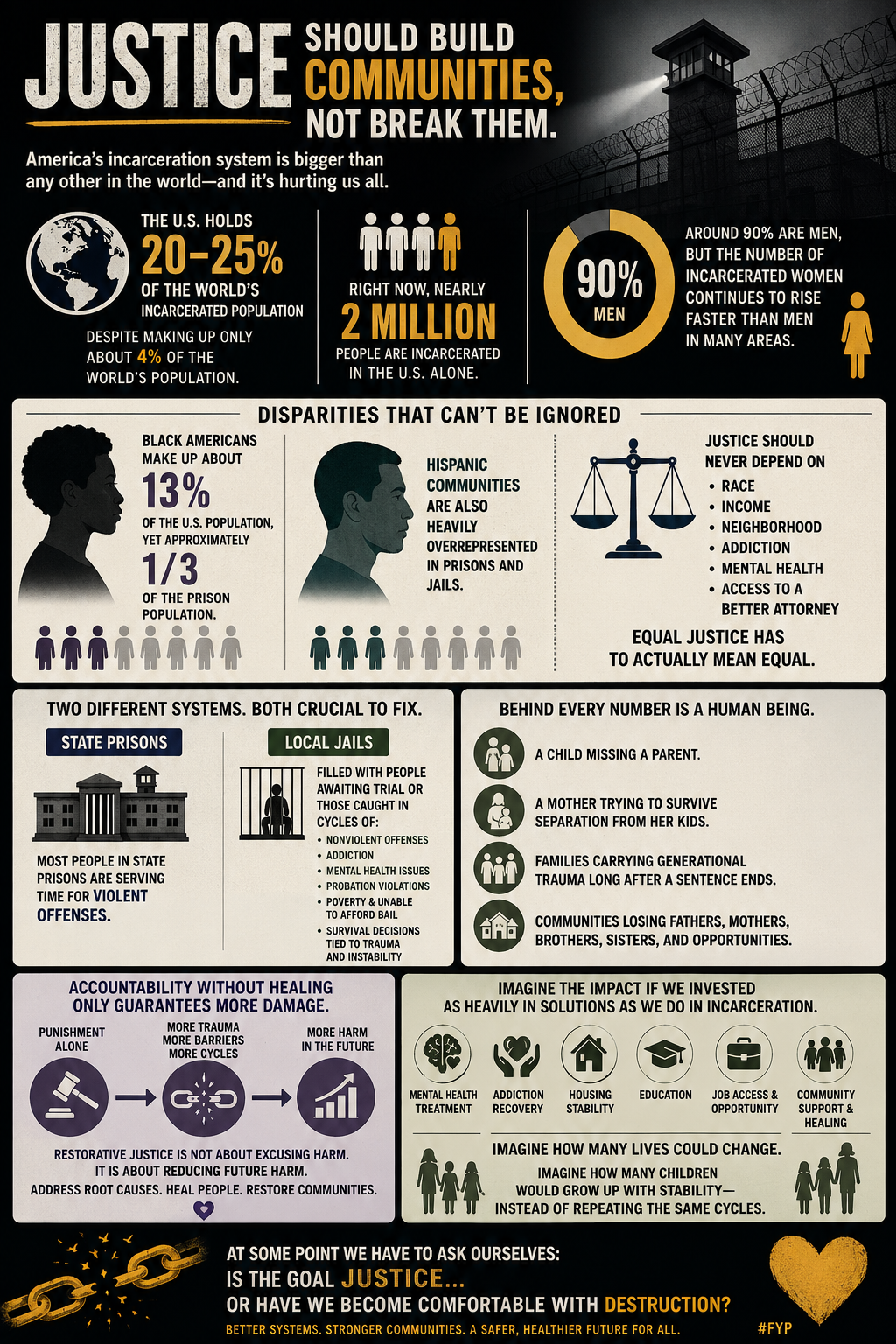
 The United States holds roughly 20–25% of the world’s incarcerated population despite making up only about 4% of the world’s population. Think about that for a second.
Right now, nearly 2 million people are incarcerated in the U.S. Around 90% are men, but the incarceration rate for women continues to rise in many areas. Black Americans make up about 13% of the U.S. population, yet roughly one-third of the prison population. Hispanic communities are also heavily overrepresented.
Most people in state prisons are serving time for violent offenses. At the same time, local jails are filled with people awaiting trial, sitting on probation violations, struggling with addiction, mental health issues, poverty, or survival decisions tied to trauma and instability. Those are two different conversations, but both matter.
This is not an excuse for crime. Accountability matters. Victims matter. Public safety matters. But these numbers are a clear indication that punishment alone is not solving the problem. If generation after generation continues ending up in the exact same systems, then we have to start asking harder questions about what is actually working.
Behind every number is a human being. A child missing a parent. A mother separated from her kids. Families carrying trauma long after a sentence ends. Entire communities losing fathers, mothers, brothers, sisters, stability, and opportunity.
Justice should not depend on income, neighborhood, race, addiction, mental health, or access to a better attorney. Equal justice has to actually mean equal.
Accountability without rehabilitation, education, treatment, restoration, and opportunity only guarantees more damage later. Restorative justice is not about excusing harm. It is about reducing future harm by addressing root causes instead of endlessly punishing symptoms.
Imagine how many lives could change if we invested as heavily into mental health treatment, addiction recovery, housing, education, job access, and community support as we do incarceration. Imagine how many children would grow up with stability instead of repeating the same cycles.
At some point we have to ask ourselves whether the goal is justice… or whether we have become comfortable with destruction
Comments