
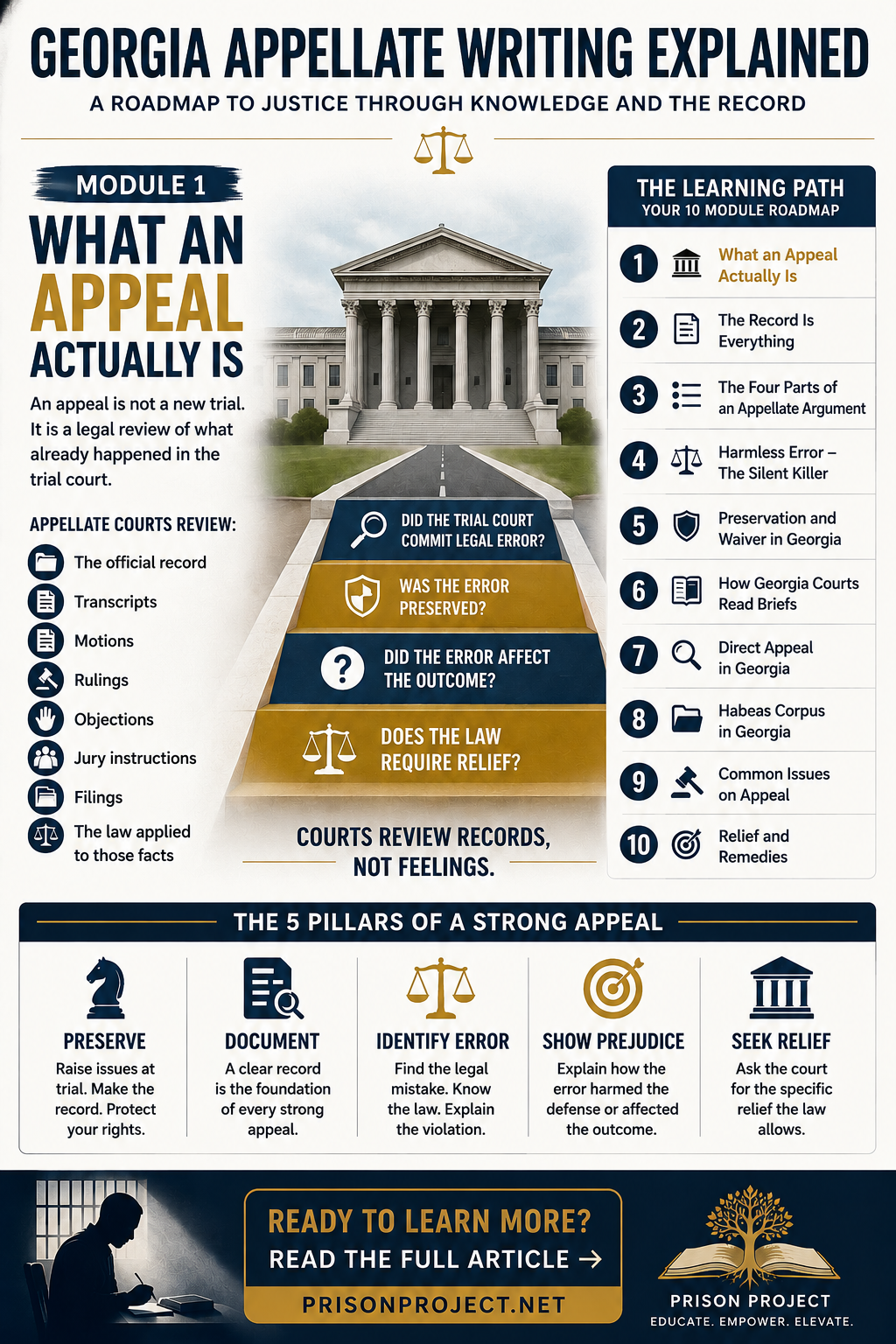
 Georgia Appellate Writing Explained
## Module 1 — What an Appeal Actually Is
Most people misunderstand appeals.
An appeal is not a new trial.
It is not a chance to retell the story.
It is not a place to introduce new evidence because the jury “got it wrong.”
And it is not simply a complaint that the outcome felt unfair.
An appeal is a structured legal review of what already happened in the trial court.
The appellate court reviews:
- the official record
- the transcripts
- the motions
- the rulings
- the objections
- the jury instructions
- the filings
- the law applied to those facts
That distinction matters because appellate courts are limited in what they can do.
The appellate court does not decide whether it personally believes someone is innocent or guilty.
Instead, it asks questions like:
- Did the trial court commit legal error?
- Was the error preserved?
- Did the error affect the outcome?
- Does the law require relief?
That means a person can have a trial that feels deeply unfair and still lose on appeal if the legal issues were not properly preserved or presented.
This is one of the hardest truths in post-conviction litigation:
Courts review records, not feelings.
The Record Is the Battlefield
Everything in appellate practice begins with the record.
If something is not documented:
- it becomes harder to prove
- harder to review
- and sometimes impossible to raise later
The “record” includes:
- hearing transcripts
- trial transcripts
- filed motions
- exhibits
- written orders
- objections
- rulings from the judge
This is why trial lawyers matter so much.
A weak record at trial often becomes a weak appeal later.
For example:
If improper evidence comes into trial and nobody objects, the appellate court may later say the issue was waived.
If the judge makes a questionable ruling but no motion is filed, the issue may never become reviewable.
If misconduct occurs off the record, appellate courts often cannot evaluate it at all.
This is why preservation matters.
## Appeals Are About Legal Error
An appellate court is not looking for generalized unfairness.
It is looking for reviewable legal error.
Some common appellate issues include:
- improper jury instructions
- unconstitutional searches
- prosecutorial misconduct
- ineffective assistance of counsel
- improper admission of evidence
- sentencing errors
- Brady violations
- judicial misconduct
- insufficient evidence
- due process violations
But identifying an issue is not enough.
The person raising the issue usually must show:
1. What happened.
2. Why it violated the law.
3. Why it mattered.
4. What relief should be granted.
That structure is the foundation of appellate writing.
Harmless Error
One of the most misunderstood concepts in appellate law is harmless error.
Sometimes appellate courts agree that a mistake happened.
But they still affirm the conviction.
Why?
Because the court concludes the mistake did not affect the outcome enough to justify reversal.
This is called harmless error analysis.
That means:
Showing error alone is often not enough.
The appellant usually must also show prejudice.
In plain English:
How did the mistake actually harm the defense?
This is one of the biggest reasons appeals fail.
Direct Appeal vs. Habeas Corpus
A direct appeal reviews errors from the trial court record.
Habeas corpus is different.
Habeas is often used for:
- evidence outside the record
- ineffective assistance claims requiring investigation
- newly discovered evidence
- Brady material discovered later
- constitutional violations not fully visible in the original transcripts
Many people confuse these processes.
They are related, but they are not the same thing.
Final Thought
Appellate litigation is not built on outrage.
It is built on structure.
The people who succeed in post-conviction work learn how to:
- preserve issues
- document problems
- build records
- identify legal error
- explain prejudice
- present arguments clearly and credibly
That is the work.
Freedom is often determined by what was preserved, documented, and reviewable long before the appeal was ever filed.
Comments