Report: Federal Bureau of Prisons “Lockdowns and Modified Operations” Policy Shift (2026) Overview This report summarizes the findings from our review of: the new Federal Bureau of Prisons (BOP) Program Statement 5525.01, related DOJ oversight activity, operational trends surrounding lockdowns and “modified operations,” and broader recent BOP reform efforts. The evidence strongly suggests the BOP is undergoing a significant operational restructuring tied to: staffing shortages, federal oversight pressure, COVID-era operational lessons, litigation exposure, infrastructure decline, and political pressure surrounding prison conditions. The new “Lockdowns and Modified Operations” policy appears to be part of a broader modernization effort rather than an isolated administrative memo.
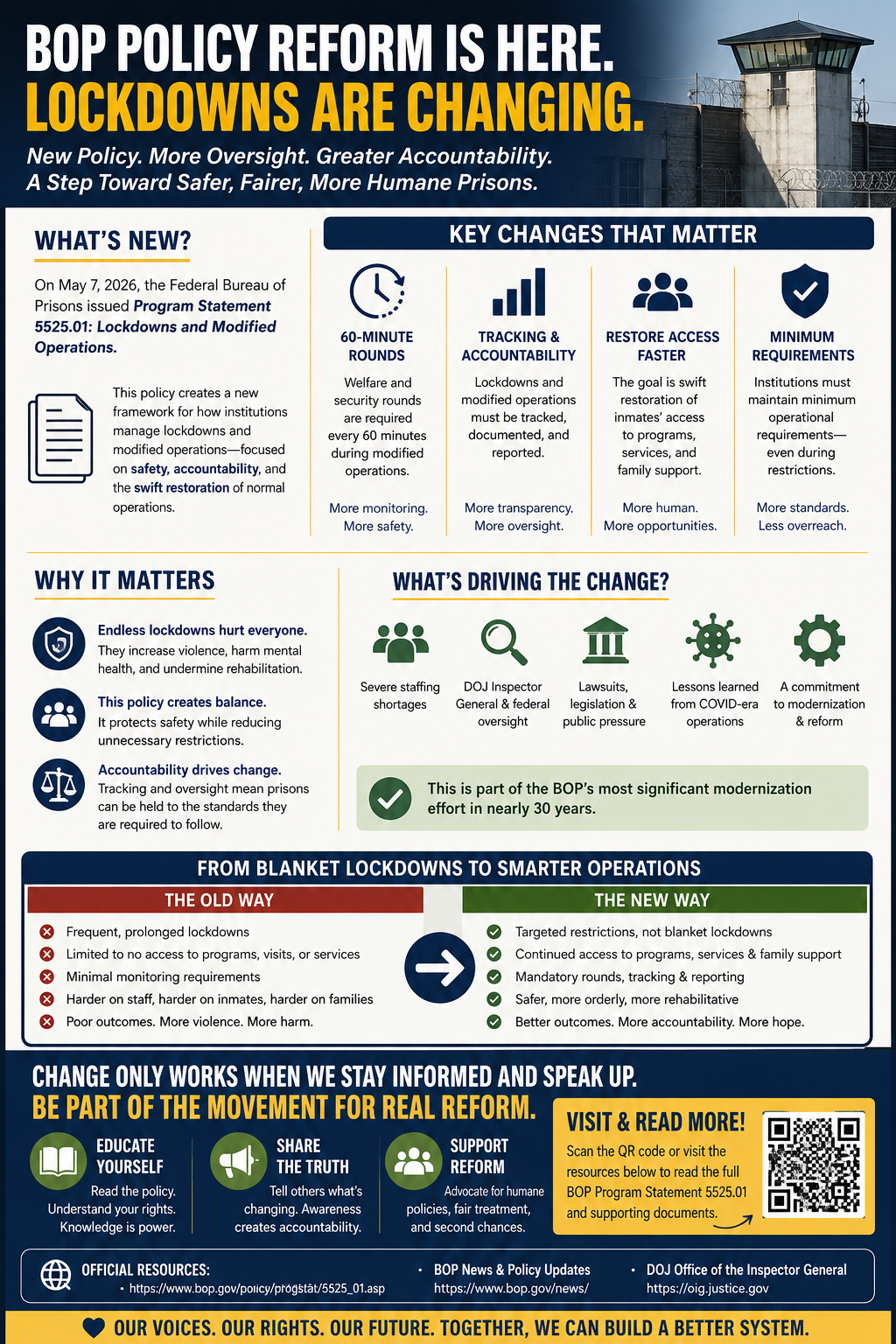
--- 1. New BOP Program Statement 5525.01 Document Identified The document shown in the screenshot is: Federal Bureau of Prisons Program Statement 5525.01 “Lockdowns and Modified Operations” Dated: May 7, 2026 The policy language emphasizes: restoration of normal operations, minimizing restricted movement duration, operational tracking, minimum operational requirements, and maintaining inmate access to programs and services whenever possible. Key language from the document includes: “swift restoration of normal operations,” “minimize the duration of restricted movement,” and formal tracking of lockdowns and modified operations. This represents a more structured operational framework than older informal lockdown practices.
--- 2. Major Policy Shift: “Modified Operations” Core Change The most important operational shift appears to be the expansion and formalization of the term: “Modified Operations” This creates a middle category between: full institutional lockdown, and fully normal prison operations. Historically, prisons often relied on broad lockdowns that severely restricted: movement, programming, visitation, recreation, education, and services. The new framework appears designed to: reduce blanket lockdown use, narrow restrictions to affected areas, maintain partial institutional functioning, and establish measurable operational standards.
--- 3. The 60-Minute Rounds Requirement One of the most operationally significant provisions identified is the apparent requirement for: security/welfare rounds every 60 minutes during modified operations. This matters because lockdowns traditionally reduce staffing burdens by limiting inmate movement and institutional activity. If staff must now: conduct documented rounds, maintain operational tracking, satisfy minimum service standards, and comply with reporting requirements, then restrictive operations become more labor-intensive. This creates institutional pressure to: shorten lockdown duration, avoid unnecessary lockdown declarations, or use narrower restrictions. In practical terms: the policy may discourage prolonged lockdowns simply because they become harder to sustain administratively during staffing shortages.
--- 4. Oversight and Accountability Expansion The strongest supporting evidence that this policy is part of a larger federal initiative comes from DOJ Office of Inspector General (OIG) materials. The DOJ OIG has confirmed: ongoing evaluations of BOP lockdowns and modified operations, broader reviews of staffing failures, and continuing oversight of institutional conditions. This is important because: once operational standards become formalized, they create: discoverable records, measurable compliance standards, audit trails, and litigation evidence. That may affect: civil-rights litigation, ADA claims, conditions-of-confinement cases, access-to-courts claims, and congressional oversight investigations.
--- 5. Relationship to COVID-Era Policies The term “modified operations” is not entirely new. The BOP heavily used the phrase during COVID-related restrictions beginning in 2020. COVID-era modified operations included: movement restrictions, social distancing, housing controls, programming limitations, and tiered institutional response systems. The difference now appears to be: formal standardization, enterprise-wide operational definitions, reporting structures, and permanent policy integration. In other words: the BOP may be transforming temporary emergency procedures into long-term institutional operating doctrine.
--- 6. Staffing Shortages as a Driving Force Nearly every oversight document reviewed identifies staffing shortages as a foundational BOP crisis. Problems repeatedly cited include: officer shortages, mandatory overtime, reassignment of non-security staff into custody roles, healthcare staffing failures, and institutional instability. This context is critical. Permanent or repeated lockdowns become operationally attractive in understaffed prisons because they reduce: inmate movement, escort requirements, programming demands, and logistical complexity. The new policy may represent an attempt to balance: institutional control, with operational sustainability, without relying on indefinite lockdown conditions.
--- 7. Broader BOP Modernization Efforts Additional BOP policy changes indicate larger systemic restructuring is underway. Recent reforms and modernization efforts include: classification and placement reforms, First Step Act implementation changes, expanded home confinement directives, revised transfer policies, updated inmate placement calculations, and modernization of outdated inmate management systems. The BOP itself described recent policy updates as: “one of the most significant modernization efforts in nearly 30 years.”
--- 8. Potential Implications Best-Case Outcome If implemented honestly, the policy could: reduce prolonged lockdowns, improve access to services, increase accountability, improve documentation, and reduce arbitrary restrictions. Worst-Case Outcome Critics may argue the changes merely: rename lockdowns, rebrand restrictive housing, or improve administrative optics without meaningful operational change. Historically, corrections systems have frequently changed terminology faster than actual conditions. Examples include: “solitary confinement” → “restrictive housing,” “segregation” → “special management,” “lockdown” → “modified operations.” Whether the current reforms produce real-world change remains uncertain.
--- 9. Advocacy and Litigation Significance From an advocacy perspective, the most important development may not be the policy language itself. It may be the creation of: formal tracking systems, operational classifications, documented standards, and measurable institutional obligations. That creates opportunities to compare: official operational status, against actual lived conditions inside facilities. That difference can become evidence.
--- Conclusion The available evidence strongly suggests the Federal Bureau of Prisons is shifting toward: more bureaucratically structured operational management, reduced reliance on blanket lockdowns, expanded documentation and oversight, and more classification-based restrictions rather than institution-wide shutdowns. This shift appears driven by: staffing shortages, federal oversight pressure, litigation concerns, COVID-era operational lessons, and broader institutional instability. The May 2026 “Lockdowns and Modified Operations” Program Statement is likely one piece of a much larger operational transformation underway inside the federal prison system.
Comments