 Georgia Appellate Writing Explained
Module 3 — The Four Parts of an Appellate Argument By the time a case reaches the appellate court, one question matters more than almost anything else:
Can the issue be explained in a clear, legally structured way? Many appeals fail before the court ever reaches the deeper issues because the argument itself is poorly organized, emotionally driven, or legally incomplete. Strong appellate arguments usually follow a predictable structure.
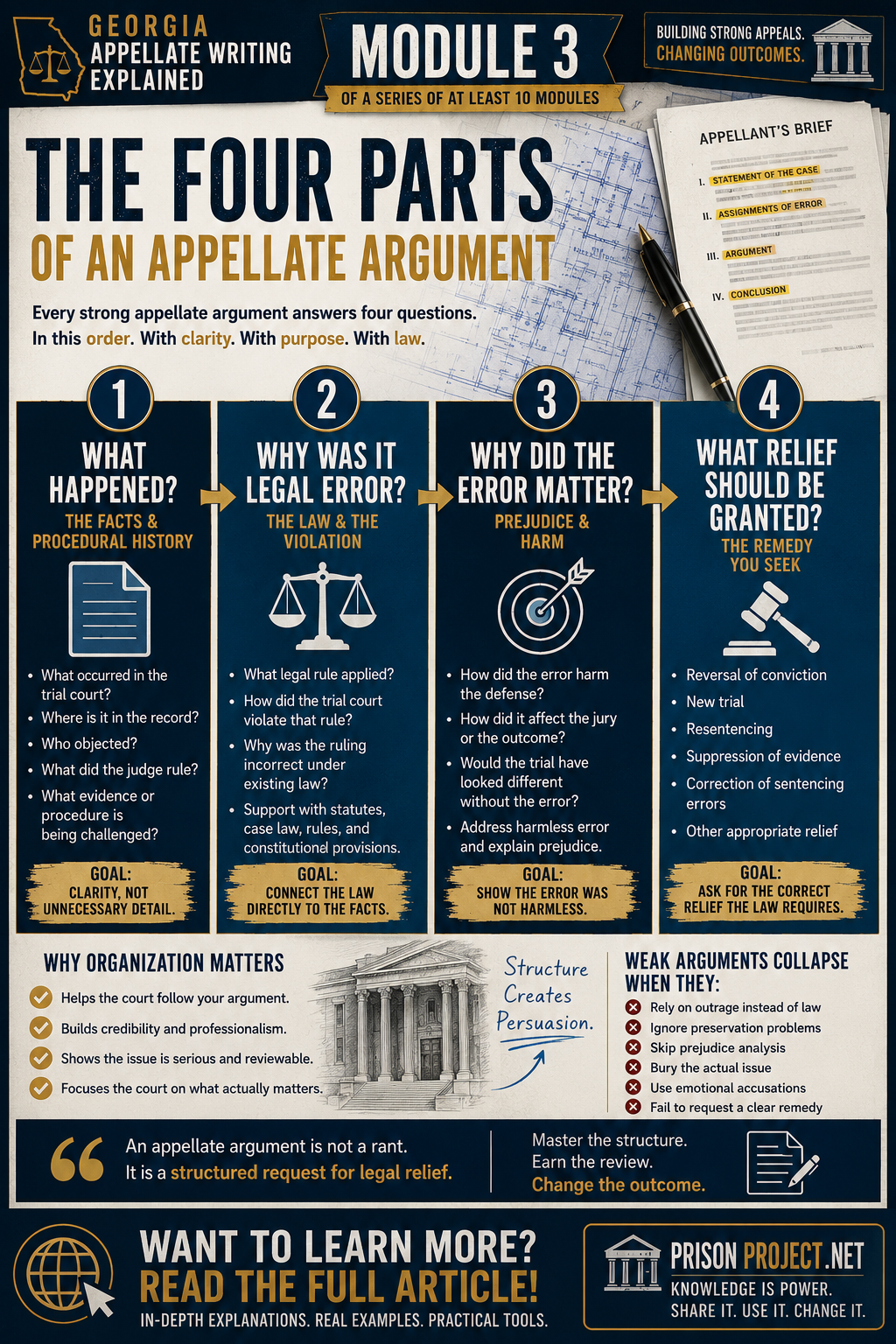
Not because courts love formality for its own sake. But because appellate courts need a logical framework for reviewing claims of legal error. At its core, most appellate arguments answer four questions:
1. What happened?
2. Why was it legal error?
3. Why did the error matter?
4. What relief should the court grant? Those four components form the backbone of effective appellate writing.
Part One — What Happened? Every appellate argument begins with the facts and procedural history relevant to the issue.
This section explains:
- what occurred in the trial court
- where it occurred in the record
- who objected
- what the judge ruled
- what evidence or procedure is being challenged
This is not the place for emotional storytelling or unnecessary detail. The goal is clarity. The appellate court should immediately understand:
- the event - the context
- and why the issue matters legally
Strong appellate lawyers guide the reader directly to the disputed issue without drowning the court in irrelevant information.
Part Two — Why Was It Legal Error?
This is where the law enters the argument. The appellant must explain:
- what legal rule applied
- how the trial court violated that rule
- and why the ruling was incorrect under existing law
This section may involve:
- statutes
- constitutional provisions
- case law
- procedural rules - evidentiary standards
- standards governing jury instructions
- sentencing law
- due process protections
But strong appellate writing does more than quote law. It connects the law directly to the facts of the case. The court does not want pages of abstract legal theory disconnected from the actual record. It wants to know:
Why was this ruling legally wrong in this specific case?
Part Three — Why Did the Error Matter?
This is often the most important part of the appeal. Many people believe proving error is enough. Usually, it is not. Appellate courts often apply harmless error analysis. That means the court may agree a mistake happened but still affirm the conviction if it believes the mistake did not affect the outcome enough to justify reversal.
This is called prejudice analysis.
The appellant must explain:
- how the error harmed the defense
- how it affected the jury
- how it weakened the fairness of the trial
- or how it impacted the outcome
This is where many appeals fail. Not because no error occurred. But because the court concludes the error was harmless.
Strong prejudice arguments often focus on:
- weak evidence
- close cases
- credibility problems
- improper evidence
- jury confusion - constitutional violations
- limitations placed on the defense.
The question becomes:
Would the trial have looked different without the error?
Part Four — What Relief Should Be Granted?
Every appellate argument should clearly explain what the appellant wants the court to do.
Possible remedies may include:
- reversing the conviction
- ordering a new trial
- remanding for resentencing
- suppressing evidence
- vacating part of a sentence
- correcting sentencing errors
- ordering further proceedings.
The requested remedy should match the legal issue being raised. A strong appellate argument does not simply complain about error. It explains what correction the law requires.
Why Organization Matters
Organization is not cosmetic. It is part of persuasion. Confused arguments lose credibility. Disorganized arguments make courts work harder. Strong appellate writing:
- moves logically - stays focused
- avoids unnecessary emotion
- connects facts to law
- explains prejudice clearly
- asks for precise relief
This is one reason appellate courts value disciplined writing so heavily. Good organization tells the court:
This issue is serious, structured, and reviewable.
How Weak Arguments Collapse Weak appellate arguments often fail because they:
- rely on outrage instead of law
- ignore preservation problems
- skip prejudice analysis
- bury the actual issue
- overload the court with unnecessary facts
- use emotional accusations instead of legal reasoning
- fail to request a clear remedy The court is not looking for the loudest argument. It is looking for the most legally persuasive one.
Final Thought An appellate argument is not a rant. It is a structured request for legal relief. The strongest appellate advocates learn how to:
- organize facts
- identify legal error
- explain prejudice
- and connect the law to a specific remedy
That structure is what transforms a complaint into a reviewable appellate claim. And in appellate litigation, structure often determines whether an argument survives at all.
Comments