
 Georgia’s Prison Crisis Is No Longer Hidden. It Is Preserved in the Record.
The State of Georgia says Tyler Ryals resigned.
Ryals says he never did.
For nearly a decade, he worked inside Georgia prisons, rising from correctional officer to lieutenant and eventually commanding Correctional Emergency Response Teams—the officers called when ordinary prison operations had already failed.
On August 1, 2024, Ryals submitted a sworn statement using the Georgia Department of Corrections’ own form. He warned that prisons were dangerously understaffed, violence was rising, contraband had flooded the institutions and officers were being placed in situations they could not safely control.
He refused to continue participating in accreditation paperwork while those dangers remained unaddressed. He even acknowledged in writing that speaking up might cost him his job.
Twelve days later, he was gone.
A state separation document categorized his departure as a resignation. Ryals says he was ordered to resign or be terminated, refused to submit a resignation and was later told that declining a transfer meant he had resigned anyway. GDC’s record is neat. His account is not.
That conflict—a dangerous reality reduced to reassuring paperwork—is not a side story in Georgia’s prison crisis.
It may be the central story.
On Paper, the System Keeps Passing
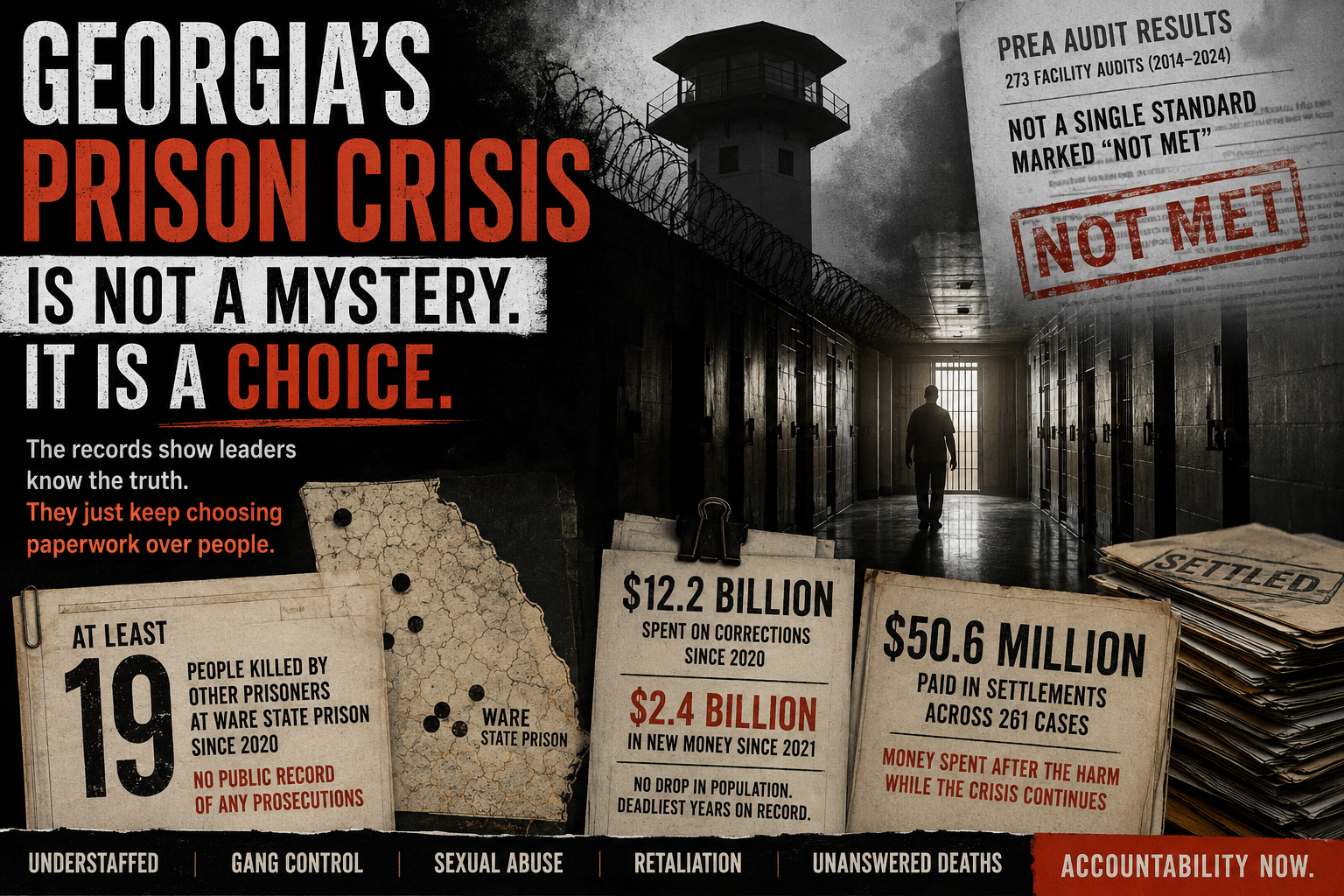
Georgia Prisoners’ Speak recently examined all 273 published facility audits conducted in Georgia under the federal Prison Rape Elimination Act.
Those audits cover five cycles and more than a decade of prison operations. According to the organization’s database, not one facility received a single finding that a PREA standard was “not met.”
Not one failed standard in 273 audits.
During roughly the same period, incarcerated people reported sexual abuse or harassment 15,542 times. The Georgia Department of Corrections substantiated 543 of those reports—about 3.5 percent.
In October 2024, the United States Department of Justice reached a conclusion that bears little resemblance to Georgia’s perfect audit record. Following a multiyear investigation, the DOJ found that Georgia exposed incarcerated people to an unreasonable risk of sexual abuse and failed to protect them from widespread violence. Federal investigators identified critical understaffing, broken classification and housing practices, poor contraband control, deficient investigations and gangs exercising control over entire housing units.
So Georgia now has two official-looking versions of its prison system.
In one, the facilities repeatedly satisfy every audited PREA standard.
In the other, the United States Department of Justice says the state is violating the Constitution.
Both cannot adequately describe the same reality.
The question is no longer whether Georgia has information about what is happening. The question is what Georgia does with information that threatens the story it wants to tell.
The Numbers Are Managed Before They Are Reported
Ryals is not the only former corrections commander accusing GDC of concealing the depth of its staffing failure.
Russell Zirkle, another former prison administrator, has publicly alleged that officials were pressured to produce staffing reports that made dangerously depleted institutions appear healthier than they were. Zirkle began as an officer and rose to deputy warden before leaving Georgia corrections and accepting a lower-ranking position elsewhere.
He says the problem was not simply that the prisons were hard to manage.
The problem was being expected to represent failure as normal operation.
GPS reports that Ryals and Zirkle served at Georgia prisons in senior operational roles and independently described a system in which staffing numbers were averaged or presented in ways that concealed extreme shortages at individual facilities. They described institutions where a handful of officers could be responsible for hundreds of prisoners and where meaningful supervision sometimes disappeared for hours.
This matters because staffing is not just another budget statistic.
An empty officer post is an unobserved assault.
It is a medical emergency no one sees.
It is a gang-controlled cell assignment.
It is a weapon moving through a dorm.
It is five hours during which anything can happen and no state employee may enter the building.
When the vacancy number is softened, averaged or hidden inside statewide totals, the danger does not disappear. Only the public’s ability to see it disappears.
At Ware State Prison, the Paper Trail Ends at Homicide
The most disturbing example may be Ware State Prison.
GPS obtained 231 coroner reports, autopsies and toxicology records covering 84 deaths at Ware since 2020. Those records document at least 19 people killed by other prisoners.
In 11 cases, state death-investigation records reportedly identified one or more suspected attackers. Yet after searching news reports, agency announcements, public offender information and available court sources, GPS said it could find no public record showing that anyone had been charged, indicted or tried for any of those 19 deaths.
That does not establish that no prosecution occurred; Ware County criminal dockets are not fully searchable online. It establishes something nearly as troubling: the public record does not provide an accessible account of what the justice system did after the state classified these deaths as homicides.
Georgia knew the men were dead.
Its coroners examined their bodies.
Its investigators produced reports.
Its laboratories processed evidence.
In some cases, its records identified suspected assailants.
Then the public trail appears to stop.
Outside prison, homicide normally activates the full authority of government. Police investigate. Prosecutors decide whether to bring charges. Courts create dockets. Hearings occur. Outcomes become part of a public record.
Inside Ware State Prison, GPS found a collection of deaths for which that system of visible accountability appears to have gone silent.
The prison sentence became something more than the punishment imposed by a judge. For at least 19 men, it became exposure to lethal violence inside a facility the state controlled.
Their deaths should not be treated as administrative events.
Georgia Pays Afterward
The state’s financial records tell another part of the story.
GPS compiled payments made to resolve prison-related deaths, injuries and other claims. Its database identifies approximately $50.6 million paid through 261 settlements and claims involving 31 facilities between 2008 and 2025.
The largest listed payment was $4 million. Several other death cases resulted in multimillion-dollar payouts. GPS correctly warns that its total is a floor, not a complete accounting, because recent incidents may remain in litigation for years before any payment appears in state records.
These payments are not reform.
They are the price charged after reform failed.
Taxpayers pay to operate the prison. They pay for increased security budgets. They pay for emergency responses, investigations and medical contracts. Then, when preventable harm produces a lawsuit, taxpayers pay again.
Georgia has reportedly spent approximately $12.2 billion on corrections since fiscal year 2020 through the enacted and proposed fiscal year 2027 budgets. GPS calculates that nearly $2.4 billion of that represents spending above the fiscal year 2021 baseline. During those same years, the organization reports that staffing vacancies persisted and deaths reached historic levels.
Money is entering the system.
Accountability is not coming out.
Silence Is Part of the Operating Model
There is another reason the official record can look cleaner than the reality inside: the people with firsthand knowledge may be punished for contributing to it.
GPS reviewed accounts submitted by incarcerated people and their families and identified recurring allegations of retaliation after people filed grievances, reported sexual assaults, contacted lawyers, spoke to journalists or participated in civil-rights litigation.
The reported methods include transfers into more dangerous housing, disciplinary charges unsupported by witnesses, segregation, lost property, interrupted legal mail, denied medical care and rumors labeling someone an informant.
These allegations are not individually proven merely because they appear repeatedly. But the pattern deserves independent investigation, particularly because the DOJ has already confirmed the dangerous conditions that can make a retaliatory transfer or informant label potentially life-threatening.
Retaliation does more than punish one person.
It teaches everyone watching what will happen if they speak next.
That means silence inside a prison cannot automatically be interpreted as evidence that nothing is wrong. Silence may be evidence that reporting has become too dangerous.
The people closest to the violence are often the people with the least power to document it safely.
That is why outside record-building matters.
GPS Is Building the Record Georgia Failed to Build
Georgia Prisoners’ Speak is an advocacy organization, and its claims should be examined critically like those of any organization seeking policy change.
But much of what makes its recent work important is not rhetoric. It is source material.
Coroner reports.
Autopsies.
Settlement ledgers.
PREA reports.
Facility audits.
Budget appropriations.
Personnel documents.
Sworn statements.
Open-records correspondence.
The organization says it filed 130 records requests during this reporting period alone. It assembled the PREA records into a searchable database, compiled settlement payments, documented deaths by facility and mailed investigations and firsthand accounts directly to Georgia legislators.
This is not simply a campaign to persuade people that Georgia’s prisons are failing.
It is an attempt to prevent officials from later claiming they did not know.
The DOJ has already established that Georgia’s prison conditions violate the Eighth Amendment. It found widespread violence, sexual abuse risks, chronic understaffing, failed classification systems, contraband and gang control. Former commanders now say the state obscures its staffing collapse. State audit reports show uninterrupted compliance. Coroner records document homicides. Settlement ledgers document millions paid after deaths and injuries.
The crisis is no longer hidden behind prison walls.
It is written across the state’s own records.
The Question Is No Longer Whether Georgia Knows
For years, prison officials could claim that stories from inside were exaggerated, isolated or impossible to verify.
That defense is collapsing.
The warnings are now coming from former commanders.
The constitutional findings are coming from the Justice Department.
The homicide classifications are coming from coroners.
The financial costs are coming from state settlement records.
The allegations are coming from thousands of PREA reports.
The zero-failure audit history is coming from the prison system itself.
Georgia does not suffer from a lack of evidence.
It suffers from a system that repeatedly records evidence without allowing that evidence to produce responsibility.
A commander warns the state and his departure becomes a resignation.
A prison reports hundreds of abuse allegations and its audit becomes a passing grade.
A man is killed and his death becomes a file.
A family sues and the failure becomes a settlement.
A prisoner speaks and the complaint becomes a disciplinary problem.
Everything is documented.
Nothing is allowed to mean what it plainly means.
That is the distance Georgia Prisoners’ Speak is exposing: the distance between what Georgia knows and what Georgia is willing to admit.
The record has now been assembled.
What happens next will reveal whether Georgia’s leaders intend to correct the crisis—or merely continue documenting it.
Comments