THE GRIEVANCE TRAP: How the Prison System Can Control a Prisoner's Access to Court
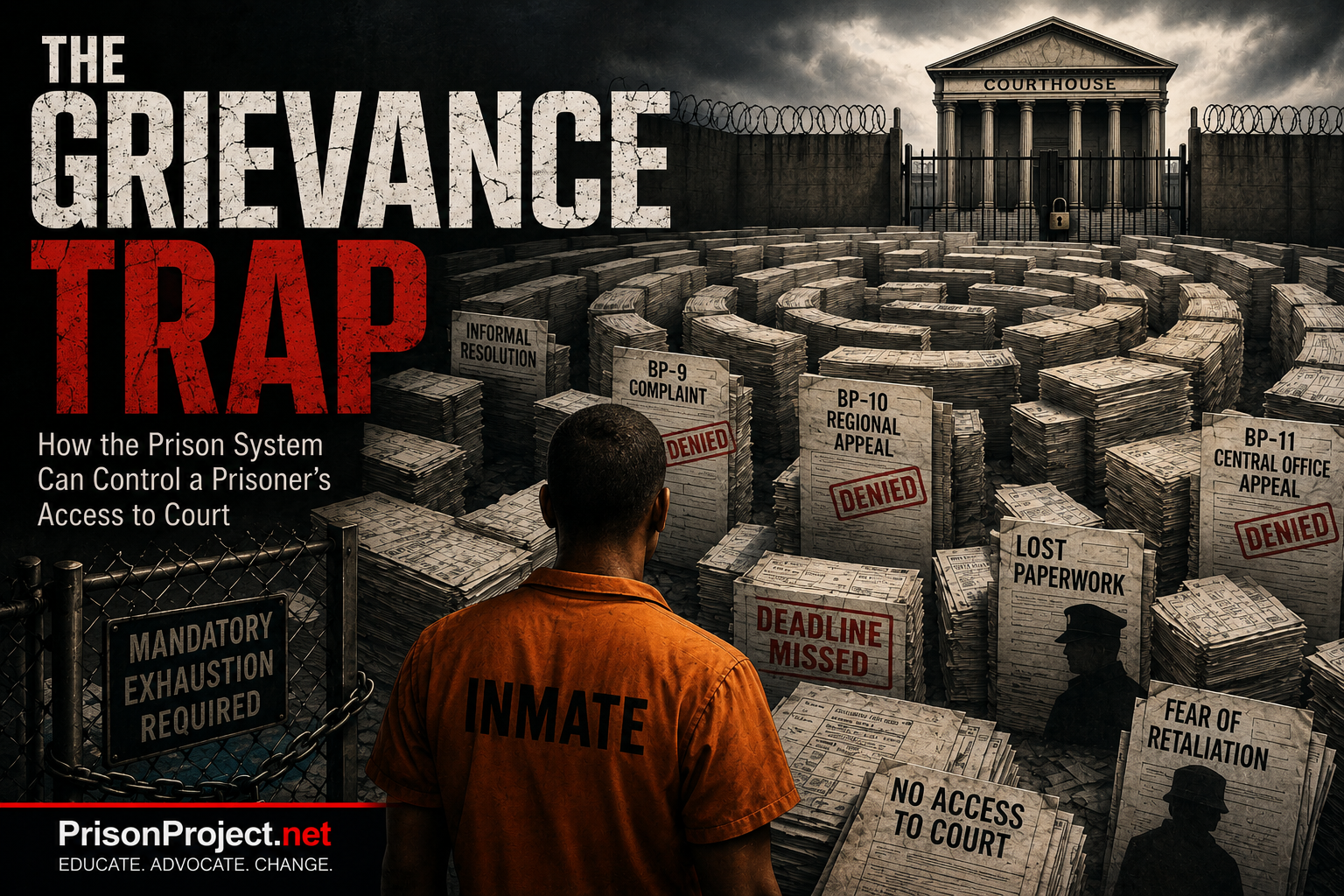
Federal prisoners are required to exhaust the prison grievance system before challenging prison conditions in court. A new investigation found fewer than 2% of federal grievances were granted in 2023 — while prisoners report lost paperwork, missed deadlines, retaliation and a system controlled by the very institution they may be accusing of wrongdoing.
There is a fundamental contradiction buried inside America's prison grievance system.
When a person incarcerated in federal prison believes their rights have been violated, federal law generally requires them to first pursue the prison's administrative remedy process before bringing a lawsuit challenging prison conditions.
That sounds reasonable on paper.
Give the institution an opportunity to correct the problem before involving a federal court.
But what happens when the institution accused of causing the problem also controls the process a prisoner must successfully navigate before reaching that court?
That question is at the center of a major investigation published by The Marshall Project and NPR.
Their findings deserve attention from every incarcerated person, family member and prisoner advocate in America.
According to their analysis of federal prison grievance data, less than 2% of grievances filed in federal prisons during 2023 were granted.
The investigation examined a federal database containing nearly one million administrative-remedy cases dating back to 2000. A majority of the 2023 grievances were rejected for procedural errors or administratively closed for other reasons.
That is not merely a customer-service problem inside prisons.
Because of federal law, a failed grievance can become something much more serious:
A LOCKED COURTHOUSE DOOR.
THE PRISON LITIGATION REFORM ACT CHANGED EVERYTHING
Congress enacted the Prison Litigation Reform Act in 1996.
One of its most consequential provisions requires incarcerated people challenging prison conditions under federal law to exhaust the administrative remedies that are available before filing suit.
In plain English:
YOU GENERALLY HAVE TO COMPLETE THE PRISON GRIEVANCE PROCESS BEFORE YOU CAN TAKE THE CLAIM TO FEDERAL COURT.
Failure to properly exhaust can result in dismissal.
The Supreme Court has repeatedly treated this exhaustion requirement seriously.
In Ross v. Blake, the Court held that mandatory exhaustion applies to remedies that are actually available.
But the Court also recognized an important limitation.
An administrative remedy is not truly available when, for example, the process operates as a dead end, is so confusing that it is practically unusable, or when prison administrators prevent prisoners from using it through misrepresentation, intimidation or similar interference.
That distinction matters enormously.
There is a difference between:
A prisoner failing to use an available grievance system
and
A prison making the grievance system effectively unavailable.
Proving the second situation, however, can itself become a legal battle.
FOUR LEVELS BETWEEN THE PRISONER AND THE COURTHOUSE
The federal Bureau of Prisons administrative-remedy process generally involves multiple stages.
It begins with an attempt at informal resolution and can proceed through:
- informal resolution;
- a formal institutional grievance;
- an appeal to the appropriate BOP Regional Director; and
- a final appeal to the BOP's General Counsel/Central Office.
The deadlines change depending upon the stage.
BOP materials, for example, provide 30 days for a regional response, subject to a possible 30-day extension, while the Central Office generally receives 40 days, with another possible extension.
The incarcerated person has deadlines too.
And that creates one of the most dangerous parts of the system.
A PROCEDURAL MISTAKE CAN BECOME MORE IMPORTANT THAN THE UNDERLYING ALLEGATION.
A person might be complaining about inadequate medical treatment, excessive force, dangerous conditions or another serious issue.
But litigation may ultimately turn on something entirely different:
- Was the correct form used?
- Was it submitted to the correct office?
- Was the previous response attached?
- Was the appeal received before the deadline?
- Were all required levels completed?
That is why grievance documentation isn't bureaucratic busywork.
IT CAN BECOME EVIDENCE.
WHEN THE PAPERWORK DISAPPEARS
The Marshall Project's reporting identified another recurring complaint from incarcerated people:
Paper grievances can disappear.
Federal prisoners described paperwork being lost or destroyed and problems following them when they were transferred between institutions.
That is why one of the most straightforward reforms proposed by prisoners surveyed for the investigation was surprisingly simple:
ELECTRONIC GRIEVANCE FILING.
An electronic system could automatically establish when something was submitted and create a record that does not depend entirely upon a piece of paper traveling through the same institution being challenged.
The problem isn't theoretical.
The Marshall Project describes the case of Terri McGuire-Mollica, whose medical-care lawsuit was initially dismissed after the Bureau of Prisons contended that it had never received her final administrative appeal.
She had sent it using certified legal mail.
The tracking evidence eventually mattered.
That case illustrates a lesson Prison Project has emphasized repeatedly:
DOCUMENT EVERYTHING.
If a grievance disappears, a prisoner needs evidence showing that it existed.
If a response arrives late, document when it arrived.
If officials refuse to provide a form, document the refusal when safely possible.
If something is mailed, preserve whatever mailing documentation is available.
And families can play an important role in maintaining copies and timelines outside the institution.
THE DEADLINE PROBLEM
The grievance system contains another imbalance.
Prisoners can suffer severe consequences for missing deadlines while prison officials themselves receive substantially more time to respond — including authorized extensions.
Prisoners interviewed by The Marshall Project described situations in which institutional delays consumed part of the time available for the next appeal.
Experienced incarcerated litigants have developed defensive documentation practices because of this problem.
When a response arrives late, some immediately create another written record showing when they actually received it.
Others proceed to the next administrative level once the agency's response period expires rather than indefinitely waiting for an answer.
BOP itself acknowledges that an incarcerated person may proceed when the agency's response deadline expires.
This is exactly why prisoners should maintain a grievance timeline, not simply a pile of grievance papers.
Dates matter.
THE MOST SERIOUS PROBLEM: RETALIATION
Lost paperwork is one problem.
Fear is another.
The Marshall Project and NPR investigation found allegations that incarcerated people sometimes avoid grievances because they fear retaliation from correctional employees.
That creates an extraordinary conflict.
A prisoner may be required to complain through a system controlled by the same institution — and potentially involving employees connected to the misconduct being reported — before gaining access to federal court.
The Marshall Project's reporting described allegations ranging from intimidation to physical abuse associated with attempts to pursue grievances.
Its investigation also noted that fear of retaliation can prevent some incidents from ever entering the grievance database at all.
That means even the extremely low grievance-success statistics cannot tell the entire story.
YOU CANNOT COUNT GRIEVANCES THAT FRIGHTENED PRISONERS NEVER FILED.
And this isn't simply an allegation made by advocacy organizations.
A May 2026 Government Accountability Office examination of sexual abuse within federal prisons identified continuing problems and issued seven recommendations to the Department of Justice aimed at improving prevention, detection and response. DOJ agreed with those recommendations.
THE BUREAU OF PRISONS SAYS CHANGES ARE COMING
There is at least official recognition that the system needs work.
In responding to The Marshall Project, a Bureau of Prisons spokesperson acknowledged that the agency needs to overhaul its Administrative Remedy Program and said updates and additional guidance were being developed as part of a broader policy review.
The agency did not specify exactly what those reforms would include.
That distinction matters.
ACKNOWLEDGING A BROKEN SYSTEM IS NOT THE SAME THING AS FIXING IT.
Until actual changes are implemented, incarcerated people remain responsible for navigating the system that currently exists.
CONGRESS HAS ALREADY RECOGNIZED THE OVERSIGHT PROBLEM
There is another important development.
The Federal Prison Oversight Act, enacted in 2024, created a new framework for independent federal prison oversight.
Among other things, the law calls for independent inspections of federal prisons through the Department of Justice Inspector General and establishes an independent ombudsman structure intended to provide another avenue for complaints from incarcerated people and their families.
Implementation, however, has faced funding and organizational issues.
The larger significance is difficult to miss:
CONGRESS ITSELF RECOGNIZED THAT INTERNAL PRISON ACCOUNTABILITY MECHANISMS WERE NOT ENOUGH.
PRISON PROJECT'S POSITION: THE EVIDENCE TRAIL IS EVERYTHING
There is an uncomfortable reality families and incarcerated people need to understand.
The grievance system serves two completely different purposes.
The first is the purpose everyone sees:
Ask the institution to correct a problem.
The second is often more important:
BUILD THE ADMINISTRATIVE RECORD NECESSARY TO PRESERVE THE POSSIBILITY OF COURT REVIEW.
That changes how grievances should be approached.
A grievance should not simply be an angry letter.
It is potentially part of a future legal record.
Dates matter.
Names matter.
Facts matter.
Copies matter.
Responses matter.
Deadlines matter.
Proof of submission matters.
And what happens when prison officials interfere with the process matters too.
A grievance that produces no immediate relief may still become extremely important later.
FAMILIES CAN BECOME THE OUTSIDE RECORD KEEPER
Families often believe there is nothing they can do when someone they love is fighting a grievance from inside prison.
That isn't necessarily true.
One of the most useful things an outside family member can do is maintain an independent documentation file.
That can include:
- copies of grievances;
- copies of administrative appeals;
- responses from prison officials;
- mailing receipts or tracking information;
- dates documents were submitted;
- dates responses were actually received;
- names and titles of officials involved;
- supporting medical or other records when lawfully available; and
- a chronological timeline of every step.
The Marshall Project investigation notes that experienced prisoners and advocates have similarly recommended maintaining outside copies because institutional paperwork can be lost or discarded.
This isn't about flooding officials with paperwork.
It is about preserving evidence.
A SYSTEM CANNOT BE CALLED A REMEDY IF PRISONERS CANNOT SAFELY USE IT
Administrative grievance systems have a legitimate purpose.
Prisons should have an opportunity to investigate problems and correct them without requiring every disagreement to become federal litigation.
But that principle only works when the remedy is genuinely accessible.
A grievance system cannot function as meaningful accountability if prisoners are afraid to use it.
It cannot function properly if paperwork disappears without a reliable submission record.
It cannot function fairly if procedural technicalities overwhelm legitimate constitutional complaints.
And it cannot provide meaningful access to justice if the people being accused effectively control whether the complainant can complete the process required to reach a court.
The numbers uncovered by The Marshall Project and NPR should force a serious examination of that system.
Less than 2% of federal grievances granted in 2023.
Nearly one million grievance records examined going back more than two decades.
And behind those statistics are countless complaints involving medical treatment, safety, living conditions and alleged misconduct.
The question isn't whether prisons need grievance procedures.
They do.
The question is whether the current system functions as a genuine avenue for resolving grievances —
OR AS ANOTHER BARRIER STANDING BETWEEN INCARCERATED PEOPLE AND ACCOUNTABILITY.
WHAT YOU CAN DO
If you have someone incarcerated, do not wait until litigation begins to start preserving records.
Create an outside grievance file now.
Keep the paperwork.
Track the dates.
Preserve correspondence.
Build the timeline.
Because months or years later, the difference between "I filed it" and "here is the evidence showing exactly when I filed it" can be enormous.
RELATED PRISON PROJECT RESOURCES
GRIEVANCE GOLD
Our Prison Project grievance education and documentation resources explain how incarcerated people and their families can build stronger administrative records.
PRO SE LITIGATION MANUAL
We are expanding our litigation resources to help incarcerated people understand the procedural barriers that often determine whether a federal claim ever reaches its merits.
MORE FROM PRISON PROJECT ON GRIEVANCES
Prison Project has previously examined grievance exhaustion, documentation, deadlines and the consequences of failing to preserve the administrative record.
[ADD LINKS TO OUR PREVIOUS GRIEVANCE ARTICLES HERE]
RELATED: INMATE RIGHTS UNDER THE AMERICANS WITH DISABILITIES ACT
Our guide to disability rights in prisons explains why grievance documentation and exhaustion can become critical when an incarcerated person is denied an accommodation.
Read Prison Project's guide to inmate rights under the ADA
SHARE YOUR EXPERIENCE
If you or someone you love has experienced lost grievances, rejected filings, unexplained delays or retaliation connected with the grievance process, Prison Project wants to hear about it.
Contact: info@prisonproject.net
SOURCES AND FURTHER READING
The reporting that prompted this article comes from the recent work of Aala Abdullahi and Christie Thompson at The Marshall Project in partnership with NPR.
The Marshall Project
How People in Federal Prison Say the Grievance System Should Be Fixed
The Marshall Project
In Federal Prisons, Some Guards Use Fear and Violence to Stifle Complaints
U.S. Government Accountability Office
U.S. Government Accountability Office
U.S. Department of Justice — Office of the Inspector General
Ongoing Challenges Facing the Federal Bureau of Prisons
Prison Project provides public education and advocacy information. Nothing in this article is intended as individualized legal advice.
Comments