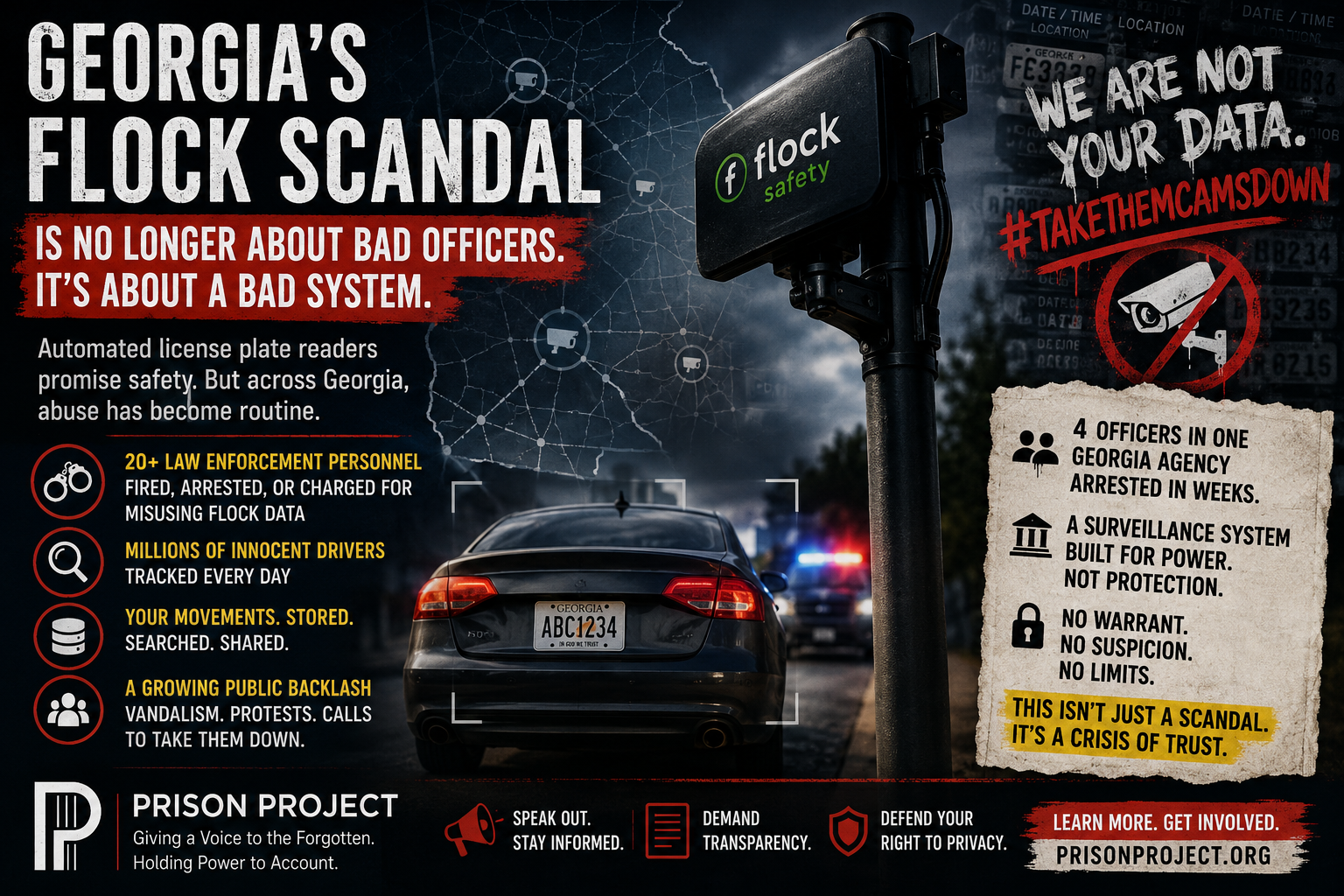
 Georgia's Flock Scandal Is No Longer About Bad Officers. It's About a Bad System.
Four officers in one Georgia agency. Twenty personnel statewide. How many cases does it take before we question the surveillance itself?
Opinion | Prison Project
Published: July 20, 2026
For years, Americans were told not to worry.
"If you're not doing anything wrong, you have nothing to fear."
It is the same argument that has accompanied nearly every expansion of government surveillance in modern history. More cameras. More databases. More tracking. More assurances that only criminals would ever have reason to object.
Georgia's recent Flock scandals tell a different story.
Within the past several weeks alone, four Richmond County Sheriff's Office employees have been fired and arrested after investigators alleged they accessed Flock license-plate data for personal reasons. Across Georgia, at least twenty current or former law-enforcement personnel have now been fired, arrested, charged, or placed under investigation for allegedly misusing automated license plate reader systems.
Those numbers are not simply embarrassing.
They are evidence of a deeper problem.
Every time another officer is arrested, the public is told the same thing: the auditing system worked.
We disagree.
If misuse is occurring often enough to produce arrests across multiple agencies, then the question is no longer whether audits work. The question is why government has built a surveillance system that creates this opportunity in the first place.
Flock Safety promotes its technology as a tool to recover stolen vehicles, locate missing children, and help solve crimes. There is no doubt that automated license plate readers have assisted legitimate investigations.
But constitutional rights are not measured only by success stories.
They are measured by what government is permitted to do to millions of innocent people who are suspected of nothing.
Every trip to church.
Every doctor's appointment.
Every political rally.
Every visit to a family member.
Every drive home from work.
All of it can become part of a searchable database simply because a camera happened to record a passing vehicle.
That reality should concern every American, regardless of political affiliation.
Nor is Georgia alone.
Across the country, automated surveillance has generated growing public resistance. Civil-liberties organizations have questioned the scope of license-plate reader networks, how long information is retained, who may access it, how widely it is shared, and whether meaningful oversight actually exists.
The backlash has become increasingly visible. Across social media, users openly call for the removal of Flock cameras. News reports have documented repeated acts of vandalism against camera installations in multiple states. In one widely reported incident, a man allegedly purchased hundreds of hacksaws and distributed them near camera locations, a symbolic act reflecting the intensity of public anger toward expanding surveillance.
Prison Project does not support vandalism or the destruction of public or private property.
But dismissing these incidents as simple criminal acts misses the larger point.
They reflect a growing crisis of confidence.
People increasingly believe they are being monitored first and protected second.
Government should pay attention when ordinary citizens begin viewing surveillance infrastructure as a threat rather than a safeguard.
The answer cannot simply be another software update.
It cannot be another audit.
And it certainly cannot be another press conference announcing that yet another officer has been caught abusing a system that was supposedly protected against abuse.
Surveillance is unlike most government powers.
Once created, it rarely shrinks.
Databases expand.
Retention periods grow longer.
Information sharing becomes routine.
Access spreads to more agencies.
New technologies are layered on top of old ones until extraordinary surveillance becomes ordinary government.
The Fourth Amendment exists precisely because the Framers understood that government power tends to expand unless it is restrained.
Technology has changed.
Human nature has not.
The repeated misuse of Flock data demonstrates that no policy manual can eliminate curiosity, personal grudges, jealousy, revenge, or simple abuse of authority.
The system assumes that those with extraordinary access will always exercise extraordinary restraint.
History suggests otherwise.
Prison Project believes Georgia's legislature should undertake a comprehensive review of automated license plate reader systems operating within this state. That review should include independent oversight, meaningful transparency, stronger public reporting requirements, and a serious debate over whether these systems remain consistent with the privacy expectations of a free society.
At the same time, citizens should begin asking a more fundamental question:
If a surveillance system is repeatedly abused by the very people entrusted to operate it, has that system earned the public's trust?
In our opinion, the answer is increasingly becoming no.
Liberty has always carried risk.
The alternative is a society in which every movement is quietly recorded, stored, searched, and analyzed—not because there is probable cause, but because technology made it possible.
That is not a future Prison Project is willing to accept.
What You Can Do
Have you been stopped after a Flock camera alert? Have you discovered your vehicle was searched without a legitimate law-enforcement purpose? Do you have public records, internal documents, audit reports, or firsthand knowledge about the use—or misuse—of automated license plate reader systems?
We want to hear from you.
Prison Project investigates government accountability, prison conditions, civil liberties, and abuses of power. Responsible whistleblowers and informed citizens are often the reason important stories come to light.
Related Coverage
- Georgia officers arrested over alleged Flock misuse.
- Government surveillance and civil liberties in Georgia.
- Prison Project investigations into government accountability.
Support Our Work
Prison Project is an independent publication dedicated to government accountability, criminal justice reform, civil liberties, and giving a voice to people too often ignored.
If you believe this reporting matters, consider becoming a member or making a donation. Your support helps fund investigations, public-records requests, educational resources, and advocacy for families navigating the justice system.
Prison Project
Giving a Voice to the Forgotten. Holding Power to Account.
Comments