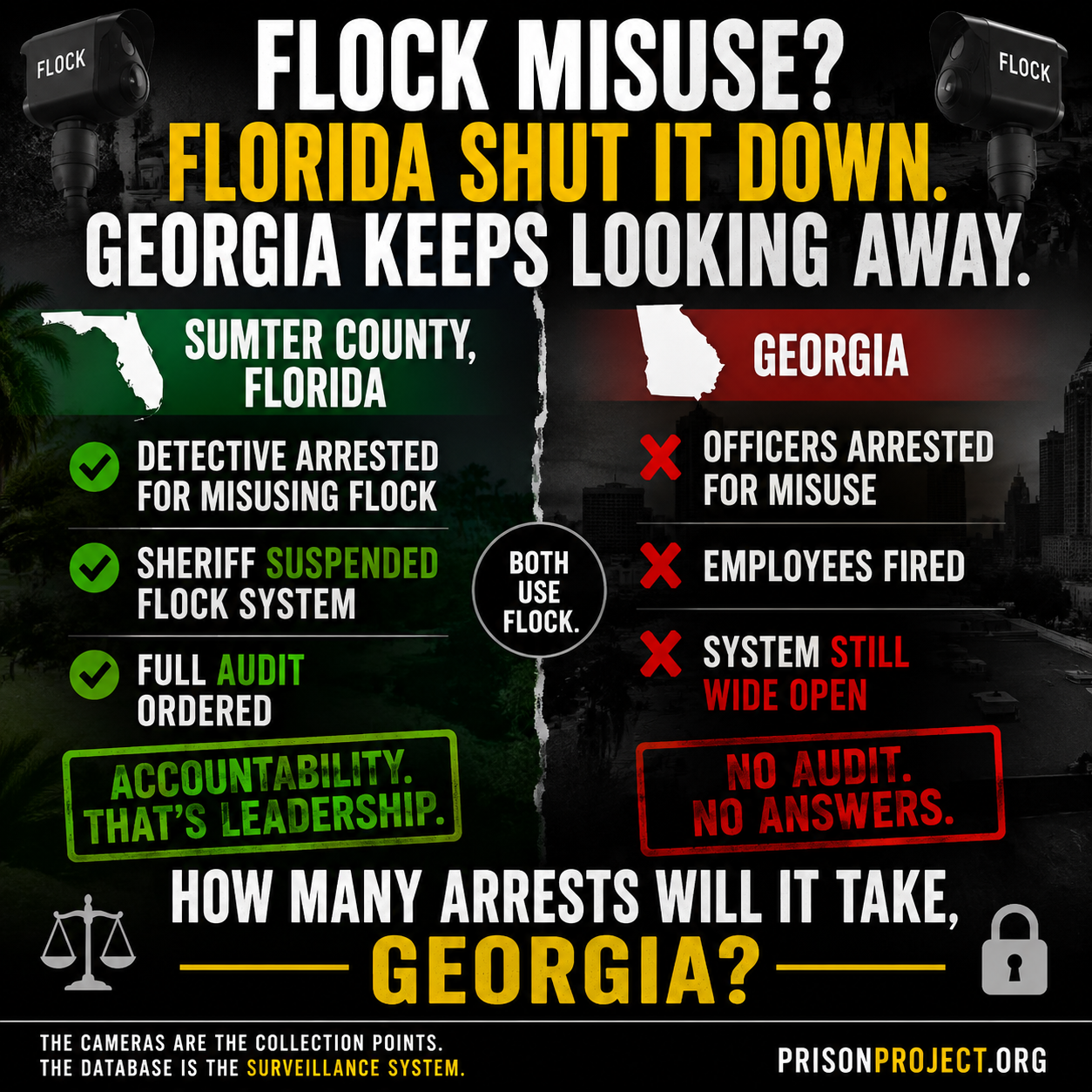
Florida Hit Pause on Flock After One Detective's Alleged Misuse. Georgia Should Be Paying Attention.
SUMTER COUNTY, FLORIDA — One detective was accused of abusing powerful law-enforcement databases.
The sheriff didn't just fire her.
He stopped the system and ordered an audit.
That response should get Georgia's attention.
On July 23, 2026, the Sumter County Sheriff's Office announced the arrest and termination of Detective Brandy Almany after an internal audit allegedly uncovered improper use of restricted law-enforcement databases.
Authorities allege Almany accessed Flock's automated license-plate-reader system, Florida's Driver and Vehicle Information Database and another law-enforcement information system for personal rather than legitimate investigative purposes.
Investigators say the searches involved her husband's ex-wife.
Authorities further allege Almany associated personal searches with unrelated sheriff's-office case numbers and entered false investigative justifications that made the activity appear connected to legitimate law-enforcement work.
She faces criminal charges including official misconduct and offenses involving unauthorized computer access.
Those are allegations.
Almany is entitled to the presumption of innocence, and Prison Project will not treat criminal charges as proof of guilt.
But her individual criminal case isn't the biggest reason this belongs in The Flock Files.
What happened next is.
The Sheriff Suspended Flock
Sumter County Sheriff Patrick Breeden could have announced an arrest, fired the employee and declared the problem solved.
He didn't.
The Sheriff's Office suspended its use of Flock.
Then Breeden ordered a broader audit of database activity inside the agency.
Additional auditing remains underway, and authorities have indicated that the results could potentially produce additional charges.
Think about the significance of that response.
One employee was accused.
The sheriff examined the system.
That is substantially different from treating every alleged misuse case as an isolated personnel problem.
And Georgia now has very good reason to consider the difference.
The Database Is the Surveillance System
Flock's automated license-plate readers photograph vehicles traveling on public roads and create searchable records from those observations.
A roadside camera is only the collection point.
The real investigative power exists behind it.
Accumulated observations. Searchable records. Connections between cameras and agencies. Access to information collected elsewhere.
And human beings authorized to type something into a search box.
That is why Prison Project has repeatedly made one distinction throughout The Flock Files:
The cameras are the collection points. The database is the surveillance system.
The Sumter County allegations demonstrate exactly why that matters.
Nobody needed to climb a pole and tamper with a camera.
The alleged abuse happened through access.
Who searched?
Whose vehicle was searched?
Why?
What investigative justification was entered?
What case number supported the search?
Who reviewed it?
And how long would questionable searches continue if nobody examined the audit trail?
Those aren't hypothetical questions anymore.
Georgia Has Already Seen the Warning Signs
This Florida case arrives while Georgia is confronting its own remarkable series of allegations involving law-enforcement use of Flock and automated license-plate-reader information.
Police officers, sheriff's deputies, supervisors and other law-enforcement personnel across multiple Georgia jurisdictions have been arrested, fired, investigated or disciplined amid allegations involving improper searches.
Prison Project is documenting those cases in our continuing investigation:
Read: Flock on the Wrong Side of the Law →
The cases aren't identical.
The allegations aren't identical.
And allegations against one employee prove nothing about another employee or agency.
But eventually repetition creates a legitimate policy question:
At what point does repeated individual misuse require examination of the system itself?
Florida just gave Georgia a real-world example of one possible answer.
Auditing One Person Is Not the Same as Auditing the System
Unauthorized use can be prohibited by statute.
It can be prohibited by departmental policy.
Employees can receive training.
Searches can require a stated reason.
None of those safeguards answers the most important practical question:
Who is actually checking?
An accountability system capable of discovering questionable searches is fundamentally different from a rulebook saying questionable searches aren't allowed.
And an audit conducted only after somebody is suspected of misconduct is different from routine auditing designed to discover misconduct nobody has reported.
That distinction matters enormously with surveillance technology.
The overwhelming majority of people whose vehicles appear in an ALPR database will never know their information was collected.
They certainly won't receive a notification every time someone searches for their vehicle.
That means the person being searched often cannot be the person responsible for discovering abuse.
The institution has to police itself — or somebody outside the institution has to examine the records.
That is one reason Prison Project created The Flock Files.
The Network Can Reach Far Beyond One County
The potential scale of networked ALPR surveillance became dramatically clear in another case Prison Project has been following.
A Texas investigation involving a woman who had obtained an abortion produced a Flock search that reportedly expanded across 6,809 networks and 83,345 cameras.
One local investigation.
Thousands of networks.
Tens of thousands of cameras.
That case demonstrates why counting the cameras physically owned by one police department doesn't necessarily measure the investigative reach available to somebody sitting behind a computer.
It also reinforces the question raised by Sumter County:
If access can extend that far, how strong should the auditing be?
Los Angeles Asked an Even Bigger Question
Sumter County isn't the only jurisdiction reconsidering its relationship with Flock.
Los Angeles recently allowed LAPD's Flock agreement to expire amid concerns involving privacy, civil liberties, data ownership and information sharing.
That was a different situation and a different governmental response.
But it belongs in the same national conversation.
Read: Los Angeles Says Flock Off →
Los Angeles questioned whether its relationship with Flock should continue.
Sumter County suspended Flock while auditing alleged misuse.
Georgia has repeatedly arrested, fired or investigated individual personnel accused of misuse.
Different jurisdictions are confronting different pieces of the same fundamental question:
What level of oversight should match this level of surveillance power?
Florida Just Gave Georgia a Test
Georgia doesn't have to blindly copy Sumter County.
But Georgia agencies should be able to answer some straightforward questions.
- When one employee is accused of improperly searching Flock, does the department examine only that employee — or everyone with access?
- How far backward does the audit go?
- Are search reasons examined?
- Are case numbers verified against actual investigations?
- Are searches involving friends, relatives, coworkers and acquaintances automatically flagged?
- Are searches performed for outside agencies reviewed?
- Who supervises the supervisors?
- Are audits routine?
- Are the findings documented?
- When misconduct is discovered, does the public ever learn whether investigators looked for more?
There is another question Georgia should be prepared to answer:
How many arrests will it take before we ask whether the problem extends beyond the people who happened to get caught?
That is not an accusation that every officer using Flock is abusing it.
Quite the opposite.
A serious audit could establish that hundreds or thousands of legitimate searches were conducted properly while identifying the handful that weren't.
That is what meaningful oversight is supposed to do.
Accountability Is Not Anti-Police
Sheriff Breeden's response also destroys one of the weakest arguments surrounding surveillance oversight.
Questioning Flock does not require believing Flock has no legitimate law-enforcement value.
Breeden has defended the usefulness of these investigative systems while simultaneously suspending Flock and ordering an audit.
Those positions aren't contradictory.
Law enforcement can have useful technology.
Citizens can demand meaningful controls over that technology.
Police can solve crimes with surveillance tools.
And police departments can audit the people entrusted with those tools.
We do not have to choose between:
"Give law enforcement powerful technology and stop asking questions."
and:
"Take every investigative technology away from police."
There is an obvious third position:
Give law enforcement legitimate tools — and build accountability strong enough to match their power.
If the technology is being used properly, audits should demonstrate that.
If somebody abuses it, audits should expose that.
And if misuse extends beyond one employee, nobody should have to wait for another victim, another arrest or another scandal to discover it.
One Arrest. A Systemwide Response.
That's what makes Sumter County important.
One detective was accused.
The sheriff didn't assume one detective represented the entire problem.
He looked at the system.
Georgia should be paying attention.
Because Georgia isn't just another state using Flock.
Flock Safety was founded here.
The company is headquartered here.
Hundreds of Georgia law-enforcement agencies have adopted its technology.
And Georgia has become one of the most important states in the national debate over what happens when authorized access becomes unauthorized surveillance.
WHO WATCHES THE PEOPLE DOING THE WATCHING?
This Story Is Part of The Flock Files
This Florida investigation is one piece of Prison Project's continuing examination of Flock Safety and the rapidly expanding automated license-plate surveillance network.
The Flock Files tracks what is happening in Georgia while following the national developments that can tell us what may be coming next.
We're following:
- Georgia officer arrests, firings and alleged misuse
- Government contracts and spending
- Immigration and federal access
- Interstate data sharing
- Privacy and security failures
- Court challenges and the Fourth Amendment
- Cities suspending, restricting or abandoning Flock
- The public records showing how these systems actually operate
Start with the complete investigation:
From there you can follow the Georgia investigations, national cases, independent research resources and the records behind our reporting.
DON'T TAKE PRISON PROJECT'S WORD FOR IT.
DON'T TAKE FLOCK'S WORD FOR IT.
FOLLOW THE RECORD.
COMPARE THE SOURCES.
EXAMINE THE EVIDENCE YOURSELF.
Have a Flock Tip or Document?
Do you have a Flock contract, audit log, agency policy, disciplinary record, public-records response or other documented information?
Prison Project wants to see it.
Email: info@prisonproject.net
Comments