
THEY TOOK AWAY HIS MEDICATION.
HE TOOK THEM TO COURT.
Cameron McCary says Delaware prison officials withheld prescribed mental-health treatment for eight months. He didn't have a lawyer when he started fighting back.
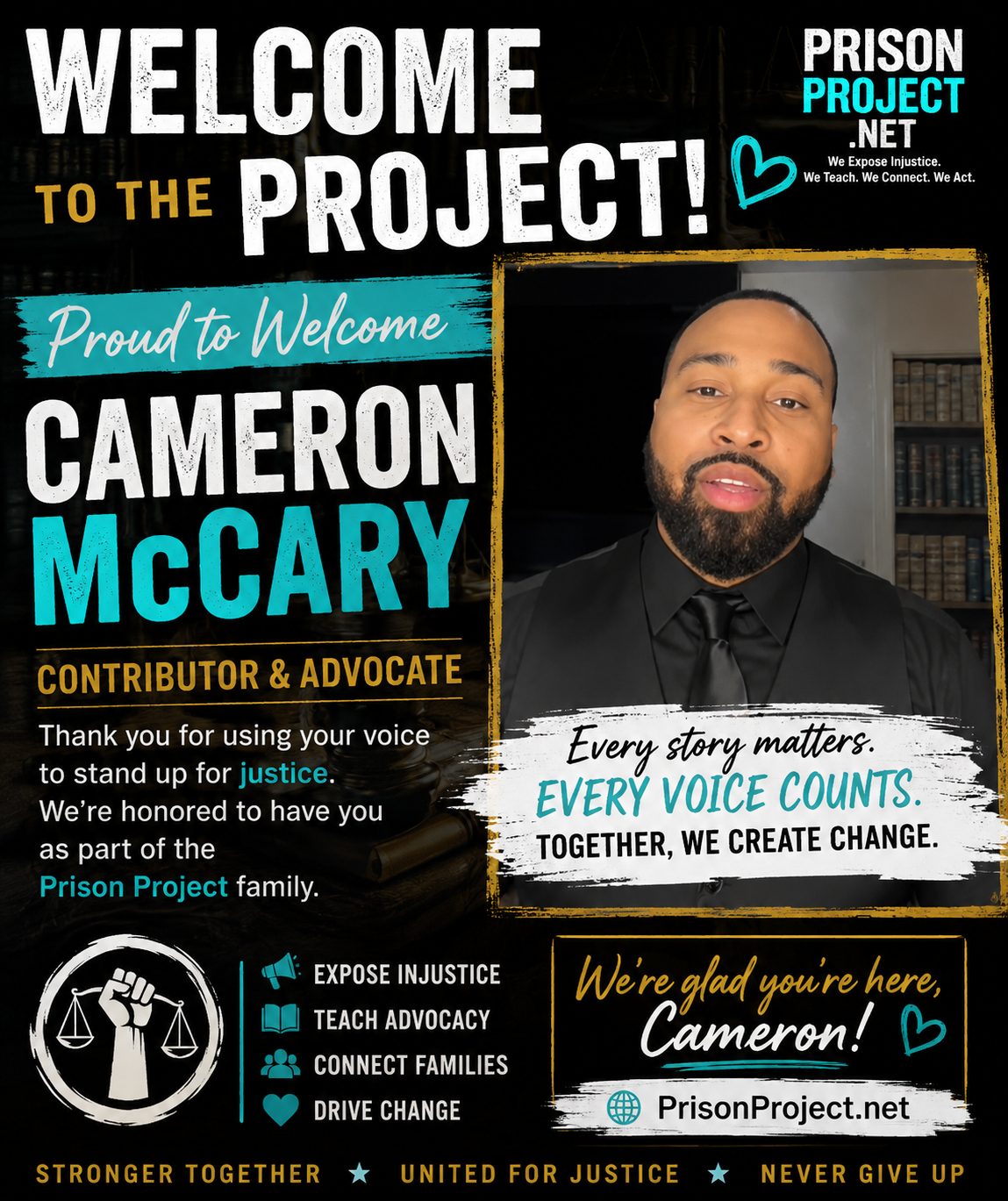
Welcome Cameron McCary to Prison Project
Prison Project is proud to welcome Cameron McCary, a former Delaware prisoner whose fight over prison medical care has grown into something much larger than his own case.
Cameron brings something we value enormously: lived experience combined with the willingness to learn the system and fight it.
His experience touches almost every issue we teach families about — medical treatment, documentation, grievances, exhaustion, pro se litigation, accountability and the importance of creating a record when the system refuses to fix itself.
Cameron intends to use what he has learned to help other incarcerated people and their families navigate these same systems. That makes him a natural addition to what we're building at Prison Project.
Cameron's Fight Is Now Part of a Much Bigger Story
Delaware Online and The News Journal recently featured Cameron's case in an investigation examining ongoing lawsuits over healthcare inside Delaware prisons.
Cameron was incarcerated at Howard R. Young Correctional Institution beginning in 2020.
According to the reporting and medical records discussed in the investigation, Cameron had been diagnosed with mental-health conditions and was prescribed medication while incarcerated.
Then the treatment stopped.
It Started With an Accusation
According to records described by Delaware Online, a nurse accused Cameron of "cheeking" medication — prison terminology for pretending to swallow medication and keeping it for later.
But Cameron's lawsuit alleges something critical:
The reporting also states that there was no discussion with the prescribing doctor about the abrupt termination of treatment or possible alternatives.
Cameron immediately began doing something Prison Project repeatedly teaches incarcerated people and families to do:
HE CREATED A PAPER TRAIL.
The day after the medication stopped, Cameron filed both a grievance and a sick call.
He challenged the allegation and argued that abruptly stopping his medication without warning, treatment or a reduction in dosage was medically inappropriate.
His grievance was denied.
So he appealed.
And This Is Where Cameron's Story Becomes Bigger Than Cameron
Cameron's lawsuit isn't the only litigation challenging prison healthcare in Delaware.
Delaware Online reports that numerous current and former prisoners have pending cases involving prison healthcare providers.
Separate litigation has alleged delayed or denied medical care, inadequate staffing, ineffective grievance systems and failures to provide medications, testing and specialist treatment.
Delaware's Attorney General has also joined a whistleblower lawsuit alleging that former prison healthcare contractor Centurion concealed deficiencies in care. Centurion has denied claims against it in court filings.
Then Cameron Did Something Thousands of Prisoners Are Told They Can't Do
He went to federal court.
Cameron's litigation began the way many prisoner civil-rights cases begin:
WITHOUT AN ATTORNEY.
His lawsuit names Delaware correctional officials and former officials associated with Centurion, the company that previously contracted with Delaware to provide prison healthcare.
The defendants have disputed aspects of Cameron's allegations and denied liability.
But the case didn't disappear.
According to the August 11 report, Cameron's lawsuit is scheduled for trial next year.
You can't get help within the prison—they're going to deny your case. You have to take it to the courtroom.
— Cameron McCary, as quoted by Delaware Online
This Is Why We Never Shut Up About Documentation
Cameron's story illustrates something families need to understand.
A grievance isn't just a complaint.
A sick-call request isn't just asking for treatment.
An appeal isn't simply another piece of prison paperwork.
Every one of those documents can become part of the record.
When an incarcerated person says something happened and the institution says it didn't, documentation can become the difference between an allegation that disappears inside a prison and a claim a court can actually examine.
Federal prisoner litigation also comes with procedural barriers. One of the biggest is exhaustion — prisoners generally must properly use available administrative remedies before pursuing many federal prison-condition claims.
That means learning the grievance system, meeting deadlines, appealing when required and keeping copies whenever possible isn't busywork.
It can be litigation preparation before anybody realizes litigation is coming.
What Cameron Brings to Prison Project
Cameron isn't joining us because he read about prison systems in a textbook.
He lived inside one.
He used its grievance system.
He says that system failed him.
And then he learned how to carry the dispute outside the prison walls and into court.
Cameron has said he hopes to build a nonprofit helping prisoners facing similar circumstances navigate the legal system and that he wants to pursue policy, statutory and funding changes.
Prison Project and Cameron share a basic philosophy:
TEACH PEOPLE HOW THE SYSTEM WORKS.
TEACH THEM TO DOCUMENT IT.
TEACH THEM TO ADVOCATE EFFECTIVELY.
You'll be hearing more from Cameron through Prison Project as we continue expanding our work on prison healthcare, grievances, constitutional litigation and practical advocacy.
Original Reporting:
Xerxes Wilson, Delaware News Journal / Delaware Online
“Withheld meds lead to litigation over DE prison health care | Exclusive”
Published August 11, 2026.
Prison Project's article summarizes and comments on the reporting and Cameron McCary's publicly reported litigation. Allegations remain allegations unless established by a court, and defendants have disputed claims and denied liability.
HAVE A LOVED ONE INSIDE?
Don't wait until a medical problem, grievance or constitutional violation becomes a crisis before learning how the system works.
Prison Project teaches families and incarcerated people how to document problems, build records, understand grievance procedures and become stronger advocates.
PrisonProject.net • Advocacy • Education • Accountability
Comments